Showing posts with label Martha's Vineyard. Show all posts

Monday, November 14, 2022

The Wedding by Dorothy West

When she got lost, she was lost altogether, her identity deserting her, her name on doubting tongues, and her wholeness hanging by a tug of hair. There was no one to help her orient herself, and she could not communicate her need for help. In a world where everyone was adult and articulate, she was overwhelmed by the handicap of having to be a child. That she would ever coalesce into something concrete, with more sense than lack of it, seemed beyond the promise of prayer. She was still bits and pieces of other people: a frown she had no use for, a phrase stuck in a senseless sentence, a grunt like Gram's when the weather tied a knot in her back, walking like Gram when she had to place her hand on her hip to ease the pain of a rainy day, and echoing Liz's yeas and nays when half the time she felt just the opposite. Like most children, Shelby spent her days and hours trying on the most transparent parts of other personalities, gradually growing aware of their insufficiencies. Then slowly, at a snail's pace, and with a snail's patience, she would thread her frailties and fears, her courage and strength, her hopes and doubts, into the warp and woof that would cloak her naked innocence in a soul of her own.

The Oval is a community of black vacationers on Martha's Vineyard, proud and exclusive, named for the oval shape of the ring of inward-facing houses that compose it. Many of these "Ovalites" are descending on the island to attend the wedding of one of their daughters, Shelby Coles, to a white jazz musician named Meade. The marriage sets off old racial anxieties: could it be that, as Shelby's father and sister suspect, Shelby's upbringing among the light-skinned Ovalites has taught her to hate her own race? A neighboring interloper, a dark-skinned man named Lute whose presence on the Oval is suspect, decides he will get revenge on the Ovalites who spurn him by making a conquest of Shelby on the week of her wedding. Will Shelby, testing her own deep-seeded racial feelings, use Lute to conquer her own suspicions about herself?

I'm reading Passing right now with my juniors; I was struck by what a companion piece The Wedding makes. The Wedding is a late work by Dorothy West, one of the last surviving doyennes of the Harlem Renaissance, and it takes up many of the same questions about race, color, and class that Passing does. West keeps Meade--and the wedding--off stage, instead using it as a pretext to comb through the family history of the branches that have come together to make Shelby: Gram, the disappointed white matriarch; her desperate and sickly daughter who marries the self-made Hannibal; on the other side, the kindly doctor Isaac and his charity-crusader wife. And of course, Shelby's parents, including her father, who married a light-skinned woman like himself, though he has kept a darker mistress for decades. Like Passing, The Wedding understands the intimate relationship between colorism and racism: "passing" is, for the black upper class, a mark of unparalleled distinction. But chasing it requires a tightrope act: you can marry another light-skinned person for it, but to marry white threatens a wholesale dilution of the family's blackness. Ironically, perhaps, such distinctions are predicated on the same kind of one-drop blood quantum laws that kept white families' whiteness intact.

The strongest and most interesting part of The Wedding was, I thought, an extended flashback in which the young golden-haired Shelby chases off after a stray dog and becomes lost. The Ovalites are alerted, and then the larger Vineyard community, but even when Shelby is found, wearing the outfit in which she was reported missing, her rescuers assume that she must be a different lost child, a white one. Shelby herself is unable to make sense of this mystery, because she herself doesn't know if she's black or white. She knows she has a white grandmother, and black family, but how to cobble an identity out of these parts, no one has ever told her. This formative experience is an early wound in Shelby's identity, and reveals the shakiness at the heart of the racial logic that serves to keep the boundaries of the Oval tight. While each of the parts of the novel--which at times resembles a collection of stories, linked only in the sense that they are each about a member of the family--is good, I found myself wanting more of that central presence, Shelby's, to anchor the book more soundly.

Wednesday, March 31, 2021

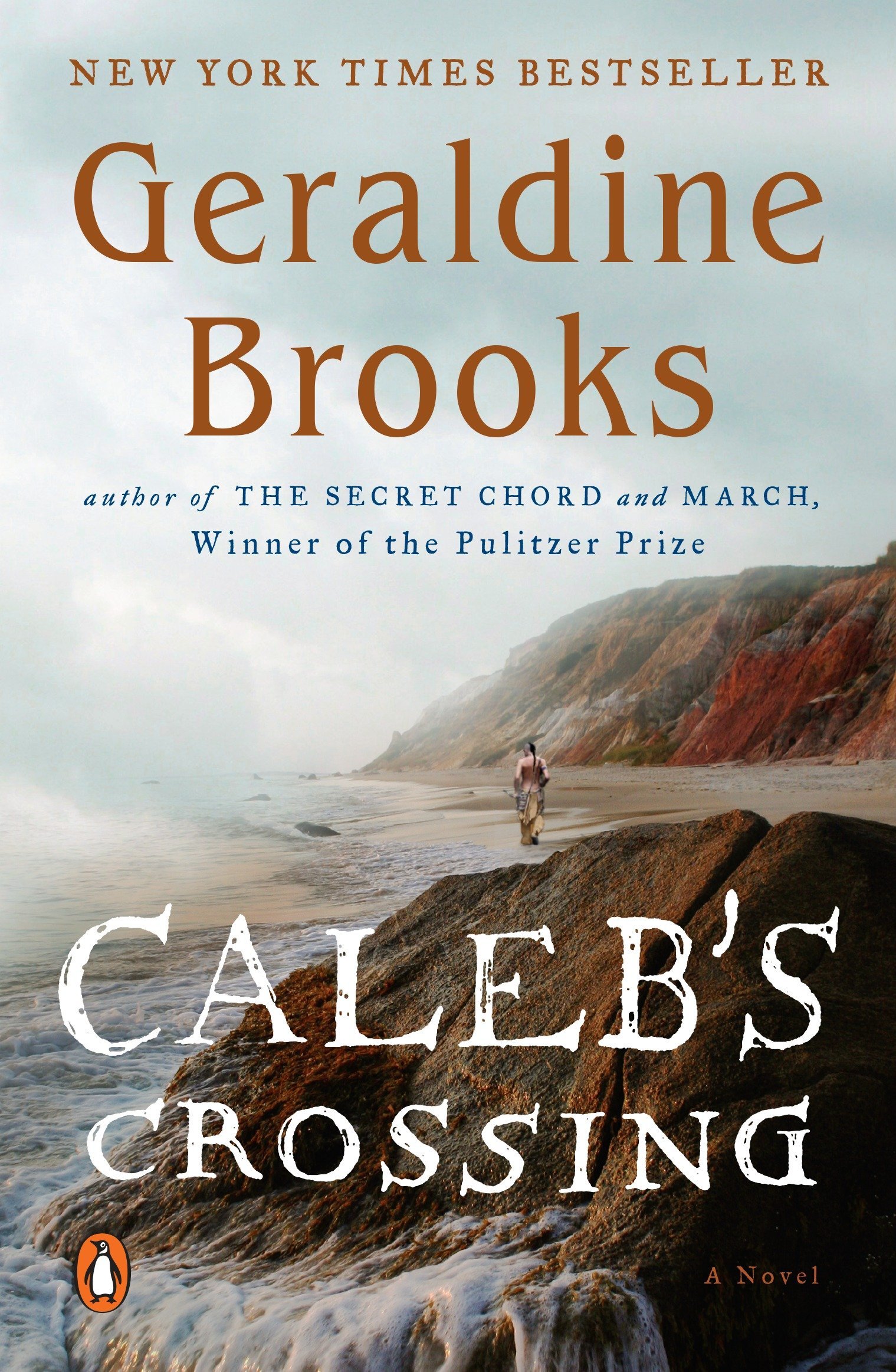
Caleb's Crossing by Geraldine Brooks

At first, I followed this wild boy hungering after his knowledge of the island--his deep understanding of everything that bloomed or swam or flew. Soon enough, a curiosity about an untamed soul had kindled, and this, too, caused me to seek him out. But it was his light temper and his easy laugh that drew me close to him, over time, until I forgot he was a half-naked, sassafras-scented heathen anointed with raccoon grease.

Martha's Vineyard, in the late 17th century, is a backwater outpost of a backwater outpost: Bethia Mayfield lives with her father, the Reverend Mayfield, and her brother Makepeace, live on the edge of a wilderness, having retreated from the strict Puritanism of the Massachusetts Bay Colony.  But there are others, of course, for whom the island--as Bethia calls it--is no wilderness at all, but their home for millennia: the Wampanoag, with who the white Islanders have a tense and tenuous peace. Bethia's father sees himself as a missionary to the Wampanoag, and although he is respected by them, his mission is made difficult by the "wizard" Tequamuck, a powerful healer who agitates against the Christian religion among the Wampanoag.

Bethia's life is a proscribed one: she will grow up and marry, probably a local farmer. Yet she has a sharp mind and a gift for languages: while her lazy brother Makepeace struggles with his Latin and Greek, she listens on, learning twice as fast as he. From her father's dealings she even learns to speak the language of the Wampanoag, a feat that enables her to make secret friends with a Wampanoag boy she names Caleb. Caleb, the son of the sonquem, or chief, and nephew to the wizard Tequamuck, and Bethia are drawn to each other, despite their differences; though Bethia learns from her father to be suspicious of the Wampanoag religion--which they consider Satanic--she finds there is much to admire in it, like the way that Caleb awakes before the dawn to greet the personified sun. In their secret meetings, they spar curiously over these different ways of seeing the world. Bethia begins to fear for her own soul, but it's Caleb that should be worried: a plague of smallpox ravages the Wampanoag, and on his death bed the sonquem concedes to the Christianization of his people and asks Reverend Mayfield to take Caleb into his home.

Caleb is an interesting character, based on a real person, the first Native American to graduate from Harvard. His father's death and his adoption by the Reverend places him in an uneasy place, caught between two worlds. He learns quickly that he can never be Christian enough for the Puritans of Harvard, where is constantly suspected and belittled. He acquits himself with talent and integrity, but are his talent and integrity being used to raise himself up, or destroy his people? These are interesting and powerful questions.

And yet the major flaw of Caleb's Crossing is that Caleb grapples with these things "off screen." Once Caleb joins Bethia's household, and then later at Harvard, their lives are too proscribed for them to continue their meetings, and somehow Caleb vanishes from the narrative right under our noses. Caleb never leaves Bethia's orbit, but as the viewpoint character she becomes focused on other things, like a pair of competing marriage proposals from a local farmer and the son of a Harvard master, and the mistreatment of a young Nimpuc woman who comes to stay with them at Cambridge. The interests of the book turn from the alienation of the indigenous to the contradictions of life as a woman, and while it does these themes justice, they seem to me much more familiar, perhaps too familiar.

At the novel's climax, Bethia must travel back to the island to consult with the dreaded Tequamuck to find a cure for a disease that has struck Caleb--a disease we suspect may be more of the spirit than the body--and yet this moment, which should bring resolution to the schisms of Caleb's psyche, seem to be the ending to a book we didn't actually get. You know, a while back I told myself I should try harder to review the book as it is, rather than imagining a book that doesn't exist that I might have liked better. That's something I do a lot. But the book is called Caleb's Crossing, and I think the way the novel holds Caleb at arm's length is ultimately unsatisfying.