Showing posts with label John Milton. Show all posts

Saturday, June 13, 2015

The Sense of an Ending by Frank Kermode

Let us take a very simple example, the ticking of a clock.  We ask what it says: and we agree that it says tick-tock.  By this fiction we humanize it, make it talk our language.  Of course, it is we who provide the fictional difference between the two sounds; tick is our word for a physical beginning, tock our word for an end.  We say they differ.  What enables them to be different is a special kind of middle.  We c an perceive a duration only when it is organized.  It can be shown by experiment that subjects who listen to the rhythmic structures such as tick-tock, repeated identically, 'can reproduce the intervals within the structure accurately, but they cannot grasp spontaneously the interval between the rhythmic groups,' that is, between tock and tick, even when this remains constant... The clock's tick-tock I take to be a model of what we call a plot, an organize that humanizes time by giving it form; and the interval between tock and tick represents purely successive time, disorganized time of the sort we need to humanize.

Frank Kermode argues that we are "men in the middest," that is, we find ourselves in the middle of things, at a temporal point that is really of no consequence at all.  The kind of time we experience is "successive"; it passes, without any kind of special meaning or organization.  But being "in the middest" is not so bad if we can convince ourselves that the time we experience has a special relationship to a beginning and an end; if we can define it in terms of the "tick" and the "tock" in the illustration above.  We're always expecting the apocalypse, he notes--think of Y2K, or Heaven's Gate, or the apocalyptic frenzy of 1666 (for obvious numeric reasons), or 2012--and for this reason we convince ourselves that we are living in special times.  But when the date of the apocalypse appears, the compulsion is so strong that true believers merely chalk it up to a mathematical error and calculate a new date.  The danger, he says, comes from when we let what is an obvious fiction become real for us, and he singles out authors like Ezra Pound and Wyndham Lewis for falling for exactly this kind of fiction in the form of mid-century fascism.

But The Sense of an Ending is a set of lectures on literary theory, not cultural theory, and so most of what Kermode writes about is how this need to occupy the space between the "tick" and "tock" appears in fiction.  One of the simplest and strongest claims Kermode makes is that there is a natural relationship between literary fictions and other fictions; the novels we write are not so very different from the way we think about time outside of them.  The most sophisticated novels engage in peripeteia--the falsification of our expectations of plot which make our fictions seem more realistic to us--but still, they satisfy our notions that the beginning, middle, and end progress in a logical, related, and meaningful way.  This is something all literary fiction does:

One remembers the comic account of this antipathy in Iris Murdoch's Under the Net, one of the few truly philosophical novels in English; truth would be found only in a silent poem or a silent novel.  As soon as it speaks, begins to be a novel, it imposes causality and concordance, development, character, a past which matters and a future within certain broad limits determined by the project of the author rather than that of the characters.  They have their choices, but the novel has its end.

I read The Sense of an Ending for my thesis, which was on ideas of time in the work of John Milton, and it really illuminated Milton's work for me.  Milton was a believer in apocalypticism; he really thought that Cromwell's ascent to power would usher in the thousand-year reign of Christ.  Cromwell's failures were intensely disappointing to Milton, and the need to make his own life fit in between the "tick" and the "tock" is everywhere in Milton.  The saddest, most powerful parts of work are about adjusting to the sense of being "in the middest," and the fear that the time which he lives through has no meaning or significance at all.  But Kermode's observations help make sense of all sorts of literature, and they are as incisive today as they were when they were published in 1965.

Tuesday, June 10, 2014

Paradise Lost by John Milton

Of Man's first disobedience, and the fruit
Of that forbidden tree whose mortal taste
Brought death into the World, and all our woe,
With loss of Eden, till one greater Man
Restore us, and regain the blissful seat,
Sing, Heavenly Muse, that, on the secret top
Of Oreb, or of Sinai, didst inspire
That shepherd who first taught the chosen seed
In the beginning how the heavens and earth
Rose out of Chaos: or, if Sion hill
Delight thee more, and Siloa's brook that flowed
Fast by the oracle of God, I thence
Invoke thy aid to my adventurous song,
That with no middle flight intends to soar
Above th' Aonian mount, while it pursues
Things unattempted yet in prose or rhyme.

Reviewing Paradise Lost seems like a silly exercise.  It's not merely that it is a classic--so is Don Quixote, but the entertainment value of that novel is such that it seems rational to evaluate it on those terms--but that whether I enjoyed it seems ultimately beside the point of Milton's writing.  In the invocation to Book VIII, the poet-narrator asks his muse: "still govern my song, / Urania, and fit audience find, though few."  This epic is not for everyone; Milton admits as much.  It's not for the dilettante, but rather for the "fit" and "few" readers who will be receptive to its message of glory through obedience to God.  As I wrote in my review of Stanley Fish's Surprised by Sin, this goes far in explaining some of the aesthetically dreary bits of Paradise Lost, of which there are many--some of it really sucks, but hey, you've got to eat your vegetables.

In any case, I did enjoy it.  Or rather, I was impressed by it.  It's the most all-encompassing work I've ever read, the most total expression of literary capability.  (Second would be Moby Dick.)  Ostensibly, it's our only notable English language epic, modeled on Homer and Vergil and Tasso's Gerusalemme Liberata.  But it gobbles up other genres as well: tragedy, pastoral, lyric poetry.  Here's a beautiful piece of lyric from Eve speaking to Adam about her love for him and the bliss of their existence:

With thee conversing I forget all time;
All seasons, and their change, all please alike.
Sweet is the breath of Morn, her rising sweet,
With charm of earliest birds: pleasant the sun,
When first on this delightful land he spreads
His orient beams, on herb, tree, fruit, and flower,
Glistering with dew; fragrant the fertile earth
After soft showers; and sweet the coming on
Of grateful Evening mild; then silent Night,
With this her solemn bird, and this fair moon,
And these the gems of Heaven, her starry train:
But neither breath of Morn, when she ascends
With charm of earliest birds; nor rising sun
On this delightful land; nor herb, fruit, flower,
Glistering with dew; nor fragrance after showers;
Nor grateful Evening mild; nor silent Night,
With this her solemn bird, nor walk by moon,
Or glittering star-light, without thee is sweet.
But wherefore all night long shine these? for whom
This glorious sight, when sleep hath shut all eyes?

Paradise Lost is not frequently beautiful in the way that Shakespeare often is; in fact, it is often clunky and can even seem strained.   Milton is not particularly concerned about avoiding the awkward constructions that blank verse can force him into, but the strain often works to his advantage, I find.  It works, I think, when we're talking about the exploits of angels, demons, and God, who are ultimately meant to seem great and alien.  Here's a great description of Satan's shield and spear:

He scarce had ceased when the superior Fiend
Was moving toward the shore; his ponderous shield,
Ethereal temper, massy, large, and round,
Behind him cast. The broad circumference
Hung on his shoulders like the moon, whose orb
Through optic glass the Tuscan artist views
At evening, from the top of Fesole,
Or in Valdarno, to descry new lands,
Rivers, or mountains, in her spotty globe.
His spear--to equal which the tallest pine
Hewn on Norwegian hills, to be the mast
Of some great ammiral, were but a wand--
He walked with, to support uneasy steps
Over the burning marl, not like those steps
On Heaven's azure; and the torrid clime
Smote on him sore besides, vaulted with fire.

The "Tuscan artist" here is Galileo; Satan's shield looks like the moon through a telescope.  The description of the spear operates by a nifty analogy: His spear is to a mast made of the tallest pine in "Norwegian hills" as that mast is to a tiny wand.  Milton is great at describing the ineffable this way, baffling our sense of scale.

The first half of Paradise Lost have proven to be the most popular, for good reason.  They include the story of the War in Heaven (angels and demons throw mountains at each other); Satan's fall, and the construction of the terrifying city of Pandemonium in Hell; the beautiful pastoral depictions of Adam and Eve hanging out in the garden; the serpent's temptation of Eve.  The final books are a little preachy, sure, which are given over to the Archangel Michael teaching Adam about Christian providential history.  But I am also taken by the pathos of Adam's lament about the loss of God's blessing:

O fleeting joys
Of Paradise, dear bought with lasting woes!
Did I request thee, Maker, from my clay
To mould me Man? did I solicit thee
From darkness to promote me, or here place
In this delicious garden? As my will
Concurred not to my being, it were but right
And equal to reduce me to my dust;
Desirous to resign and render back
All I received; unable to perform
Thy terms too hard, by which I was to hold
The good I sought not. To the loss of that,
Sufficient penalty, why hast thou added
The sense of endless woes?

I didn't ASK to be born!  But moreover, I think the most wonderful lines of the poem are the final ones, which depict Adam and Eve walking through the Garden one last time on their way out into the wide world, together but alone, needing each other to face a daunting new existence with bravery and mutual compassion:

They, looking back, all the eastern side beheld
Of Paradise, so late their happy seat,
Waved over by that flaming brand; the gate
With dreadful faces thronged, and fiery arms:
Some natural tears they dropt, but wiped them soon;
The world was all before them, where to choose
Their place of rest, and Providence their guide:
They, hand in hand, with wandering steps and slow,
Through Eden took their solitary way.

Wednesday, May 14, 2014

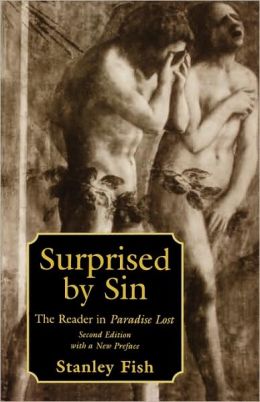
Surprised by Sin by Stanley Fish

I've been taking a class on Milton (who is great--I never knew!) and, of course, that involves reading Paradise Lost, one of English's longest and most persnickety poems.  The story, if you're a godless heathen, is Genesis: Adam and Eve enjoy some good times in the Garden of Eden, before a very bitter fallen angel named Satan infiltrates it and convinces them to eat the fruit from the only tree God's told them not to touch.  Things after that pretty much suck.

>One of the aspects of Paradise Lost people have been trying for centuries to figure out is this: Why is Satan the most compelling character?  He's the one that gets all the poetry, the fancy rhetoric, the courage and the devil-may-care attitude.  Here he is, talking to Beezlebub in Hell:
Is this the Region, this the Soil, the Clime,
Said then the lost Arch Angel, this the seat
That we must change for Heav'n, this mournful gloom
For that celestial light? Be it so, since hee
Who now is Sovran can dispose and bid
What shall be right: fardest from him is best
Whom reason hath equald, force hath made supream
Above his equals. Farewel happy Fields
Where Joy for ever dwells: Hail horrours, hail
Infernal world, and thou profoundest Hell
Receive thy new Possessor: One who brings
A mind not to be chang'd by Place or Time.
The mind is its own place, and in it self
Can make a Heav'n of Hell, a Hell of Heav'n.

Badass! God, by contrast, comes off as a self-righteous, authoritarian prude.  Why would Milton make Satan look so awesome and God look so bad?  William Blake famously said that Milton was "of the Devil's party without knowing it."  Could it be that the righteous Puritan Milton really was more emotionally invested in his artistic depiction of the devil?

Fish replies to these claims with a breathless piece of Reader-Response criticism.  He argues that Satan's seductiveness is part of the design of the poem; we are supposed to be attracted by Satan because that's his M.O.  We respond to his lies, his rhetoric, his sublimity on an internal level, and then must face the cognitive dissonance of our intense attraction to Satan.  That, Fish argues, is the way we learn to cast our gaze inward on our own fallen nature.  If we are dissatisfied with God's language, well, as Milton reminds us in On Reformation: "The very essence of truth is plainness and brightness; the darkness and crookedness is our own."

I find this a very compelling way of reading the poem, and perfectly in accord with the kind of poetry Milton writes elsewhere (though I admit I am not quite yet an expert).  Some critics have derided this image of God as a disciplinary schoolmarm, but I think those critics--and to some extent Fish--discount the way in which the poet himself is entangled in this process, having to endure the same education that we are.  Paradise Lost is not very interesting if you regard Milton as an uptight jackass (like Robert Graves did) who is constantly bringing the ruler down on the reader's fingers; but as the introspection of a blind, defeated, and utterly broken man, it's something different all together.  

I'm going to post a longer review, of course, on Paradise Lost, which is a great poem, though perhaps not what the Kindle Generation wants or feels they need.  When I do, I'll share more thoughts about the best way to read the poem, but to be sure, they will be closely modeled after Fish's reading.