Showing posts with label John Barth. Show all posts

Saturday, July 18, 2026

Lost in the Funhouse by John Barth

On the other hand perhaps it was that he drew her to him in the dark, held her close, and gave her to know that while he could never feel just the same respect for her, he loved her nonetheless. They kissed. Tenderly together they rehearsed their secrets; long they lingered in the Sphinx's Den; then he bore her from the Jungle, lovingly to the beach, into the water. They swam until her tears were made a part of the Earth's waters; then hand in hand they waded shoreward on the track of the moon. In the shallows they paused to face each other. Warm wavelets flashed about their feet; waterdrops sparkled on their bodies. Washed of shame, washed of fear; nothing was but sweetest knowledge.

The first story in John Barth's Lost in the Funhouse is written from the perspective of a sperm having an existential crisis. How can you have faith when you know that only one "swimmer" among billions will make it to the promised land? And is there even a promised land--an egg--at all? It's classic Barth: first of all, it's funny. Secondly, it operates via layers of irony and metaknowledge; one must understand how the ironies of the sperm's existence point back to the self of the reader. But there's a real humanity underneath in the way that explores the difficulty of understanding one's cosmological place when by their very nature the larger forces, be they God or the universe or the possessors of testicles and ovaries, are beyond our understanding. It is maybe the best story--not a good sign for a collection when the first story is the best--but actually I think I slightly preferred "Petition," written from the perspective of a conjoined twin cursed to ride eternally on his brother's back, asking the King of Siam for help in severing them. Like "Night-Sea Journey," the sperm story, I enjoyed how slowly, by design, I came to understand who and what was speaking to me.

Lost in the Funhouse is most famous for its title story, about a trip to the Maryland sea shore where Barth's stand-in, Ambrose, gets--well, you know. The story is famous for its metafictional elements, which call attention to the narrative choices, and the narrative failings, of the author, even going so far as to introduce a diagram of Freytag's pyramid. This is all purposely deflationary; I think even Barth would agree it's a paragraph like the one above, from another story about Ambrose, in which he imagines a relationship with an older girl, that really stir the spirit. But in "Lost in the Funhouse" Barth questions what it that's happening to us when our spirit is stirred, whether that spirit-stirring is an honest exchange. There may not be so much difference between Ambrose tricking himself into happiness by telling himself a story and the reader who lets himself be tricked. Be that as it may, I found "Lost in the Funhouse" to feel stale. It is, as Brent said, "the OG" in a way, but sixty years of postmodernism has produced, I think, more interesting and effective ways of exploring the same ideas. The subsequent stories, "Life-Story" and "Title," which take these ideas to their most abstract and intricate ends, I felt to be absolutely dreary reading.

Much better, then, are "Menelaid" and "Anonymiad," a pair of stories that draw from Greek myth to explore the nature of storytelling. "Menelaid" is a particularly difficult read, in which Menelaus tells a number of stories to Telemachus that involve quoting the discourses of others so that eventually ten or twelve sets of quotation marks are nested inside one another and you don't know who the hell is saying anything. But I really enjoyed the story's suggestion that, when Menelaus wrestles with the shape-shifting god Proteus (as I guess happens in the myth), it destabilizes the entire story, if not the world: how do we know the Menelaus that ends up with Proteus in his arms is not actually Proteus himself in Menelaus' guise? And if Proteus could be Menelaus, why not Helen, or Telemachus--or the reader? 

Saturday, December 10, 2016

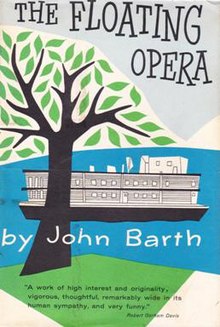
The Floating Opera by John Barth

Why The Floating Opera?  I could explain until Judgment Day, and still not explain completely.  I think that to understand any one thing entirely, no matter how minute, requires the understanding of every other thing in the world... Well, The Floating Opera.  That's part of the name of a showboat that used to travel around the Virginia and Maryland tidewater areas: Adam's Original and Unparalleled Floating Opera; Jacob R. Adam, owner and captain; admissions 20, 35, and 50 cents.  The Floating Opera was tied up at Long Wharf on the day I changed my mind, in 1937, and some of this book happens aboard it.  That's reason enough to use it as a title.  But there's a better reason.  It always seemed a fine idea to me to build a showboat with just one big flat open deck on it, and to keep a play going continuously.  The boat wouldn't be moored, but would drift up and down the river on the tide, and the audience would sit along both banks.  They could catch whatever part of the plot happened to unfold as the boat floated past, and then they'd have to wait until the tide ran back to catch another snatch of it, if they still happened to be sitting there.  To fill in the gaps they'd have to use their imaginations, or ask more attentive neighbors, or hear the word passed along from upriver or downriver.  Most times they wouldn't understand what was going on at all, or they'd think they knew, when actually they didn't... I needn't explain that that's how much of life works: our friend float past; we become involved with them; they float on, and we must rely on hearsay or lose track of them completely; they float back again, and we either renew our friendship--catch up to date--or find that they and we don't comprehend each other anymore.  And that's how this book will work, I'm sure.

John Barth's The Floating Opera is about the day that the narrator, Todd Andrews, decides not to kill himself.  That intriguing detail is laid out at the very beginning of the text, and then returned to after a number of long, digressive interludes about Todd's life.  We learn that his father committed suicide, and that he long had an affair with the wife of his friend, the pickle magnate Harrison Mack.  We learn about a long legal case he adjudicated that involved, among other things, the proper possession of hundreds of jars of human urine.  But the question laid out at the beginning of the novel--why did Todd consider killing himself, and why did he change his mind--hangs over the shaggy, humorous narrative:

So.  Todd Andrews is my name.  You can spell it with one or two d's; I get letters addressed either way.  I fear you'd say, "Tod is German for death: perhaps the name is symbolic."  I myself use two d's, partly in order to avoid that symbolism.  But you see, I ended by not warning you at all, and that is because it just occurred to me that the double-d Todd is symbolic, too, and accurately so.  Tod is death, and this book hasn't much to do with death; Todd is almost Tod--that is, almost death--and this book, if it gets written, has very much to do with almost-death.

The central image of the novel is the Floating Opera, a Vaudeville-esque show that takes place off shore in the town where Todd lives.  (Weird aside: this is the second novel I've read this year that takes place on Maryland's eastern shore.)  The Opera is central to Todd's existential pondering: he decides that suicide is the logical extension of the absurdity of life:

III. There is, therefore, no ultimate "reason" for valuing anything.

Now I added including life, and at once the next proposition was clear:

IV. Living is action.  There's no final reason for action.
V. There's no final reason for living.

But--and here goes the spoiler alert--what the reader has not realized is that when Todd decides to kill himself, he decides to sabotage the ventilation system of the Floating Opera and blow up hundreds of people along with him, including his friends, and a girl who his possibly his own daughter.  This decision is so starkly at odds with the light-hearted silliness of the narrative, that it comes as an explosive surprise.  Todd's decision to not kill himself, in the end, is linked to the failure of this attempt to blow up the Opera.

The ultimate message of The Floating Opera is this: if life is meaningless, you might as well live it as do anything else.  As a moral statement, it's not quite profound, but it matches the absurd and digressive nature of the novel, which is clearly modeled on the proto-modernist excess of Tristram Shandy.  Everyone lives on, but at the dark center of the novel is the awareness that it might have been otherwise.