Thursday, January 14, 2016

The Tsar of Love and Techno by Anthony Marra


 "Everything large enough to love eventually disappoints you, then betrays you, and finally, forgets you. But the things small enough to fit into a shoebox, these stay as they were."
If you spend any amount of time with Russian literature (or a Russian babushka), you will be confronted with the idea of the Russian Soul. The Russian Soul sets Russia and Russians on a level above us philistines; it sets them apart from the West, gives them faith in times of crisis, and allows them to see the redemptive beauty of suffering. Dostoevsky, Tolstoy, Gogol, Chekov, etc. all wrestle with this essential Russianness as they try to rationalize their way through their own evolving religious faiths. I spent four years of college trying to figure out what, exactly, the Russian Soul is, and while I still can't define it succinctly, I can confidently say The Tsar of Love and Techno is just oozing with it.

The book starts out with what I think is my favorite vignette of the whole shebang. Roman Osipovich is a censor for the Department of Party Propaganda and Agitation in 1930's Leningrad. A classically trained painter, he has been enlisted by the regime to paint away people who have been "disappeared" in photographs, murals, and library books. In their place, he begins to paint the face of his dead brother (who himself has been "disappeared"), leaving a trail of clues for the dead man's son so that he has a record of what his father looked like. Even read on its own, it's an almost perfect little nugget of Russian tragedy: It's beautiful and heart wrenching and you hate the main character so much that by the end you start to love him. 

From Leningrad, Marra takes us to Kivorsk, a town above the arctic circle, to Chechnya, to Moscow. The stories span seven decades and weave in and out of each other effortlessly. Narration shifts from story to story, but the book still somehow feels cohesive and manageable. Throughout, Marra scatters ridiculously Russian characters (a soldier who heavily implies that he lost both of his legs in an explosion in Chechnya, but really got drunk and fell asleep on trolley tracks; a mother who continues to write her daughter letters filled with wildly exaggerated and optimistic versions of her life even after the daughter has moved back in with her, a father obsessed with space, despite never having seen the stars because his home is permanently covered in haze) and absurdly Russian scenarios (a forest made of metal and plastic trees commissioned by the government for morale, a ballet performance by a prima ballerina in a gulag, The Kivorsk Museum of Inner and Outer Space whose exhibits are made up entirely of repurposed trash from aforementioned metal forest). In typical Russian Epic fashion, the characters are all so deeply flawed that you can't help but feel for them even when they do horrible, unforgivable things. When they do, on occasion, redeem themselves, you are suddenly convinced that all the problems in the world are going to work themselves out. 

My only slight issue with it was the ending. The last story circles back to one of the main characters who has died during a land mine explosion. We meet him again after he has died while he hurtles through space in a capsule he and his brother built from trash as kids. His body is slowly disintegrating and his life drifts past him as he listens to a tape of his brother and ex-girlfriend singing to him. This level of tripped out craziness is totally out of character with the rest of the book, and I was pretty annoyed with it until I got to this line: "If ever there was an utterance of perfection, it is this. If God has a voice, it is ours." This is some next level modern Russian Soul insanity, and I totally forgave Marra for getting weird. 

If you love Russia, read this book. If you hate people, read this book. If you love people, read this book. Really...just read this book. 

Monday, January 11, 2016

The First Bad Man by Miranda July


I drove to the doctor's office as if I was starring in a movie Phillip was watching - windows down, hair blowing, just one hand on the wheel. When I stopped at red lights, I kept my eyes mysteriously forward. Who is she? people might have been wondering. Who is that middle-aged woman in the blue Honda? 


I read this book in less than a day, stopping only to sleep. From the opening lines above to the very satisfying end, I was hooked. My love for Miranda July is immense and all encompassing although I realize that her work is definitely not for everyone. She knows the inside of my brain in a way that scares and electrifies me, and I see myself in her characters across her films, short stories, and now in her novel. If you are the kind of person who, like the narrator Cheryl, imagines yourself starring in a movie and analyzing how someone else would watch that movie, then I would definitely recommend this book. The only caveat I have is that it's filled with vulgar language and a lot of sex stuff, so it's not for everyone. The cast is small and the premise is simple. Cheryl, a lonely socially awkward middle-aged woman, has her life turned upside down when Clee, a bombshell blonde girl in her 20s, moves in. The only other characters are Cheryl's crush, Phillip, her therapist, her homeless gardener, and a handful of coworkers. 

I love July's pick for a protagonist. We rarely see women over the age of 40 in the media, so even if it wasn't a choice she made in an attempt to make a statement, a statement is being made. Cheryl is a manager of a "non-profit" that does self defense for women (they still do classes to keep their non-profit status, but most of their business is now selling upbeat fitness DVDs with pop soundtracks). She's the kind of manager who works from home because her office thinks she has a more....hands off style. In fact, she's only allowed in the office once a week; she has to yell a warning before entering at other times. In the opening pages she goes to a color therapist recommended by Phillip (her crush, a board member) just so she can have an excuse to call him and say she did. We have all been there! However, 20 pages later Cheryl describes her system for apartment cleaning
Let's say a person is down in the dumps, or maybe just lazy, and they stop doing the dishes. Soon the dishes are piled sky-high and it seems impossible to even clean a fork. So the person starts eating with dirty forks out of dirty dishes and this makes the person feel like a homeless person. So they stop bathing. Which makes it hard to leave the house. The person begins to throw trash anywhere and pee in cups because they're closer to the bed. We've all been this person, so there is no place for judgement, but the solution is simple: Fewer dishes. 
Maybe we haven't all been there, but there is something delightful about going there with a person like Cheryl. 

Phillip, Cheryl's crush, plays an important role throughout the novel, and July does such a good job of characterizing his skeeziness and also showing how and why women excuse and accept skeezy behavior. For example, he grabs Cheryl by the necklace to pull her towards him or tells her her shirt is unzipped while unzipping it. Cheryl is lonely and her romantic options are Phillip - 22 years her senior - or her homeless gardener, so she chooses Phil to fixate on, excusing his behavior as ironic commentary on the kind of men who would do such things seriously. 

An outsider...might have thought this moment was degrading, but I knew the degradation was just a joke; he was mocking the kind of man who would do something like that....The joke was, Can you believe people? The tacky kinds of things they do? But it had another layer to it, because imitating crass people was kind of liberating - like pretending to be a child or a crazy person.
The final main character is Clee, the daughter of Cheryl's bosses. She is unemployed and needs a place to stay, but her parents won't have her, so she is foisted upon Cheryl. Clee is a perfect foil. While Cheryl has a sturdy name that she tries to force into a nick name (calling herself CherBear when no one would ever call her CherBear), Clee has a name that doesn't even seem like a name. Cheryl has short cropped hair, doesn't shave her legs, refuses to wear uncomfortable shoes, and several characters ask if she's a lesbian. Clee is a blonde bombshell with thongs spilling out of her duffel bag and shiny purple bra straps showing under her tank tops. 
She was much older than she'd been when she was fourteen. She was a woman. So much a woman that for a moment I wasn't sure what I was. 
Clee is dirty, lazy, a mean girl, and a bully. She starts laughing at Cheryl, and Cheryl joins in thinking it's a friendly laugh, which then makes her an easy target of Clee's cruelty. 
Why are you laughing? ...You thought I was laughing about the pan? Like ha ha you're so kooky with your dirty pan and your funny way of doing things? ... I was laughing because you're so sad. Soooo. Saaaad. 
These kinds of moments highlight July's masterful manipulation of the audience. It makes us want to wrap Cheryl up and protect her from the cruel world while at the same time we are thinking what Clee is thinking - Cheryl's pan is dirty and gross and we would be horrified to be staying with someone who never washed the single pan they use to cook in and eat out of. 

Assumptions and judgments play an important throughout the novel, and the different foils and parallels point out the potentially arbitrary distinctions society makes between right and wrong, good and bad, bad and worse, especially when it comes to romantic and sexual relationships. Stronger than the characters and plot is the writing itself. There are so many perfect sentences and sentiments, the book is really a joy to read. 
Sometimes I looked at her sleeping face, the living flesh of it, and was overwhelmed by how precarious it was to love a living thing. She could die simply from lack of water. It hardly seemed safer than falling in love with a plant. 

Sunday, January 10, 2016

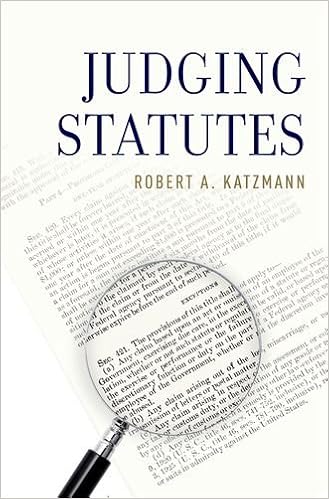
Judging Statutes by Robert A. Katzmann

It seems to me that the fundamental task for the judge is to determine what Congress was trying to do in passing the law.  In other words, the task is to interpret language in light of the statute's purpose(s) as enacted by the legislators, with particular attention to those legislative materials that reliably contribute to understanding the statute's meaning.

There are two general philosophies competing today when it comes to judicial interpretation of statutes: what I call the Scalia camp (textualism) and the Breyer camp (purposivism).  In short, Scalia believes that when interpreting a statute, judges should look primarily to the words of the statute and almost nothing else.  Breyer, on the other hand, believes that judges should use whatever reliable sources they have access to in order to ascertain the legislature's purpose and intent.  Katzmann falls very much in the Breyer camp, as do I, so I approached Judging Statutes as a choir member ready for a sermon.  Surprisingly, some of Katzmann's arguments actually made me question the Breyer philosophy a little (though in the end I still reject Scalia and remain in the Breyer camp).

One of the biggest points of conflict between the two philosophies is the use of legislative history.  Katzmann spends a long time describing Congress's processes for passing legislation and writes about the long paper trail that follows a bill, from committee reports to floor speeches to agency directives.  Katzmann argues that judges should use this material in its interpretation, but given how complex the process is and how many different people produce the work product, it's easy to understand Scalia's view that there is no "leglislative intent" because the legislature doesn't speak with one voice, aside from the bill that it votes on and passes.  Plus, these committee reports, etc., aren't voted on, they're usually drafted by unelected staffers.  To put too much emphasis on these materials would undermine our republican system of government.

On the other hand, Katzmann points out that agencies are often the first bodies to interpret statutes, that they often use legislative history and other materials, and that it's a broadly established doctrine that judges must give deference to agency interpretation of statutes when reasonable (Sup Chevron).  Thus, it seems silly to give so much weight to agency interpretation, which relies on legislative history, while completely rejecting legislative history in other contexts.

Fundamentally, though, the best argument in favor of purposivism is the deficiencies of textualism.  Scalia has said that we are governed by laws, not the intentions of legislators and presents his approach as some pure objective way of interpreting statutes without bias.  Of course, this leaves the judge free to inject her own biases into her analysis without identifying them or transparently confronting them.

Overall I thought Katzmann did a good job of explaining the two approaches to statutory interpretation and agree with his conclusion that purposivism is a better choice most of the time, but it was interesting how he got there.

Best of, 2015 Edition

As always, I'm going to do a top 20% because I didn't hit 50 (although this is the most books I've read since joining The Fifty Books Project). And, although I'm going to reveal my list in rank order, I'm also going to note that these books are the de facto bests in their respective genres, because I have regular, predictable categories of books.

Best Book with (Un)Necessary,;; P(un)ctuation Marks: The Familiar, Volume I: One Rainy Day in May by Mark Z. Danielewski. I make no secret of my love for Danielewski's work. House of Leaves is, to this day, still one of my favorite novels (which is not the same as saying that I would recommend it to people). In The Familiar, Volume I, Danielewski is the opening salvo of what appears to be his most ambitious work. Indeed, this is may be the most ambitious literary project currently happening. I've already read Volume II (review pending), so I can with all honesty, that this is promising.

Best Sports Book about a Sport that I did in High School and College and Happened to have Coached a Year of: The Boys in the Boat:Nine Americans and Their Epic Quest for Gold at the 1936 Olympic by Daniel James Brown. I generally am not a sports lit person (this category could also be: Only Sports Book I've Ever Read, Ever). However, I love rowing and Brown managed to capture all of it: everything I love about rowing was there, its beauty, its athleticism, its emphasis on team. And, he picked an inspiring story, where the sport was more than a sport.

Best Book about Legal  Interpretation Offered to Counterbalance Scalia's Originalism: Law's Empire by Ronald Dworkin. Since law school, legal interpretation has been a pretty significant interest. Dworkin persuasively concluded this topic for me. This is not to say solved; rather, I feel I have a handle for the difficulties in trying to solve the question of legal interpretation. And, insofar as such a question is solvable, I think Dworkin has solved the question. Insofar as it's not solvable, I think I'm interested in other legal theory questions.

Best Political History of How the Democrats Helped Screw Up the Criminal Justice System: The First Civil Right: How Liberals Built Prison America by Naomi Murakawa. An important history about political discourse. It's very easy to assume that people with conservative views about race were behind the massive incarceration problem this country faces. However, the truth is much harsher: both political parties abdicated their duty to rule responsibly. And, for me, this truth is much scarier: it is tragically easy for politicians to rally against an other for political gain, for policy makers to fall into the trap of fear-mongering.

Best Book about How Totally Screwed Up the Criminal Justice System is: The Collapse of American Criminal Justice by William J. Stuntz. The most important work I've yet read about what ails the criminal justice system. The book does a great job of explaining the problems, but also explaining the roots of those problems. For me, this inherently provides ideas for how we might improve the system.

Best Book by a Young Writer You've Probably Never Heard of (Unless You Read The Paris Review): Eileen by Otessa Moshfegh. I know my book review was...mediocre. Nonetheless, this was a really great novel. My snarky categories aside, this was the best novel I read in 2015. I am extremely excited about Moshfegh as a writer and wish I could say more about the novel without feeling like I am depriving possible readers of the pleasure of encountering every detail anew. I'll say this, her writing does it all: great style and great plot..

Best Book about the Law: Minding the Law by Anthony G. Amsterdam & Jerome Bruner. As I mentioned above, Dworkin basically has resolved my interest in legal interpretation as a separate and distinct topic. Minding the Law has given me something new to be interested in: what I will lovingly refer to, for now (and for lack of a better term) as the story-behind-the-story of legal decision making. Amsterdam and Bruner show that there are many ways to understand the basis for a decision beyond the literal arguments made within. I put this down as the best book of 2015 because I think it's going to be the book come back to in the future.

Last year in my best-of, I listed the books I was most looking forward to. Disappointingly, there was no J.D. Salinger novel. I'm furious. Shane Salerno gave us a documentary that was extremely dull but for the promise of new novels. Now that the new novels have not appeared, Salerno's empty promises render his documentary empty-feeling. Sadly, this year, there are not any upcoming novels that I know of...other than another Danielewski novel. Still, I'm thinking maybe this year, I'll dabble in narrative theory, maybe a new Arendt book (or an old one...?). Cheers to another year of reading and the Fifty Books Project.

Saturday, January 9, 2016

The Givenness of Things by Marilynne Robinson

The fact, or at least the degree, of human exceptionalism is often disputed.  In some quarters it is considered modest and seemly for us to take our place among the animals, conceptually speaking--to acknowledge finally the bonds of kinship evolution implies.  Yet, in view of our history with regard to the animals, not to mention our history with one another, it seems fair to wonder if the beasts, given a voice in the matter, would not feel a bit insulted by our intrusion.  History is the great unfinished portrait of old Adam.  In the very fact of having a history we are unique.  And when we look at it we are astonished.  Only in myth or nightmare could another such creature be found.  What a thing is man.

Say, however, that God is a given, the God of the psalmist and of Jesus.  Then it is possible to claim a dignity for humankind that is assured because it is bestowed on us, that is, because it is beyond even our formidable powers to besmirch and destroy.  Say that the one earthly thing God did not put under our own feet was our own essential nature.  The one great corrective to our tendency toward depredation would be a recognition of our abiding sacredness, since we are both, and often simultaneously, victim and villain.  The divine image in us, despite all, is an act of God, immune to our sacrilege, apparent in the loveliness that never ceases to shine out in incalculable instances of beauty and love and imagination that make the dire assessment of our character, however solidly grounded in our history and our prospects, radically untrue.

I believe in God, and with some trepidation I will admit that I consider myself a Christian.  I don't say that often, and I can recall clearly several instances in which people I know otherwise quite well have been shocked to hear it.  Mostly I keep it to myself, partly because I don't want to be associated with a religious culture that feels to me increasingly shallow, mindless, and vicious.  (Robinson talks about "the growing numbers among our people who have begun to reject [Christianity] as ignorant, intolerant, and belligerently nationalistic, as they might reasonably conclude that it is, if they hear only the loudest voices.")  Partly because a belief in God is increasingly difficult to defend under the hyperrationalist terms that characterize our century.  Partly it is just good, old-fashioned shame.

Robinson's new collection of essays, The Givenness of Things, addresses all of my misgivings directly.  But it's the lack of shame about her that captivates me most; the lack of any sheepishness or need to apologize for this belief.  Robinson happily identifies herself as a throwback, a mainline Protestant with a fondness for the language and ideas of hymnals and prayer books, at a time when that seems an endangered species:

There is a word that fell like a curse on American religious culture--"relevance."  Any number opf assumptions are packed into this word, for example, that the substance and the boundaries of a life can be known, and that they should not be enriched or expanded beyond the circle of the familiar, the colloquial.  We encouraged ourselves to believe that our own small, brief lives were the measure of all things.  Wisdom would have told us that our lives are indeed small and brief, like the billiosn that preceded them and the billions that will follow, but this information was precisely not welcome.  Wisdom would have told us, too, that, by grace of our extraordinary gifts, and theirs, we are heirs to the testimonies of unnumbered generations.  But these gifts, of course, failed the test of relevance, which was a narrow and ungenerous standard, systematically unforgiving of anything that bore the marks of another age, era, or decade.

The Givenness of Things is divided into a number of essays with short titles that promise reflections on broad, if profound topics, like "Grace," "Fear," and "Metaphysics."  The first chapter, "Humanism," recently published in The Nation, shows that each can stand alone.  But the book is really a single essay, with a few key themes that Robinson hits again and again.

First, she objects to rationalist and positivist ways of thinking which deny the reality of much of human experience.  Neuroscience, for example, tries to reduce the very essence of our being to a series of physical, chemical, and electrical interactions, but this is a definition of the real which lops off, wholesale, thousands of years of human culture and learning.  "Our realism," she writes, "distracts us from reality, that most remarkable phenomenon."  But Robinson is far from anti-science; rather, she argues that positivists ignore the implication that the last century of scientific progress have led us to: that our old "nuts-and-bolts physics" is thoroughly insufficient to describe the world.  "The antidote to our gloom," she writes, "is to be found in contemporary science," not least because the strangeness of the new vision of the cosmos--with its multiple dimensions, dark matter, and quantum entanglement--have resurrected the need for a metaphysics that positivism sought to bury.

Second, she argues that we have made a great mistake by removing human beings from the center of the cosmos.  She puts the lie to the humanism of those "secular humanists" who diminish the uniqueness of the human being:

A number of times I have read or heard from the scientists and the rationalists that the brain is a peice of meat.  This being true of the brain, then the brain/mind, the mind/soul, are degraded or dismissed by their being revealed in their actual, brutish nature.  But why limit this insight to the brain?  The entire human person is meat, except where it is bone, no enhancement.  If it is reasonable to say the brain is meat, it is reasonable on the same grounds, the next time you look into a baby carriage, to compliment the mother on her lovely little piece of meat.  I could as reasonably say that pieces of meat come to my classes, sit in the chairs, and gaze at me with something that looks for all the world like interest or indifference.  Whatever else might be said of these living hams and chops and ribs, they seem to bore easily...

More to the point, what is meat?  Complex life.  And what is that?  The universe's greatest mystery.  It is meat that sings and flies and fledges, meat that makes civilizations and pulls them down.

Robinson labors over this point again and again, because as moderns we have trouble believing it, though it seems, by the time she's done, entirely self-evident.  "Our brilliance," she writes, "has shown us grounds for utter humility.  We could vanish into the ether like a breath, leaving nothing behind to say who we were, what we were.  No doubt we will vanish in fact, mere transients in a cosmos that will realize itself over eons.  How astonishing that we know this."  That is, those rationalists who show us how small and insignificant we are in relation to the cosmos often take the wrong lesson, for no ape, bird, plant, or stone has any conception of what its relationship to the cosmos is, or can even conceive of a cosmos.  Even our immense capacity for evil sets us apart, because "[t]here is something inversely godlike in our potential de-creation of the biosphere."

Finally, she argues that the exceptionalism of the human being is at the heart of Christianity.  The book, toward its end, becomes a theological defense of Robinson's conception of Christianity and of Calvinism.  She speaks beautifully and persuasively about the meaning of the Incarnation, which, she argues, isn't so much God taking on a human form as an expression of the way in which human beings, and Being itself, share and have always shared the nature of God:

I have spent all this time clearing the ground so that I can say, and be understood to mean, without reservation, that I believe in a divine Creation, and in the Incarnation, the Crucifixion, the Resurrection, the Holy Spirit, and the life to come.  I take the Christian mythos to be a special revelation of a general truth, that truth being the ontological centrality of humankind in the created order, with its theological corollary, the profound and unique sacredness of human beings as such.  The arbitrariness of our circumstance frees me to say that the Arbiter of our being might well act toward us freely, break in on us, present us with radical Truth in forms and figures we can radically comprehend.

As ever, Robinson's careful prose contains its own wonders; only now, typing that passage out, do I notice the exquisite application of the word "radically" to the verb "comprehend."  Of course, that is part of Robinson's argument: comprehension itself is radical, and implies radical things.  I will risk sounding like a fanboy, but I believe there's nothing short of remarkable in Robinson's gift for uniting beautiful ideas with beautiful words.  In that way reading The Givenness of Things is not so different from reading Robinson's fiction.  And as much as I have loved and treasured Housekeeping, Gilead, and Lila, I think perhaps this book has meant the most to me.

Friday, January 8, 2016

Notorious RBG by Irin Carmon and Shana Knizhnik


RBG often repeated her mother's advice that getting angry was a waste of your own time. Even more often, she shared her mother-in-law's counsel for marriage: that sometimes it helped to be a little deaf. Those words had served her in the bad old days of  blatant sexism, through the conservative backlash of the eighties, and on a court of people essentially stuck together for life. But lately, RBG was tired of pretending not to hear....That 2012-2013 term, reading dissents from the bench in five cases, RBG broke a half-century-long record among all justices. 


I'm a huge fan of ladies who kick ass and do things people don't expect them to, and I have developed an appreciation for SCOTUS because I share bookshelves with Randy, who reads a lot of legal books. He once dressed up as Darth Bader for Halloween and I bought him his own Notorious RBG shirt, but I personally didn't know a lot about her outside of her memeification. Then I was binge listening to the podcast Call Your Girlfriend and the hosts share RBG love frequently. Aminatou Sow even got to go to the Supreme Court and meet RBG! In a recent episode she calls Irin Carmon to chat about the book and their talk was the final thing that pushed me into adding this book to my Christmas list. 

The book is excellent, well-researched, well-written, and engaging. The pages are glossy full-color, although there are some problematic graphics (the timeline in the opening pages is really difficult to follow). It's definitely not a book targeting academics or scholars, but was more serious than I was expecting for a pop biography based on a meme. It is full of amazing and horrible anecdotes about RBG's life, like the memo she sent to another supreme court justice after her clerks' fantasy baseball team beat his clerks' fantasy baseball team or the times that people shook her husband's hand after being introduced to "Justice Ginsberg". It has charts outlining cases she argued in front of the supreme court as well as her dissents as a justice. Her legal writings are excerpted and annotated in a way that is very user-friendly for non-lawyers. 

This book is for every feminist, every person interested in equal rights, and any person who works with the justice system. I had tears in my eyes when I finished the book (which I didn't realize was over because there are many many pages of endnotes) and then immediately lent it to a lady friend who I thought would love it (it turned out it was already on her list). 

Wednesday, January 6, 2016

Gold Fame Citrus by Claire Vaye Watkins


"California people are quitters. No offense. It's just you've got restlessness in your blood...Your people came here looking for something better. Gold, fame, citrus. Mirage. They were feckless, yeah? Schemers. That's why no one wants them now. Mojavs."


I was gifted Gold Fame Citrus for Christmas. It's rare that someone gives me a book I didn't request, haven't read, and have never even heard of, so I was intrigued just by its existence in my home. The opening lines convinced me to pick it over my other Christmas books because they were so vivid and funny.
"Punting the prairie dog into the library was a mistake. Luz Dunn knew that now, but it had been a long time since she'd seen a little live thing, and the beast had startled her."
Book One, lasting 109 pages, focuses on Luz Dunn. A conservation propaganda baby, a teenage model, one of the last Mojavs left in the post-water West who hasn't allowed herself to be relocated to a more precipitous place in America. She and her boyfriend Ray live in an abandoned starlet's home, shitting in holes, drinking ration water, grossly overpaying for black market fresh produce, and bemoaning that of all the empty pools in Hollywood, they picked the house with one that can't be turned into a half pipe (it has a bottom made of river rocks instead of smooth concrete). A mysterious little girl enters their life and forces them to start making different kinds of choices. I really really enjoyed the premise and writing and characters of Book One. 

I have often said that shifting point of views is an easy way to win me over as a reader. I am also a fan of multigenre - the slide show in Jennifer Egan's A Visit from the Goon Squad is still one of my favorite non-text things to appear in a  book - but this novel has both not enough and too many Point of Views and Genres. 

POV changes several times because multiple characters are believed dead and then reappear. Rather than feeling like I'm purposefully being taken on a journey through different perspectives in order to show me more about the world and characters being developed, it seems like a ploy because the author didn't know how to move plot without the 'deaths' and the deaths necessitated a different perspective (along with the multiple miraculous survivals).

There are several genres: 20 pages of past-tense history recounted in a distant narrative voice that isn't repeated elsewhere, a 6 page survey about a character on a Top Secret mission, a psychiatric evaluation about a character that comes from a time outside of the setting of the story, an anecdote about the mole people who work in the Yucca Mountain Nuclear Waste Repository. At three different points  - each about 100 pages apart - there are chorus-like sections with short quotes from a variety of characters who are all responding to a single situation. Again, these don't feel like they are developing anything for the novel and are more distracting than they are illuminating. 

The one exception is an illustrated book with descriptions of different creatures that live in the Amargosa Dune Sea (the giant sand dune that has taken over the south west) - this was lovely on its own and set up a plot point about a character that became evident as the novel went on. 
          DUMBO JACKRABBIT 
Easily identifiable by its enormous ears, which grow four to five times larger than the rabbit's body and serve as a cooling system in the extreme heat of the dune sea.  

I really wanted to like Gold Citrus Fame. Watkins is a new young author who runs a cool free writing workshop in my own Battleborn state, the protagonist of her novel is a Hispanic female, the setting is the desert that I love so much, the Amargosa Opera House and Pappy and Harriet's steakhouse are two physical places that I adore which have cute cameo appearances, the writing is oftentimes funny, engaging, and beautiful, but the novel falls short. Her short story collection, Battleborn, is fairly well acclaimed, and many people liked the novel, but it felt like she didn't quite know how to handle the full scale and scope of a novel. I am incapable of even trying, so I applaud her efforts, but I still wouldn't recommend this book.

I do, however, intend to read Battleborn. This does feel reminiscent of my experience with Karen Russell, though. I read Swamplandia!  because of what people said about her short stories, and was disappointed. Then I read Vampires in the Lemon Grove and was still disappointed. People still say such good things about St. Lucy's Home for Girls Raised by Wolves that I still think about picking it up in spite of the fact that I just can't seem to get into Karen Russell.  

Tuesday, January 5, 2016

Go Set a Watchman by Harper Lee

You must have lived it.  If a man says to you, "This is truth," and you believe him, and you discover what he says is not the truth, you are disappointed and and you make sure you will not be caught out by him again.

But a man who has lived by truth--and you have believed in what he has lived--he does not leave you merely wary when he fails you, he leaves you with nothing.

It wasn't intentional, but after Faulkner's The Unvanquished, set, as always, in Mississippi, I moved only just across the border to Harper Lee's Alabama.  And to be sure, the Maycomb County of this novel is just as central for Lee as Yoknapatawpha County is for Faulkner.  Both are fictional and yet real, slightly skewed images of the Deep South Faulkner and Lee knew, loved, and sometimes hated. (Or, in Lee's case, knows, loves, and apparently sometimes hate.)  When Jean Louise, To Kill a Mockingbird's Scout all grown up, spies her father in a white supremacist Citizens' Council, the betrayal robs her of both an identity and a home:

The glaring sun pierced her eyes with pain, and she put her hands to her face.  When she took them down slowly to adjust her eyes from dark to light, she saw Maycomb with no people in it, shimmering in the steaming afternoon.

She walked down the steps into the shade of a live oak.  She put her arm out and leaned against the trunk.  She looked at Maycomb, and her throat tightened: Maycomb was looking back at her.

At the book's beginning, Jean Louise is grappling with the much more banal question of whether she should return home from New York where she's been living, compelled by Atticus' failing health and the entreaties of her beau, Henry.  Atticus' presence at the meeting reveals a much deeper, and more frightening question beneath this one: If Atticus is rotten, has always been rotten, who is Jean Louise, who has lived her life under his example?  And is it true you can't go home again?

It's no secret that Go Set a Watchman was published under questionable circumstances.  On whether the aging Harper Lee had full control over its release, I express no opinion.  If she did, I wonder if she felt any sympathy toward the senescent Atticus.  But, more to the point, I wonder how much of our suspicion is fueled by what seems to be a very foreign, almost unrecognizable Atticus Finch.  One who says things like, "the Negroes down here are still in their childhood as a people."  Randy urges us to reject this impostor.

Maybe that's right.  But I think the alternative is more interesting, though scarier: What if the Atticus of Go Set a Watchman is really the same as the one of To Kill a Mockingbird?  In Mockingbird, Atticus is devoted to general notions of justice and fair play, and proudly voices the essential equality of human beings.  But so did many proponents of segregation, upstanding men whose moral codes, strict as they were, failed to account for segregation's fundamental inequality and indignity.  In this book, too, Atticus takes a case on behalf of a black man: Zeebo, the son of his old housekeeper Calpurnia, arrested for vehicular manslaughter.  Jean Louise accuses him:

"I remember that rape case you defended, but I missed the point.  You love justice, all right.  Abstract justice written down item by item on a brief--nothing to do with that black boy, you just like a neat brief.  His cause interfered with your orderly mind, and you had to work order out of disorder."


Go Set a Watchman is not a good book.  It's too heavy on dialogue, for one thing.  Sometimes it threatens to be one, as in a heartwrenching scene where Jean Louise, met with stony silence by Calpurnia after Zeebo's arrest, demands of her: "Did you hate us?"  But it presents us with a good and valuable question: Why do we feel so protective of Atticus Finch?  When do our own sophist notions of justice serve to excuse white paternalism?  When are we, in short, not as good as we hoped we would be?

Michiko Kakutani writes that the novel "seems to want to document the worst in Maycomb in terms of racial and class prejudice, the people’s enmity and hypocrisy and small-mindedness."  Even with Bob Ewell in it, the Maycomb of Mockingbird is a kinder, gentler place.  But Lee wants us to consider, what do we do when the places we have loved, and the people in them, are neither kind nor gentle?  I am a Southerner and I do not consider this a frivolous question.  The ending of Watchman suggests that, while Jean Louise must construct her own conscience as she sees fit (the Biblical watchman of the title), it still might be possible for her to love her father and her home, and to live within them.  Watchman doesn't succeed as a novel, but it does succeed in presenting this problem in a serious way, without flattering our sense of self-satisfaction, like The Help.  I think that makes it worth reading.

Monday, January 4, 2016

The Unvanquished by William Faulkner

There is a limit to what a child can accept, assimilate; not to what it can believe because a child can believe anything, given time, but to what it can accept, a limit in time, the very time which nourishes the believing of the incredible.  And I was still a child at that moment when Father's and my horses came over the hill and seemed to cease galloping and to float, hang suspended rather in a dimension without time in it and I heard Ringo's half blind beast crashing and blundering among the trees to our right and Ringo yelling, and looked quietly down at the scene beneath rather than before us--the dusk, the fire, the creek running quiet and peaceful beneath a bridge, the muskets all stacked carefully and neatly and nobody within fifty feet of them; and the men, the faces, the blue Yankee coats and pants and boots, squatting about the fire with cups in their hands and looking toward the crest of the hill with the same peaceful expression on all their faces like so many dolls.  Father's hat was flung onto his head now, his teeth were showing and his eyes were bright as a cat's.

The stories in William Faulkner's The Unvanquished tell the story of the Civil War from a child's point of view.  In the first story, the narrator, young Bayard Sartoris and his friend (and family slave) Ringo shoot at a Union officer who has appeared, like something out of a myth, near their Mississippi home.  Bayard's father John is a Confederate Colonel, off fighting in Memphis, but the war has come to Yoknataphawa County, which means that it is very nearly over.  As Bayard grows up over the course of these stories, he witnesses a profound change in his world.  At one point Union soldiers burn down his family home, forcing him, Ringo, and his grandmother, to live, as so many genteel Southerners had to, in the slave quarters, with all the irony that suggests.

What is one to make of a Civil War story written from the Confederate perspective?  They're certainly more permissible than, say, a World War II story written from a Nazi point of view, and sometimes even wildly popular.  Yet something uneasy about them remains.  Are we meant to see the equality between Bayard and his friend Ringo as a kind of apologetic?:

Father always said that Ringo was a little smarter than I was, but that didn't count with us, anymore than the difference in the color of our skins counted.  What counted was, what one of us had done or seen that the other had not, and ever since that Christmas I had been ahead of Ringo because I had seen a railroad, a locomotive.

I think Faulkner has a deep regard for the old gentility and the gritty resolve of the Confederate South.  There's a kind of wild-eyed heroism in Colonel Sartoris, whose perpetual absence makes him a kind of myth to his own son.  And there's Granny Rosa, whose shrewdness fuels a long-running scheme in which she, Bayard, and Ringo fake Union requisition orders to steal mules in droves, only to sell them back to the Yankees.  There's Bayard's cousin Drusilla, a kind of Amazon who fights alongside Col. Sartoris' regiment and says things like,

"...Who wants to sleep now, with so much happening, so much to see?  Living used to be dull, you see.  Stupid.  You lived in the same house your father was born in and your father's sons and daughters had the sons and daughters of the same negro slaves to nurse and coddle, and then you grew up and you fell in love with your acceptable young man and in time you would marry him, in your mother's wedding gown perhaps and with the same silver for presents she had received, and then you settled down forever more while your husband got children on your body for you to feed and bathe and dress until they grew up to; and then you and your husband died quietly and were buried together maybe on a summer afternoon just before summertime.  Stupid, you see.  But now you can see for yourself how it is, it's fine now; you dont have to worry now about the house and the silver because they get burned up and carried away, and you dont have to worry about the negroes because they tramp the roads all night waiting for a chance to drown in homemade Jordan, and you dont have to worry about getting children on your body to bathe and feed and change because the young men can ride away and get killed in the fine battles and you dont even have to sleep alone, you dont even have to sleep alone at all and so all you have to do is show the stick to the dog now and say Thank God for nothing..."

But Drusilla cannot see the irony: the same violent upheaval of the old ways that have freed her from the conventional life is the same that has freed the Sartoris' slaves.  She thrives in the chaos of the war, but in defense of a social order that, sure enough, comes to force her into marriage with Colonel Sartoris later in the novel out of its iron sense of propriety.

Similarly, I think I read the moment when Granny, meeting a freed slave on her way north who has fallen behind from illness and starvation, offers her food for the promise that she'll "go back home," as a moment when an idealized Southern culture comes face-to-face with a likeness of itself that has not been able, or refused, to recognize.  "Hit's Jorden we coming to," the woman says, "Jesus gonter seem that far," and her steadfast resolve is the image of Granny's.  This story, where Granny, Bayard, and Ringo find themselves among a mass migration of freed slaves, is a lyric reminder of the stakes beyond the limited worldview of the Sartorises:

They were coming up the road.  It sounded like about fifty of them; we could hear the feet hurrying, and a kind of panting murmur.  It was not singing exactly, it was not that loud; it was just a sound, a breathing, a kind of gasping murmuring chant and the feet whispering fast in the deep dust... We couldn't see them and they did not see us; maybe they didn't even look, just walking fast in the dark with that panting hurrying murmuring, going on.

(Every now and then Faulkner will toss up a phrase to remind you of how calmly in control of his prose he is--here, "the feet whispering fast in the deep dust.")  In the last story, Bayard, grown up now, learns that his father has been killed by a business rival.  He confronts the killer, as the townspeople urge him to, but unarmed, relying on nothing more than his familial resolve.  In doing so, he rebukes violence and war.  He beats his sword into a ploughshare.  Bayard establishes a legacy different from, and greater than, his father's.  This is, I think Faulkner is suggesting, a way that is more true to the best of the South, wholly different from rebellion and from war. 

Friday, January 1, 2016

The Matisse Stories by A. S. Byatt

'I went to see him once, you know, after the war, when he was living in that apartment in Nice... The rooms in that apartment were shrouded in darkness.  The shutters were closed, the curtains were drawn.  I was terribly shocked--I thought he lived in the light, you know, that was the idea I had of him.  I blurted it out, the shock, I said, "Oh, how can you bear to shut out the light?"  And he said, quite mildly, quite courteously, that there had been some question of him going blind.  He thought he had better acquaint himself with the dark.  And then he added, "and anyway, you know, black is the colour of light".  Do you know the painting La Porte noire?  It has a young woman in an armchair quite at ease in a peignoir striped in lemon and cadmium and... over a white dress with touches of cardinal red--her hair is yellow ochre and scarlet--and at the side is the window and the coloured light and behind--above--is the black door.  Almost no one could paint the colour black as he could.  Almost no one.'

Each of the three stories in this collection is based on a different work by Matisse.  Writing about art is always tricky, and never seems to do the work justice, and here is no different.  Byatt throws up lists of numerous colors--see the "cadmium" and "lemon" and "scarlet" and "cardinal red" above--which never cohere into a successful visual object, instead remaining as half-realized as the black-and-white reproductions that preface each story.

But perhaps that's how it is meant to be; each story in some way shows us the impossibility of realizing the optimism and joy that embodied Matisse's work.  The first story, "Medusa's Ankles," is narrated by a woman grappling with her own aging appearance at her salon, where one of Matisse's nudes hangs, emblematic of a very different kind of beauty than the models who appear in the surrounding posters, but unlike the narrator, immune to change and decline.  The second, "Art Work," is about a family of frustrated artists who are shocked when their working-class maid finds success as a sculptor, knitting masterworks together from the clothes they gave her, thinking of them as hand-me-downs.  Each of these stories is about the gap between the way we are and the we are seen or the way we want to be seen.

The best of the stories, though, is the last, "The Chinese Lobster."  The narrator is a college's dean of women students, meeting a colleague at a Chinese restaurant to discuss sexual harassment charges made against him.  The student--who Byatt pointedly makes the subject of discussion, rather than a character with any agency--is neurotic and deeply troubled, and her thesis centers around a misguided perception that Matisse's work objectifies and belittles women.  She applies her thesis to a project smearing feces on reproductions of his work.  But the professor, an expert on Matisse, is almost comically villainous in his contempt for the student.

What seems at first to be a straightforward story about gender conflict becomes something different, though, when the narrator and the professor connect over a mutual understanding of Matisse:

Any two people may be talking to each other, at any moment, in a civilised way about something trivial, or something, even, complex and delicate.  And inside each of the two there runs a kind of dark river of unconnected thought, of secret fear, or violence, or bliss, hoped-for or lost, which keeps pace with the flow of talk and is neither seen nor heard.  And at times, one or both of the two will catch sight or sound of his movement, in himself, or herself, or more rarely, in the other.  And it is like the quick slip of waterfall into a pool, like a drop into darkness.  The pace changes, the weight of the air, though the talk my run smoothly onwards without a ripple or a quiver.

The professor notes that Matisse claimed his art was designed to "please and be comfortable," which, paradoxically, is what makes the work so radical.  Matisse's effusions of color are only sensible, only fruitful, when placed next to le porte noir, the black door.  The student is bereft, suicidal, but the tragedy is only compounded by her rejection of something that might ameliorate, even a little, the endemic misery of being.  "The Chinese Lobster" remains a story about a man's piggish inability to sympathize with one woman, but in his sympathy with another, the narrator, Byatt reveals something deeper and wiser.