Showing posts with label soviet union. Show all posts

Tuesday, August 16, 2022

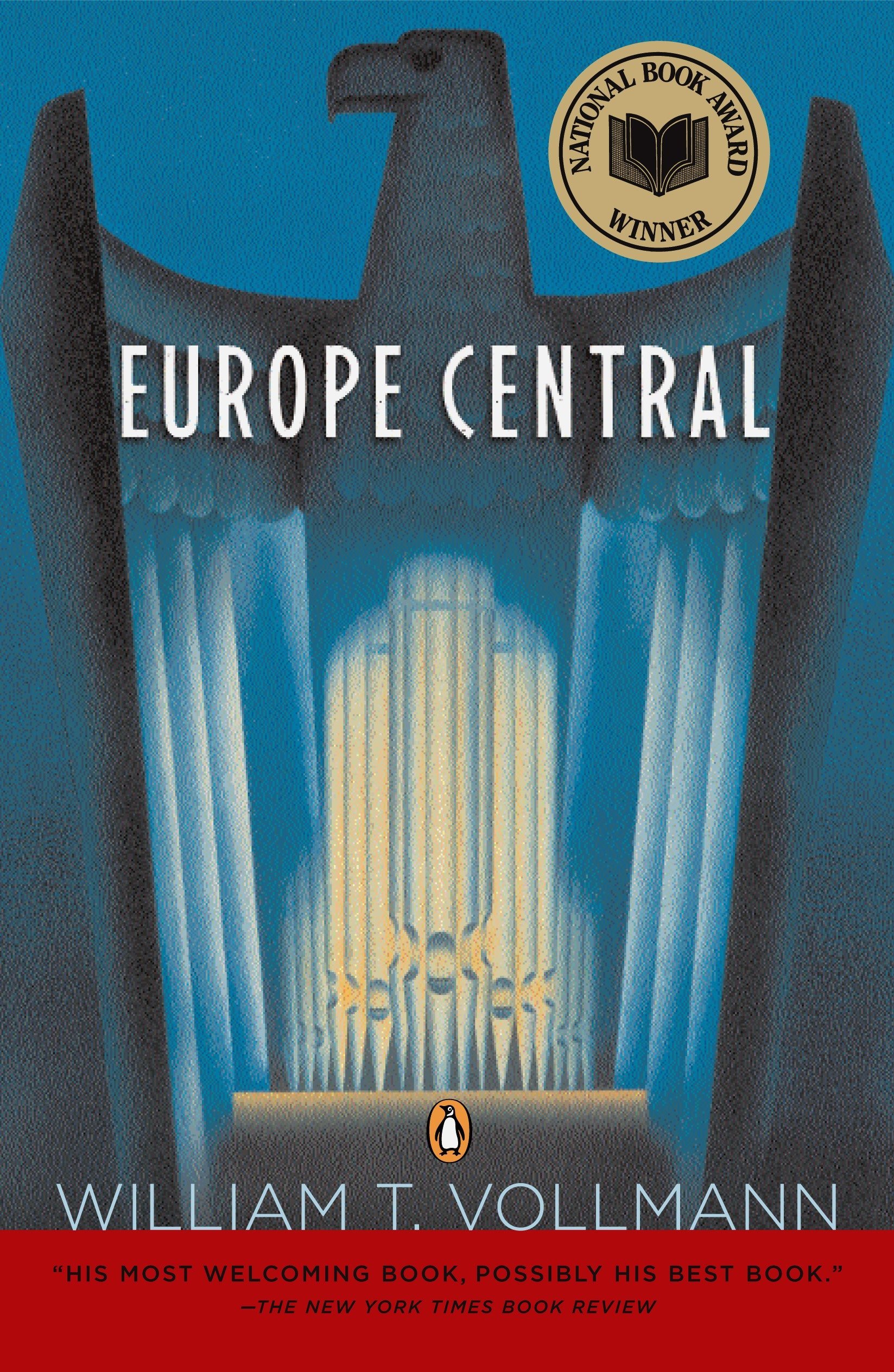
Europe Central by William T. Vollmann

About this quartet the most fundamental thing which can be said is that it is too sad even to rise from a moan into a wail at death's uncompassed crescendo. To be sure, the danse macabre of the second movement glows sickeningly vivid as a sodium flare at night (so much for flamelessness!); it's as bright as the electric light which illuminates the gas chamber when it's time to ascertain whether all the Jews are dead; while the menace of the third remains more chilling than those screams of terror in Leningrad when the German bombs come down; they'll never stop coming down. Yet on the whole the effect is of somebody drowning, his most desperate convulsions already behind him; he's begun to inhale water; the green water he sees is going black; and he's settling down into the muck. Some listeners who close their eyes during the second movement claim to perceive a whirling red eye-ball or domino, and the more rapidly it speeds, the more balefully it glows. This eidetic image seems to symbolize the approach of something evil. I myself have never seen the red spot, perhaps because Opus 110 already threatens me so perfectly that no kinesthesia is needed to extend or refine the threat. While Shostakovich's music wriggles like the worming of black-gloved fingers behind a policeman's back, the Bronze Horseman sinks down under sandbags and planks. Leningrad strangles in a loop of barbed wire.

It's a time and a place we all know, though perhaps when we Americans think of it, we're more likely to think of the beaches of Normandy, or the Battle of the Bulge, than the enormous front between Germany and Russia that brought millions under conflagration during World War II. Stalingrad, that six month siege that killed two million, doesn't feature very highly in our American memories. William T. Vollmann's epic Europe Central is a book that presents fictionalized versions of some of the Germans and Russians who lived through those years of intensity and destruction. Some are military figures, like generals A. A. Vlasov and Friedrich Paulus, or the SS member Kurt Gerstein; many are creative types: German artist Kathe Kollwitz, Russian poet Anna Akhmatova, and the novel's protagonist, more or less, the Russian composer Shostakovich.

The central image that introduces the book is a black, octopus-like telephone--"Europe Central" evokes not just central Europe but a kind of immense telephone switchboard--that snakes into the lives of its characters, making orders and demands. The same black telephone that rings in Shostakovich's house to summon him to the Stalin's secret police is the same one that rings in the field tent of Field-Marshal Paulus to inform him that he is expected to commit suicide before retreating from where he is encircled by Soviet forces. I was most interested, perhaps, in the twin stories of Vlasov and Paulus, both generals who ended up being captured by the enemy, then recruited against their former masters. Vlasov led a regiment of Russians under the Nazi army; Paulus became a spokesman for an anti-fascist Germany under the auspices of the Soviet Union, though their "betrayals" came for different reasons and they came to--unsurprisingly, given the outcome of the war--very different ends.

I was also really taken by the story of Kurt Gerstein, who "infiltrated" the SS in an attempt to save as many people as he could. Gerstein's story, which I'd never heard, is one of a noble man who tries very hard, with limited results, to stave off a great cruelty. He pretends that shipments of Zyklon-B have gone bad, to give those condemned to death more time; he tries, mostly in vain, to alert authorities outside of Germany to the horrors of the concentration camp system. For these efforts, he is put on trial as a Nazi collaborator by his French captors, ultimately committing suicide. "I consider him a hero," Vollmann writes in the (characteristically compendious) footnotes, but Gerstein's story makes one question what a hero truly is--can one be a hero when what they accomplish is so minimal, because the forces allayed against them are so great? As Vollmann grimly notes, Gerstein's name is not one of those compiled in the "Righteous Among the Nations" for their efforts to save the Jews of Europe. For all that, he's a very Vollmann-like hero, something like the noble but ineffectual Chief Joseph of The Dying Grass.

I was less sure of what to make of the novel's focus on Shostakovich, whose story gives the book its backbone. Vollmann invents, seemingly out of whole cloth, a lovelorn Shostakovich, unable to get over his early lover Elena Konstantinovskaya, who later marries the famous Soviet filmmaker R. L. Karmen. Shostakovich obsesses over Elena, even as he marries a succession of other women. What's this got to do with the political themes of a book like Europe Central? Well, perhaps in one way it's merely an observation that what drives our innermost lives is not always, or even typically, questions of justice and struggle, like those that animate Vlasov, Paulus, Gerstein, Kollwitz, Akhmatova. Shostakovich, for all his genius, is an ordinary man unable to get over the one who got away; all the grand movements of the Soviets and Germans--he lives through the siege of Leningrad--count for less than Elena. But also, there's an interesting parallel in the way that Shostakovich debases himself for Elena and for the Soviet regime. Shostakovich, a "formalist" who loved dissonance and hated the mindless patriotism of Soviet realism, was constantly in trouble with the Soviet censors. But Vollmann depicts him as absolutely spineless, falling over himself to apologize and genuflect to the apparatchiks who want him to be more conformist, though he never seems to be able to actually constrain the shape of his genius in the way they desire. Eventually, Shostakovich does what he said he never would, joining the Communist Party, and alienating all of his more principled associates. Yet clearly Vollmann finds something heroic in him, too, though perhaps it is a kind of heroism that operates at a level beneath the conscious, in the place where creativity works.

The subject matter of Europe Central doesn't resonate with me like the Native American-European culture clashes of Vollmann's Seven Dreams books. And at a subconscious level, I think I had been suspicious of Europe Central because of a vague intuition that the Seven Dreams stuff was never taken all that seriously by critics until the publication of Europe Central, with its more familiar and shopworn settings. (Who needs another World War II novel?) But I am forced to admit that the later sections of Europe Central contain some of Vollmann's most accomplished writing: the strange chapter "Airlift Idylls," narrated by a German assassin targeting Shostakovich, who seems to be more of a metaphor than anything else--have you ever seen a chapter narrated by a metaphor?--and the freewheeling, associative horror-scape of "Opus 110," which details Shostakovich's spiraling instability and debasement with a prose to match. Ultimately, Europe Central struck me as an accomplishment on the level of Vasily Grossman's Life and Fate, a novel from which it clearly takes some inspiration.

Wednesday, February 17, 2010

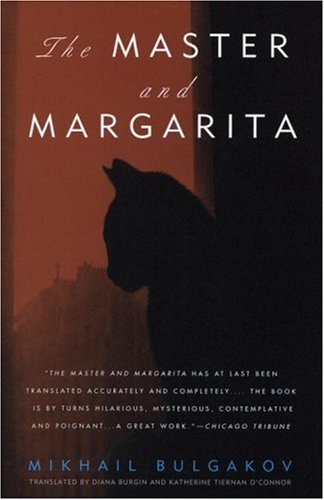
The Master and Margarita by Mikhail Bulgakov

Gods, my gods! How sad the earth is at eventide! How mysterious are the mists over the swamps. Anyone who has wandered in these mists, who has suffered a great deal before death, or flown above the earth, bearing a burden beyond his strength knows this. Someone who is exhausted knows this. And without regret he forsakes the mists of the earth, its swamps and rivers, and sinks into the arms of death with a light heart, knowing that death alone...


The Master and Margarita is one of those books whose fame comes partly from being discovered too late. Bulgakov was a famed playwright in Soviet Russia, and in the twelve years prior to his death he labored over this book, knowing completely that it wouldn't be published in his lifetime. It wasn't published until the 1960s, and today is one of the hallmarks of 20th century Russian literature.

The Master and Margarita is a rich, Faustian satire about the devil appearing in Moscow. He calls himself Woland, and begins by interrupting a conversation between an editor and a poet about the existence of Christ. After the conversation ends, the editor has been beheaded and the poet driven nearly into madness. This is just the first step--the book's first half chronicles the various and sundry ways that Woland causes havoc in Moscow, inducing death, madness, arson, and imprisonment, mostly in the city's literary and dramatic community. Most of these antics are performed by his retinue, which include a naked witch and a talking cat named Behemoth (which is totally what I'm going to name a cat, if I ever get one).

The titular characters don't appear until about halfway through the book: The Master, who has been arrested for writing a novel about Pontius Pilate, and Margarita, who desperately loves the Master. In exchange for returning the Master to her, Margarita agrees to become a witch and serve as the hostess for Satan's grand ball, which is as colorful as you might imagine. Interspersed are chapters of the Master's book about Pilate.

It's clear why the Soviet powers wouldn't have found The Master and Margarita acceptable. For one, religious subjects were taboo in atheistic Russia. Secondly, much of the havoc caused by Woland is a sly jab at the reigning policies of censorship and imprisonment. In this respect, Woland and his crew serve both as a symbol and its opposite. Though it is they who nearly destroy Moscow's literary elite, it is also Woland who saves the Master's manuscript about Pilate. The Master, regretting the trouble it has caused him, tries to burn it, but Woland reproduces it, quipping that "Manuscripts don't burn"--apparently now a rather well-known phrase in Russian. Here is the implication--the hope?--that authors survive in their works, something Bulgakov must have clung to in the face of a terminal disease. The book is largely comic, but also bittersweet, and the paragraph I've quoted above is one of the last that Bulgakov wrote. It expresses his exhaustion and frustration, and though he leaves the paragraph unfinished it is simple enough to imagine that the sentiment is "death alone can calm him." I don't know if death brought Bulgakov calm, but one hopes that he would have felt validated by The Master and Margarita's publication and subsequent popularity.

Saturday, June 20, 2009

Animal Farm by George Orwell


Boo Communism. Hooray beer!

Short and to the point. Orwell does a very good job at cutting apart Soviet style Communism while sticking to his plot and not deviating from the story to make his point. The thing I found most interesting about Animal Farm is that even though it was written as a criticism of Communism decades ago, it was still eerily relevant today (or at least a few years ago). Every time they said "If you do/don't do X, Jones will come back. You don't want Jones to come back, do you?" I heard "If you don't let us illegally wiretap your phones/If you vote for the Democrats/etc the terrorists win. You don't want the terrorists to win, do you?" Every time they talked about an impending attack from one of the neighboring farms, I felt like I was reading about Saddam's WMDs. The sheep shouting "four legs good, two legs bad" or whatever reminded me of the way political discourse degenerates into a contest to see who can shout the loudest. Also, the fact that the animals started with a long list of ideals and whittled it down to one short sentence seemed similar to the way politicians take nuanced, complex issues and turn them into a bumper sticker policy. So, take from that what you will. Animal farm = still relevant.