
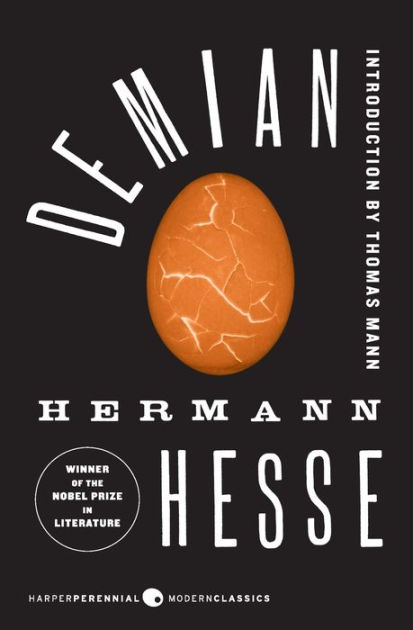
Brent hates this book so much I just had to read it for myself. Is it really that bad, or does Brent just have really bad taste? The answer, as I expected, was a little bit of both.
We agree that Hesse's Demian starts out well: the narrator, Emil Sinclair, recounts a particular story of his childhood. He makes up a story about stealing apples from an orchard to impress a local bully, Franz Kromer, which Kromer--clearly seeing through the lie--uses to blackmail Sinclair for months on end, pressing him into a kind of servanthood. It's a great story, written in clever detail, and amplified with the ironic touch of a child's perspective and lack of understanding. It's all the more interesting because of the inward agony it causes Sinclair, whose Manichaean view of the world is challenged by Kromer's cruelty. If the world is divided into the good and the bad, has Sinclair's fib aligned him with the bad; with Cain instead of Abel?
But like Brent says, the beginning of the book is the high point. Sinclair's agony is put to rest by his classmate Max Demian, who not only wards off Kromer but forces Sinclair to see the story of Cain and Abel--which operates as the principal symbol of the novel--in a different way:
"It's quite simple! The first element of the story, its actual beginning, was the mark. Here was a man with something in his face that frightened the others. They didn't dare lay hands on him; he impressed them, he and his children. We can guess--no, we can be quite certain--that it was not a mark on his forehead like a postmark--life is hardly ever as clear and straightforward as that. It is much more likely that he struck people as faintly sinister, perhaps a little more intellect and boldness in his look than people were used to. This man was powerful: you would only approach him with awe. He had a 'sign. You could explain this in any way you wished. And people always want what is agreeable to them and puts them in the right. They were afraid of Cain's children: they bore a 'sign.' So they did not interpret the sign for what it was--a mark of distinction--but its opposite. They said: 'Those fellows with the sign, they're a strange lot'--and indeed they were. People with courage and character always seem sinister to the rest. It was a scandal that a breed of fearless and sinister people ran about freely, so they attached a nickname and myth to these people to get even with them, to make up for the many times they had felt afraid--do you get it?
Cain, in this version, represents not the "dark side," but a rebuke to the Manichaean worldview that separates dark from light, bad from good, and right from wrong. Demian becomes the story of Sinclair's long, slow education in this worldview, the development of his own "mark of Cain." The God of the Bible is replaced by Abraxas, a pagan deity who represents a mixture of both God and Satan in one. In literal terms, this manifests itself in Sinclair's slow disillusion in the structures of pre-war European society and his drift back toward the figures of Demian and his alluring, androgynous mother. Gender becomes another binary to be deconstructed (which is, admittedly, anticipates a lot of our modern conversations) and Sinclair falls in love with Demian's mother precisely because she looks like Demian with a little bit of the feminine principle superadded. These two run a cult in the mountains which Sinclair joins with great enthusiasm.
There's a lot of interesting ideas there--okay, one interesting idea--but the story itself becomes dull after Kromer is dispatched. The conflict is no longer with petty bullies but with the antimetaphysical bourgeois worldview, which isn't exactly a gripping adventure. I think Demian might be more compelling if it didn't point toward an ultimate conclusion that seems retrograde for us who are able to look back on the bloody twentieth century: Demian's mother insists that the upcoming war--World War I--will offer an opportunity for man to grow and change in the crucible of violence, and for individuals to transform themselves in to enlightened Demianesque supermen. That kind of searching for meaning in violence may have been possible before, and even after, World War I, but not after World War II and the Holocaust.

