Showing posts with label Maryland. Show all posts

Friday, August 2, 2024

American Ramble by Neil King Jr.

This trip was different. On a fresh morning in late March, I stepped past the threshold of our front door, tugged the garden gate closed behind me, and set off to walk to the city of New York. A slow stroll, I liked to say, down a fast lane. An easy walk along a founding swath of the country that most travelers want to put behind them. A congested landscape usually seen as a blur, along a corridor named for a train, the Acela, whose name in turn is a faster form of accelerate. Ad + celerare, from the Latin: toward something, whatever it is, swiftly; to hasten the occurrence of a thing you want over.

No hastening anything on this trip. I wanted nothing over.

In 2021, journalist Neil King, Jr. set off from his home in Washington, D.C. to walk all the way to New York City. The journey, as he describes it in his book American Ramble, was conceived after a frightening bout with esophageal cancer that left his voice strained--a lasting mark that colors each interaction with the people he meets on his journey. Cancer, King found, contracted time and space, made things slow down, and each day seem precious and full of wonders. In a way, a journey on foot, as opposed to the machines of modern convenience, does the same thing. What would it be like, King wonders, to walk through the most heavily trafficked corridor in America, not by automobile or train, but on foot?

It's not a fair comparison, but throughout American Ramble I couldn't help but think of William Least Heat-Moon's Blue Highways, perhaps because I was so impressed by that book that I still have it on the brain. But I do think they have in common a kind of take-things-as-they-come approach: for Heat-Moon, the program is not a list of destinations, but the back routes on the highway; similarly, King is constrained to come across landmarks and communities as he finds them. I wished, in fact, that he had done a little more to synthesize the different stops on his trip, or perhaps to synthesize them in a way that was more historical and contextual than personal. What I liked best about the book is the way it reveals certain historical themes of this particular landscape that have been buried by urban sprawl and the great highways. King's route takes him through the crucibles of the American Revolution, including Valley Forge and the Delaware River, which he pointedly crosses at the same place that Washington did. It also takes him through the heartland of American religious pacificism, including the Amish country of southeastern Ohio and the vestiges of Quaker and Shaker culture. In each individual instance, King, a journalist, does a great job of investigating the particularities of place and history, but there is a larger story that emerges from the happenstance of the route that I felt was missing, somehow.

On the other hand, it's hard to ignore that momentousness of the feat by the end of the book. King makes it clear that this isn't the roughing-it style hitchhiking of his youth; he stays in hotels and AirBNBs and his meals are restaurant fish tacos, not Vienna sausages on a camp stove. And yet, by the time he strolls into New York's Central Park, he's traversed some of the most pedestrian-hostile landscapes on the face of the planet, including the great wastes of warehouses he calls "Amazonia." More than a story of physical triumph, it's a story of resolve, and a stubborn desire to see a familiar landscape in a new way. 

Saturday, December 10, 2016

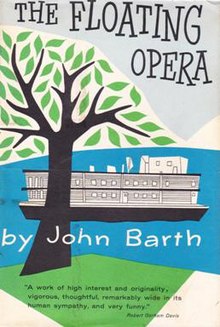
The Floating Opera by John Barth

Why The Floating Opera?  I could explain until Judgment Day, and still not explain completely.  I think that to understand any one thing entirely, no matter how minute, requires the understanding of every other thing in the world... Well, The Floating Opera.  That's part of the name of a showboat that used to travel around the Virginia and Maryland tidewater areas: Adam's Original and Unparalleled Floating Opera; Jacob R. Adam, owner and captain; admissions 20, 35, and 50 cents.  The Floating Opera was tied up at Long Wharf on the day I changed my mind, in 1937, and some of this book happens aboard it.  That's reason enough to use it as a title.  But there's a better reason.  It always seemed a fine idea to me to build a showboat with just one big flat open deck on it, and to keep a play going continuously.  The boat wouldn't be moored, but would drift up and down the river on the tide, and the audience would sit along both banks.  They could catch whatever part of the plot happened to unfold as the boat floated past, and then they'd have to wait until the tide ran back to catch another snatch of it, if they still happened to be sitting there.  To fill in the gaps they'd have to use their imaginations, or ask more attentive neighbors, or hear the word passed along from upriver or downriver.  Most times they wouldn't understand what was going on at all, or they'd think they knew, when actually they didn't... I needn't explain that that's how much of life works: our friend float past; we become involved with them; they float on, and we must rely on hearsay or lose track of them completely; they float back again, and we either renew our friendship--catch up to date--or find that they and we don't comprehend each other anymore.  And that's how this book will work, I'm sure.

John Barth's The Floating Opera is about the day that the narrator, Todd Andrews, decides not to kill himself.  That intriguing detail is laid out at the very beginning of the text, and then returned to after a number of long, digressive interludes about Todd's life.  We learn that his father committed suicide, and that he long had an affair with the wife of his friend, the pickle magnate Harrison Mack.  We learn about a long legal case he adjudicated that involved, among other things, the proper possession of hundreds of jars of human urine.  But the question laid out at the beginning of the novel--why did Todd consider killing himself, and why did he change his mind--hangs over the shaggy, humorous narrative:

So.  Todd Andrews is my name.  You can spell it with one or two d's; I get letters addressed either way.  I fear you'd say, "Tod is German for death: perhaps the name is symbolic."  I myself use two d's, partly in order to avoid that symbolism.  But you see, I ended by not warning you at all, and that is because it just occurred to me that the double-d Todd is symbolic, too, and accurately so.  Tod is death, and this book hasn't much to do with death; Todd is almost Tod--that is, almost death--and this book, if it gets written, has very much to do with almost-death.

The central image of the novel is the Floating Opera, a Vaudeville-esque show that takes place off shore in the town where Todd lives.  (Weird aside: this is the second novel I've read this year that takes place on Maryland's eastern shore.)  The Opera is central to Todd's existential pondering: he decides that suicide is the logical extension of the absurdity of life:

III. There is, therefore, no ultimate "reason" for valuing anything.

Now I added including life, and at once the next proposition was clear:

IV. Living is action.  There's no final reason for action.
V. There's no final reason for living.

But--and here goes the spoiler alert--what the reader has not realized is that when Todd decides to kill himself, he decides to sabotage the ventilation system of the Floating Opera and blow up hundreds of people along with him, including his friends, and a girl who his possibly his own daughter.  This decision is so starkly at odds with the light-hearted silliness of the narrative, that it comes as an explosive surprise.  Todd's decision to not kill himself, in the end, is linked to the failure of this attempt to blow up the Opera.

The ultimate message of The Floating Opera is this: if life is meaningless, you might as well live it as do anything else.  As a moral statement, it's not quite profound, but it matches the absurd and digressive nature of the novel, which is clearly modeled on the proto-modernist excess of Tristram Shandy.  Everyone lives on, but at the dark center of the novel is the awareness that it might have been otherwise.