Showing posts with label Aboriginal Australian. Show all posts

Sunday, March 22, 2026

Praiseworthy by Alexis Wright

Widespread Planet, same person as that piece of work Cause Man Steel, while thinking clear-headed higher rather than thinking low, was confident about how he would survive the climate emergency. He avoided the crowd--which meant humanity--and chose to be as some kind of crepuscular man, moving around the isolated bush by himself in the twilight hours in pursuit of his business venture, to put into action far more grandiose plans about how to make real money.

The aboriginal town of Praiseworthy in Australia's Northern Territory has been covered with an impenetrable haze. It's making everyone irritable, but it puts an idea into the head of one Cause Man Steel, who anticipates the worsening of climate change and the need for radical change: he'll collect a herd of feral donkeys that can be used for transport when fuel is no longer available. Cause, also known as Widespread and Planet--because he's. you know, everywhere--is especially in search of a special platinum-colored donkey he thinks will be the key to the whole scheme, for not particularly clear reasons. But the noisy, stinky donkeys only make Cause unpopular in town, and worsen the fractures in his own family: his wife Dance dreams of moving to China; his son Aboriginal Sovereignty commits suicide by drowning himself after being torn away from the younger girl who was his betrothed; his younger son Tommyhawk goes full-on "fascist" and tries to make his dreams of being adopted by the country's white minister of Aboriginal Affairs come true.

Above all, Praiseworthy is a satire on the paternalistic attitude of the Australian government towards Aboriginal people. The book presents a series of complaints, none of which I knew before: the government identified an epidemic of pedophilia among the country's outstation communities, banned pornography, keeps Aboriginal assets on a kind of controlled credit card with major restrictions. Aboriginal Sovereignty, a young man betrothed to a teenager (we never see her) is a victim of this paternalism, whereas his brother Tommyhawk absorbs the government propaganda wholeheartedly, considering everyone in Praiseworthy, including and especially his own father, a pedophile. And the "death of Aboriginal Sovereignty" has its own obvious secondary meaning, though Ab. Sov.'s death is more enigmatic and less final than such a phrase would seem. Cause, though short-sighted and selfish, represents a kind of trickster figure who stands against this paternalism, desperate to eke out a bit of autonomy and agency in a world that wishes to convince him it's better to play along.

This is the second book of Wright's I've read after Carpentaria, and I think I liked this one more, though it's possible that I was just better prepared for it. Wright's prose is still somewhat baffling to me, wordy and junky, full of cliches and weird circumlocutions. Nouns become adjectives and vice versa, and some of them even become verbs. I wondered more than once when reading both books if there's something about the strange, dense language that reflects Aboriginal dialect, but that would only be speculation on my part. I don't think I can get to the level of the writing being good, but it certainly works on its own terms, and the experience of diving into this 600-page tome is pretty brainmelting. I enjoyed it, but I'm glad to put it behind me, because it's one of those books that does something to your own words, you know? And moreso than in Carpentaria, I thought Praiseworthy reached more than once a feverish state where the clunky prose was transformed into something strikingly modernist, especially in the scenes where Aboriginal Sovereignty is described as mingling among the traditional spirits of the sea. Praiseworthy is one of those books I don't think I'd ever recommend, but if you get it, you get it.

Sunday, July 23, 2023

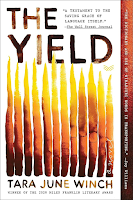
The Yield by Tara June Winch

yield, bend the feet, tread, as in waling, also long, tall -- baayanha  Yield itself is a funny word--yield in English is the reaping, the things that man can take from the land, the thing he's waited for and gets to claim. A wheat yield. In my language it's the things you give to, the movement, the space between things. It's also the action made by Baiame, because sorrow, old age, and pain bend and yield. The bodies of the ones that had passed were buried with every joint bent, even if the bones had to be broken. I think it was a bend in humiliation, just like we bend at our knees and bow our heads. Bend, yield--baayanha.

August Gondiwindi is an Aboriginal Australian woman living in London. When her father dies, she races back to the small bush town where she grew up, and finds herself facing new traumas and old ones: there's the death of her father, of course, among the new, but also a new mining operation is threatening to push her widowed mother out of her house and destroy the land. Among the old traumas is the decades-past disappearance of August's sister Jedda, who still haunts the land. August finds herself prodding through the earth for clues once again, and even imagining that the funeral will bring her sister back at last. What August discovers, though, is that her father had been writing a dictionary of their language, Wiradjuri--and its record of "Native title" over the area might just be enough to stop the predations of the mining company.

Tara June Winch's The Yield is made up of three strands: the story of August's return; a long letter by an early 19th century German missionary that explains the history of oppression and violence the local Aboriginal people have faced; and excerpts from her father's dictionary. Of these, the dictionary is the most compelling; although I can think of other literary dictionaries (like Ambrose Bierce's), I don't think I've ever seen someone tell a story that way. August's father, in a kind of antipodean pique, goes through the English-to-Wiradjuri backwards, starting with yarran tree and ending with--what else--Australia. The definitions are reflective and personal, and not only manage to express something of an Aboriginal perspective on the world, but dole out, in pieces, bits of a powerful secret: his knowledge about Jedda's disappearance and his killing of the man who perpetrate it.

The other parts of the story didn't work as well for me. August never felt as real or interesting to me as her father, perhaps because the power of her grief gets crowded out by the plotty stuff about the mining company and the quest to save her mother's house and land. The story of Jedda, which gets told in such a fascinating way in the dictionary parts, never really gets integrated into the "main story," and the letter from the missionary seemed to me to be an awfully clunky and distracting way of providing the necessary historical context. Still, I was struck by the power of the novel's use of indigenous language as an instantiation of history and values; one thing The Yield makes clear is that the loss of the Wiradjuri vocabulary is as threatening as the loss of the land itself.

One thing I did find interesting about the novel is its exploration of syncretic Christian-Indigenous religion. August's father is a Christian who takes a lot of comfort in reading the Bible, but his dictionary reveals tensions between his Christian beliefs and traditional animist ones. The missionary, Greenleaf, describes intentionally blurring the lines between Christianity and traditional Aboriginal religion, allowing himself to describe Jesus as the "son of" the creator God Baiame. Toward the end of his letter, he expresses regret for this, describing it as a kind of lie. August's father describes, in his entry for "Biyaami's son," learning from an ancestor that they do not worship Biyaami or his son, but "the things He made, the earth." Biyaami's son "Gurra-gali-gali was just a son, a coincidence." This seemed to me to be an interesting contrast to novels in a North American Indigenous tradition, like House Made of Dawn, that often position syncretism as a kind of resilience.