Saturday, November 11, 2017

Gift from the Sea by Anne Morrow Lindbergh

Solitude, says the moon shell. Every person, especially every woman, should be alone sometime during the year, some part of each week, and each day. How revolutionary that sounds and how impossible of attainment. 

My grandmother gave each woman in our family a copy of Gift from the Sea at Christmas two years ago. The front leaf of my copy is inscribed with a message recommending that I read the book every five years. My grandmother has read it in each new stage of her life and claims that it has provided her with new wisdom and comfort with each re-reading. The volume is a series of essays, written on a beach vacation. Each piece centers around a different shell and each is a meditation on a different facet of Lindbergh's life. The wisdom is a little outdated and a little on the nose; this is clearly the philosophical treatise of a wife and mother of the 1950s. Lindbergh entreats women to carve out space, time, and an identity for themselves separate from their roles as wives and mothers. It goes beyond A Room of One's Own to include all women--not just writers and thinkers--in the quest for some small modicum of independence.

I think I learned more about my grandmother by reading this than I did about the world or myself. She married at 21, left college to start a life with my grandfather, had four children before she turned 30, and generally lived a life devoted to her children, husband, and grandchildren. She was an artist who loved the water, and I saw her on every page. I bristled a little at the narrow role Lindbergh saw for women and tininess of the scope of freedom she was advocating for, but I also understand that even this felt like a big ask at the time.

I don't know that I can recommend this to modern readers. It felt stale and obvious and, if I'm being honest, somewhat anti-feminist by today's standards, but I enjoyed getting a glimpse into the inner life of my grandmother, a woman who has been generous with her love and advice over the course of my life but relatively reticent when it came to sharing her own struggles.

As a side note, I didn't realize until I had finished reading that Anne Morrow Lindbergh was Charles Lindbergh's long-suffering wife. I went down an addicting Wikipedia rabbit hole learning about their very complicated marriage, and it cast her reflections in a new light.

La Belle Sauvage by Philip Pullman

The gentleman waiting gave him a start, though all he was doing was sitting by the cold fireplace. Perhaps it was his dæmon, a beautiful silvery spotter leopard, or perhaps it was his dark, saturnine expression: in any event, Malcolm felt daunted, and very young and small. Asta became a moth.
La Belle Sauvage is the first in Pullman's newest trilogy, a companion to His Dark Materials. This first installation begins before The Golden Compass when Lyra is a baby, and Pullman introduces us to Malcolm, the son of innkeepers and Lyra's fierce defender. It's been 17 years since the final chapter in His Dark Materials was published, and I was concerned that Pullman, at 71, might have lost his touch. My concerns were utterly unfounded.

Pullman's imagination is as rich and captivating as ever. He transitions effortlessly from cozy fireside pub scenes to heart-pounding quests down flooded rivers, and he can build tension and suspense artfully. Each of his books includes a scene that is so dark that it disqualifies the book as purely YA fiction, and La Belle Sauvage had several, one so creepy, I had to stop reading.

I enjoyed hearing Pullman's take on male pre-adolescence (the earlier trilogy hinges on Lyra's coming of age), and Malcolm makes a great hero: smart, reflective, brave, but also sensitive in that way that boys who have not fully become teenagers still allow themselves to be. His love for Lyra is immediate, deep, and incredibly endearing; he's a kid and knows nothing about babies or how to care for them, but he's sold from the start.

Pullman is never overly preachy but tends to slip in some social critique (usually of religion), and in this volume, it came in the form of the League of St. Alexander--an organization named for a child who turned his parents in for being nonbelievers, sentencing them to death. The League recruits at Malcolm's school, giving children the authority to report not just their parents, but also their teachers and peers for suspicious behavior. It's one of the first hints that things are going to take a turn, and it's perfectly creepy.

Overall, this reminded me how much I enjoyed Pullman's writing. It's definitely geared to a younger audience, but it's serious and dense, and it treats young readers like the full humans they are. The next two volumes pick up where His Dark Materials lets off. I can't wait!

Friday, November 10, 2017

Lectures on Don Quixote by Vladimir Nabokov

. . . Don Quixote cannot be considered a distortion of those romance but rather a logical continuation, with the elements of madness and shame and mystification increased.

One might be forgiven for reading Mr. Nabokov's Lectures on Don Quixote and being unclear about what he thought of the novel. On the one hand, he testily chastises Cervantes for horribly bad descriptions of scenery, plot-holes, and poorly thought-out resolutions.

On the other, however, we have this, the closing lines to the lectures:

He had ridden for three hundred and fifty years through the jungles and tundras of human thought--and he has gained in vitality and stature. We do not laugh at him any longer. His blazon is pity, his banner is beauty. He stands for everything that is gentle, forlorn, pure, unselfish, and gallant. The parody has become a paragon.

Which is it then? Was Cervantes a genius or a fraud? Both, it seems. While critical of much of Cervantes's novel, Nabokov is quick to recognize the genius and beauty of Don Quixote. Nabokov feels that Quixote is a work of genius that holds up what would otherwise be a mediocre novel. In fact Quixote's character makes this novel not just good, but great.

There are two reasons to read this book. First, much like the characters bemoaning Quixote's death, when I finished the novel, I did not feel ready to say goodbye to the character of Quixote. Inspiring me to go through a not-subtle obsession with Quixote. See Exhibit A (photograph of carved pumpkin). Reading the Lectures gave me a chance to revisit and continue thinking about Quixote and what the novel means, or why it feels so meaningful.

Second, Nabokov's genius is, itself, on display here. So, the Lectures also present an opportunity to see how he tackles literary analysis. We get to see his jokes, his asides (the book is liberally footnoted to call to attention any speaking notes that Nabokov wrote for himself), and what themes or patterns Nabokov saw in the novel. Or, take, this, my favorite passage from the work:
It seems to me that the chance Cervantes missed was to have followed up the hint he had dropped himself and to have Don Quixote meet in battle, in a final scene, not Carrasco but the fake Don Quixote of Avellaneda. All along we have been meeting people who were personally acquainted with the false Don Quixote . We are as ready for the appearance of the fake Don Quixote as we are of Dulcinea. We are eager for Avellanda to produce his man. How splendid it would have been if instead of that hasty and vague last encounter with the disguised Carrasco, who tumbles our knight in a jiffy, the real Don Quixote had fought his crucial battle with the false Don Quixote! In that imagined battle who would have been the victor--the fantastic lovable madman of genius, or the fraud, the symbol of robust mediocrity? My money is on Avellaneda's man, because the beauty of it is that, in life, mediocrity is more fortunate than genius. In life it is the fraud that unhorses true valor.
Exhibit A
Here, Nabokov cannot help being himself--a writer--and improving on Cervantes's text. I have to admit, I prefer Nabokov's version, and there will always be a part of me that pretends his version is canon. (Incidentally: this passage is a good example of Nabokov's criticism of the novel. Nabokov's ending is poignant, parallels themes that run throughout Don Quixote and is itself ripe with meaning. Cervantes's version is...abrupt and almost feels like it was written because it just felt like it was time to wrap things up).

But then, who is Nabokov to criticize? It was Cervantes's genius, and not Nabokov's, who birthed Quixote.
As Cervantes would undoubtedly point out, it is not so easy to blow up a dog.

Tuesday, November 7, 2017

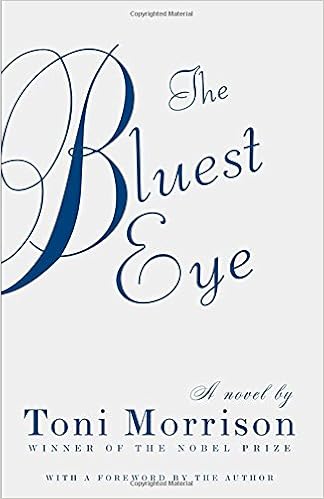
The Bluest Eye by Toni Morrison

I thought about the baby that everybody wanted dead, and saw it very clearly.  It was in a dark, wet place, its head covered with great O's of wool, the black face holding, like nickels, two clean black eyes, the flared nose, kissing-thick lips, and the living, breathing silk of black skin.  No synthetic yellow bangs suspended over marble-blue eyes, no pinched nose and bowline mouth.  More strongly than my fondness for Pecola, I felt a need for someone to want the black baby to live--just to counteract the universal love of white baby dolls, Shirley Temples, and Maureen Peals.

The first time I read The Bluest Eye, I found it to be pretty scattered, if I recall correctly.  It dwells in digressions, piles symbols upon symbols, often in a way that I found distracted from the central images of white baby dolls and blue eyes that give the novel its title.  Among other things, Morrison commits a cardinal literary sin by writing an important character--the mystic fraudster Soaphead Church, who "grants" Pecola her blue eyes--into the very end of the book, where he works the action necessary for the climax.

But Soaphead is such a fascinating character, I quickly brushed that sin aside.  Reading it a second time, those flaws, if that's what they are, failed to appear.  Because I knew the climax and Soaphead were coming, it freed me up to ignore the narrative movement of the book and really appreciate how painstakingly crafted each disparate part of the book is: Soaphead, the interludes that track the life of Pecola's mother and father, all of it.  Each of these stories is so perfectly wrought and self-contained they could exist outside of the novel without losing anything, though they also provide its halting, irregular character.  Morrison risks distracting from the intense, immense tragedy that is the story of Pecola, a young girl haunted in ways she cannot understand by the idea of physical beauty in America, but she does so out of a deep need to give each character their due.  That goes double for the worst ones, like Cholly, Pecola's father, who rapes and impregnates her in a fit of trauma-induced delusion.

Reading it a second time also allowed me to focus on just how tragic Pecola's story is.  She's an easier character to pity than to love, but perhaps that is in keeping with the tragedy: Pecola, unable to love herself, rebuffs the reader's ability to love her as well.  To a child like this, who obsesses with Mary Jane candy because of the Shirley Temple-esque white character on the wrapper, who sees the way her own mother prefers the little white girl whose house she keeps, we might say: you're beautiful the way you are!  But Pecola is not really beautiful, because the social environment represses her so heavily that anything beautiful in her has no chance to grow.  Her obsession with whiteness and with blue eyes becomes so all-consuming that it seems to carve her out from the inside.  This sad narrative gets its fullest expression in the baby that is stillborn, that "everybody wanted dead," because its mere existence would be an embodiment of the social ugliness that engendered it.  Pecola is, in a sense, as stillborn as her baby.

One thing that The Bluest Eye shows perfectly is just how difficult it is to navigate the pressures of beauty because they exist apart from the discrete actions of people.  Morrison is her own best reader and explicator, and she writes in the introduction about a friend who shared Pecola's desire for blue eyes: "Who told her?  Who made her feel that it was better to be a freak than what she was?  Who had looked at her and found her so wanting, so small a weight on the beauty scale?"  Those are good questions without good answers, which The Bluest Eye is smart enough not to offer.

Sunday, October 29, 2017

Coming to my Senses by Alice Waters

 I was very skinny and didn't like to eat much. The sandwiches my mother made me, things like peanut butter and bananas on whole wheat bread, were always dry, so sometimes I traded for my friends' cheese and bologna sandwiches on white bread. 
I really, really wanted to like this book. Coming to my Senses ends on opening night at Chez Panisse, Waters' world-famous restaurant, and it traces her path to that fateful evening starting with her childhood in New Jersey and Michigan. It follows her to L.A., Santa Barabara, Berkeley, and Paris, and gives a glimpse of activist life in the Bay Area in the late sixties. I love food, especially Berkeley food and French food; I find Alice Waters fascinating (if a little self-absorbed), and I was really hoping for a treatise on the slow food movement, or at least some good food writing. Neither came through.

The biggest issue was the writing. Even though I had high hopes, I found myself continually distracted by her awkward, almost childlike syntax, and long, italicized digressions. The quote above was the most interesting one I could find, and I only picked it because the thought of a young Alice Waters eating a bologna sandwich is entertaining. She seems to have used two ghostwriters (they are effusively thanked in the acknowledgments), but I am at a loss as to what they or her editors did to tame her stream of consciousness. Much of the book reads like what my high schoolers produce in their early college essay drafts: choppy statements of fact describing things that happened to them and awkward, superficial reflections on those events. Even though Waters provides anecdotes from decades of her life, she comes off as flat and uninteresting because the writing is so stiff.

I've always struggled with Waters' philosophy on food: that we all should be eating slow, local food; that all it takes is a taste of a "perfect peach" to win someone over to growing their own produce in their backyard. Everything else I'd read of hers wildly oversimplified the underlying issues of poverty and access that affect our national food culture, and I was hoping that this memoir, since its format would allow for more thoughtful reflection, might delve into her philosophy in a more nuanced way. It did not, and I remain frustrated.

Overall, this is not a good use of anyone's time. Fans of food or Chez Panisse will not find much to like, and even ardent Waters fans won't get much more than a few poorly told stories.

Moonglow by Michael Chabon

On balance, most of the time, in the ordinary course of life, it was probably best to say what was in your heart, to share what was on your mind, to tell the people you loved that you loved them, to ask those you had harmed to forgive you and to confront those who had hurt you with the truth about the damage they had done. When it came to things that needed to be said, speech was always preferable to silence, but it was of no use at all in the presence of the unspeakable. 
Michael Chabon spent the last week of his grandfather's life sitting with him and listening to him tell, for the first time, his entire life story. Moonglow is the novelization of that life, but it retains the frame of the deathbed confession. Chabon brings his flair for storytelling but grounds the book in his grandfather's real life and experiences (the first line is: "This is how I heard the story"). We follow Chabon's grandfather through decades of marriage, multiple careers (many of which fail impressively), WWII occupied France, and a crusade to capture the alligator terrorizing the cats in his retirement community.

This felt much like all of Chabon's other novels: it's funny and sarcastic, filled with creative characters who all seem like they're just about to catch their break (but rarely do), and just enough of the touch of the absurd to make you raise an eyebrow. Moonglow has the added layer of strange intimacy that comes with chronicling the life of a loved one who you are getting to know along with your reader. Chabon refers to his grandfather only as "my grandfather," a phrasing that can feel awkward, especially in the chapters that deal with his earlier life, but it also adds to that same sense of intimacy and makes the whole novel feel like you're listening to Chabon speak it aloud.

The most haunting presence in the book is Chabon's grandmother, a French Jewish refugee who arrived in America at the tail end of the war with a daughter in tow. Her troubled but loving marriage to Chabon's grandfather and her slow unraveling are eerily portrayed, and the truth about her identity is artfully unveiled throughout the book.

Chabon does tiny details well, and he uses them throughout to give emotional depth to a man who has come off (at least to his grandchild) as stoic and silent for most of his life. My favorite comes from a model of a moon station he has built from discarded plastic bits and assorted model railroad sets--late in life Chabon's grandfather designed and built scaled models for NASA. A spray-painted coffee lid's hatch lifts to reveal a tiny family hidden below: figures representing Chabon's grandfather, grandmother, and mother. Even long after the death of his wife, he quietly and discreetly weaves her into the fabric of his life.

I often enjoy Chabon's work because it takes place in places I know and love (I especially loved Telegraph Avenue for its portrayal of the massive range of humanity living along a few miles stretched between Berkeley and Oakland). Place played a much smaller role in this novel, but the characters shined through and were more likable than I'm used to from him.

Count Magnus and Other Stories by M. R. James

So he put his hand into the well-known nook under the pillow: only, it did not get so far.  What he touched was, according to his account, a mouth, with teeth, and with hair about it, and he declares, not the mouth of a human being.

M. R. James was a well-regarded Classical scholar who also happened to dabble in ghost stories. His stories are often described as "antiquarian," and they read exactly like the kind of story you might expect a Classical scholar to write.  The ghosts, ghouls, and monsters are often relics of a past age, accessed through a spooky artifact like an illuminated manuscript.  In one of the best stories, "The Mezzotint," the supernatural object is actually just a lithograph print depicting a country house, but the collector who acquires it notices that every time he looks at it a frightening shrouded figure has moved to a new spot in the picture, until he's made his way into the house and carried out an unsuspecting little boy.  They also take place against the backdrop of the stuffy world of Oxbridge; another story, "Casting the Runes," is all about a devious alchemist who uses his black magic to seek revenge on the scholar who refused to publish his monograph.  In another standout, "A School Story," a murdered man communicates with his murderer through his students' Latin exercises.

The best thing, I think, about James' stories, is how frightening and particular the various monsters are.  There's the mouth under the pillow above, but I also liked the monster from "Canon Alberic's Scrap Book," which has "[p]ale, dusky skin, covering nothing but bones and tendons of appalling strength; coarse black hairs, longer than ever grew on a human hand; nails rising from the ends of the fingers and curving sharply down and forward, grey, horny and wrinkled."  These disheveled ghouls are a perfect contrast to the gentility and decorum of James' professors and barristers and classicists.

My favorites are: "Number 13," in which the title hotel room appears at night and disappears during the day, housing a man who once made a deal with the devil to escape the hangman's noose, and the title story, "Count Magnus," about a medieval count who continues to hang out with demons long after his death.  Count Magnus is hardly ever seen, but the story is a masterwork of suspense.  Like most of the stories here, it's reported through several layers of hearsay, but that fails to dilute this image: "Also Anders Bjornsen was there, but he was dead.  And I tell you this about Anders Bjornsen, that he was once a beautiful man, but now his face was not there, because the flesh of it was sucked away from his bones."  Nice.  Happy Halloween, everyone!

Saturday, October 28, 2017

Demian by Herman Hesse

Novelists when they write novels tend to take an almost godlike attitude toward their subject, pretending to a total comprehension of the story, a man's life, which they can therefore recount as God Himself might, nothing standing between them and the naked truth, the entire story meaningful in every detail.  I am as little able to do this as the novelist is, even though my story is more important to me than any novelist's is to him--for this is my story; it is the story of a man, not of an invented, or possible, or idealized, or otherwise absent figure, but of a unique being of flesh and blood.

Brent hates this book so much I just had to read it for myself.  Is it really that bad, or does Brent just have really bad taste?  The answer, as I expected, was a little bit of both.

We agree that Hesse's Demian starts out well: the narrator, Emil Sinclair, recounts a particular story of his childhood.  He makes up a story about stealing apples from an orchard to impress a local bully, Franz Kromer, which Kromer--clearly seeing through the lie--uses to blackmail Sinclair for months on end, pressing him into a kind of servanthood.  It's a great story, written in clever detail, and amplified with the ironic touch of a child's perspective and lack of understanding.  It's all the more interesting because of the inward agony it causes Sinclair, whose Manichaean view of the world is challenged by Kromer's cruelty.  If the world is divided into the good and the bad, has Sinclair's fib aligned him with the bad; with Cain instead of Abel?

But like Brent says, the beginning of the book is the high point.  Sinclair's agony is put to rest by his classmate Max Demian, who not only wards off Kromer but forces Sinclair to see the story of Cain and Abel--which operates as the principal symbol of the novel--in a different way:

"It's quite simple!  The first element of the story, its actual beginning, was the mark.  Here was a man with something in his face that frightened the others.  They didn't dare lay hands on him; he impressed them, he and his children.  We can guess--no, we can be quite certain--that it was not a mark on his forehead like a postmark--life is hardly ever as clear and straightforward as that.  It is much more likely that he struck people as faintly sinister, perhaps a little more intellect and boldness in his look than people were used to.  This man was powerful: you would only approach him with awe.  He had a 'sign.  You could explain this in any way you wished.  And people always want what is agreeable to them and puts them in the right.  They were afraid of Cain's children: they bore a 'sign.'  So they did not interpret the sign for what it was--a mark of distinction--but its opposite.  They said: 'Those fellows with the sign, they're a strange lot'--and indeed they were.  People with courage and character always seem sinister to the rest.  It was a scandal that a breed of fearless and sinister people ran about freely, so they attached a nickname and myth to these people to get even with them, to make up for the many times they had felt afraid--do you get it?

Cain, in this version, represents not the "dark side," but a rebuke to the Manichaean worldview that separates dark from light, bad from good, and right from wrong.  Demian becomes the story of Sinclair's long, slow education in this worldview, the development of his own "mark of Cain."  The God of the Bible is replaced by Abraxas, a pagan deity who represents a mixture of both God and Satan in one.  In literal terms, this manifests itself in Sinclair's slow disillusion in the structures of pre-war European society and his drift back toward the figures of Demian and his alluring, androgynous mother.  Gender becomes another binary to be deconstructed (which is, admittedly, anticipates a lot of our modern conversations) and Sinclair falls in love with Demian's mother precisely because she looks like Demian with a little bit of the feminine principle superadded.  These two run a cult in the mountains which Sinclair joins with great enthusiasm.

There's a lot of interesting ideas there--okay, one interesting idea--but the story itself becomes dull after Kromer is dispatched.  The conflict is no longer with petty bullies but with the antimetaphysical bourgeois worldview, which isn't exactly a gripping adventure.  I think Demian might be more compelling if it didn't point toward an ultimate conclusion that seems retrograde for us who are able to look back on the bloody twentieth century: Demian's mother insists that the upcoming war--World War I--will offer an opportunity for man to grow and change in the crucible of violence, and for individuals to transform themselves in to enlightened Demianesque supermen.  That kind of searching for meaning in violence may have been possible before, and even after, World War I, but not after World War II and the Holocaust.

Sunday, October 15, 2017

Sanctuary by William Faulkner

The worst one of all said boys thought all girls were ugly except when they were dressed.  She said the Snake had been seeing Eve for several days and never noticed until Adam made her put on a fig leaf.  How do you know? they said, and she said because the Snake was there before Adam, because he was the first one thrown out of heaven; he was there all the time.  But that wasn't what they meant and they said, How do you know, and Temple thought of her kind of backed up against the dressing table and the rest of them in a circle around her with their combed hair and their shoulders smelling of scented soap and the light powder in the air and their eyes like knives until you could almost watch her flesh where the eyes were touching it, and her eyes in her ugly face courageous and frightened and daring, and they all saying, How do you know? until she told them and held up her hand and swore that she had.

Sanctuary is Faulkner's "potboiler," a novel that takes his familiar themes and characters and weird, poor Mississippi setting and uses them to frame a salacious and prurient story.  There's an element of pulpiness in it--check out the trashy cover in the image above--but Faulkner is too idiosyncratic and elliptical for Sanctuary to really be shocking or titillating.

The first of the novel's two main characters is Temple Drake, a Mississippi undergrad who gets mixed up with a jerkoff alcoholic frat boy who takes her against her will to a bootlegger's house where he abandons her.  There she's raped by a petty criminal named Popeye, who whisks her away to a brothel in Memphis where he stashes her away.  The second is Horace Benbow, a conflicted lawyer who has just left his wife (because of his sexual feelings for his stepdaughter--nice one, Faulkner) and who takes up the defense of the bootlegger who has been charged with a murder that Popeye committed.

Horace and Temple's stories only intersect briefly.  Horace's sympathies are oriented toward Ruby, the wife of the bootlegger Lee, and her infant child; in fact, the townspeople begin to assume that he and Ruby are carrying on an affair, explaining his pro-bono work on Lee's case.  Faulkner wants us to see that Temple is pretty much forgotten; the case hinges on a murder that has nothing to do with Temple, and though Horace tracks her down to find out what happened, his priorities are elsewhere.

Temple's character is frustrating.  We're asked to accept that her feelings toward Popeye are conflicted, and that she's not exactly his prisoner, but neither is she exactly free to leave.  A kind of Stockholm syndrome makes sense, but Faulkner wants us to believe that the rape takes away Temple's agency to a degree that makes her passiveness in the face of her imprisonment sensible.  There are hints of a retrograde notion of female hysteria.  I think we're supposed to read Temple as a cautionary tale about the teenage desire to be inducted into the world of adult sexuality, the darker side of which she and her fellow coeds are unprepared for.  But there's something about the way that's coded according to gender that makes Sanctuary seem like it's trafficking in cheap literary archetypes.

Mostly, Faulkner's elliptical style makes it difficult to really figure out what's going on.  We learn that Popeye hasn't been having sex with Temple himself; instead, he's recruited a gangster named Red to do it while he watches.  Temple has fallen for Red, in a way, making Popeye jealous, but Faulkner neglects to include any of this in the narrative.  By the time we learn about Red's existence, Popeye's already shot him, and we're expected to fill in the blanks.  Faulkner keeps the most salacious part of the ordeal close to the chest, choosing to reveal it only in the final courtroom scene: Popeye is impotent, and the initial rape is performed with a corncob.  Okay.  Honestly, the "shocking reveal" is what makes Sanctuary seem more like a pulp novel than anything else.

Still, Sanctuary has all the elements that make Faulkner worth reading: the currents of sex and death, the lack of sentimentality, the tension between the impoverished setting and the flights of decorated prose, the black humor.  The savageness of Faulkner's novels makes us underestimate how funny they can be, I think.  But it's hard not to feel that Faulkner's slumming it a little, searching for a bestseller that his style won't let him fully commit to.

Saturday, October 14, 2017

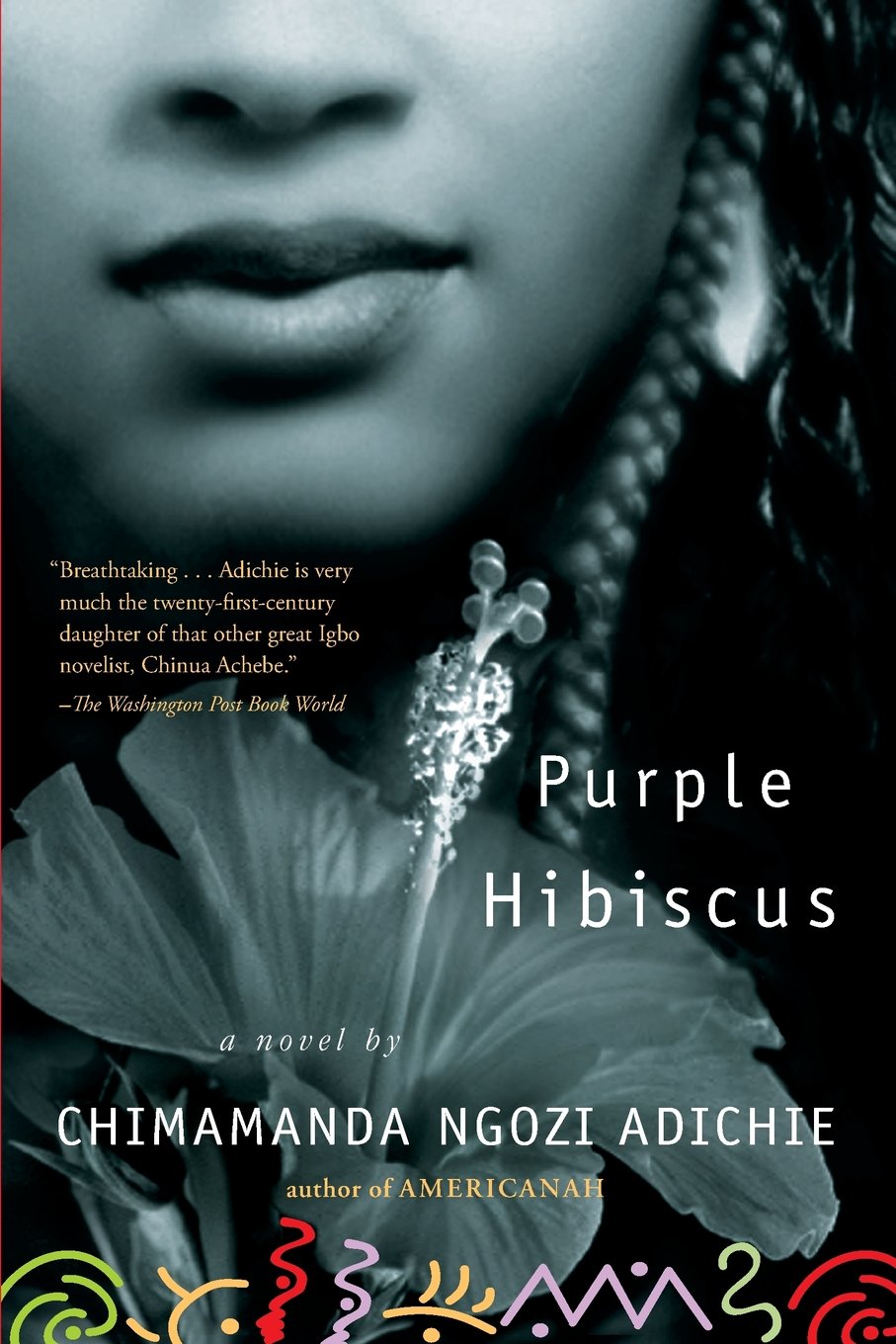
Purple Hibiscus by Chimamanda Ngozi Adichie

Nsukka started it all; Aunty Ifeoma's little garden next to the verandah of her flat in Nsukka began to lift the silence.  Jaja's defiance seemed to me now like Aunty Ifeoma's purple hibisucs: rare, fragrant with the undertones of freedom, a different kind of freedom from the one the crowds waving green leaves chanted at Government Square after the coup.  A freedom to be, to do.

Kambili is the daughter of an eminent businessman in Enugu, Nigeria.  Her father is a rich man and a brave man, who keeps supporting the local newspaper even when its criticisms of the recent military coup have become dangerous.  He is a pious man, as well-respected in his Catholic church as the priests themselves.  He also punishes his children for their perceived sins by breaking their fingers and pouring boiling water over their feet.  In a particularly theme-heavy scene, Kambili's mother gives her a little bit of food to help her stomach absorb the pills she needs to help with her menstrual cramps, but because she is supposed to be fasting before mass, her father punishes her.

Kambili and her brother Jaja are offered a vision of a different kind of life when they visit their aunt, their father's sister, Ifeoma, in the university town of Nsukka.  Ifeoma is poor but her children have a "freedom to be, to do" that Kambili had not known was possible, and sets her on the path of realizing how restrictive her father's regime has been.  In Nsukka, she can see her grandfather, from whom her father has barred her because of his traditional religion.  I really liked this observation by her grandfather about the effect of Christianity in Nigeria, which seemed to me the closest the novel ever gets to the style, namechecked on the jacket, of Adichie's fellow Igbo writer Chinua Achebe:

One day I said to them, Where is this god you worship?  They said he was like Chukwu, that he was in the sky.  I asked then, Who is the person that was killed, the person that hangs on the wood outside the mission?  They said he was the son, but that the son and the father are equal.  It was then that I knew that the white man was mad.  The father and the son are equal?  Tufia!  Do you not see?  That is why Eugene can disregard me, because he thinks we are equal.

Adichie sets the novel at a time of great social and political upheaval in Nigeria.  The student riots threaten Ifeoma's job; the fear of retaliation complicates the violent reaction of Kambili's father, who clings to a sense of supernatural order in the midst of great stress.  Adichie's depiction of Eugene is particularly sharp, as careful to show his generosity and fine principles, which grow from his piety as his abuse does.  But the story is Kambili's, who awakes into not just a realization about her family but about her home in Nigeria as well.

The symbol of the hibiscus--which grows purple only in Ifeoma's garden--is dull and heavy-handed.  I found the plain prose of the novel to be artless sometimes, but I could say the same thing about Achebe.  But I really enjoyed the complexity of the characters and the escalating tension of the novel, which I didn't expect.  Most of all I enjoyed reading a complex portrait of a place that it would be easy to spend most of my life ignoring.