I like Brittany's stats, so I'm doing the same here:
Twenty-seven books; five re-reads; six non-fiction, fourteen fiction, four lit-reviews, two art, one philosophy.
Also, oddly a big year for me and Pulitzers (four).
And, in my amorphous "law" category (i.e., the books I read, regardless of genre, that I read because it has some conceivable relationship to the law): seven books.
I'm going with the top 20% again, so here are my top five for the year:
Honorable mention: Devil in the Grove: Thurgood Marshall, the Groveland Boys, and the Dawn of a New America: I felt I couldn't do my end-year review without mentioning this book because it was one of the best non-fiction I read...other than The New Jim Crow. Still, this book is one I'd say anyone should read because of how it shows the relationship between the death penalty and race.
(5) The New Jim Crow: Mass Incarceration in the Age of Colorblindness by Michelle Alexander: the best contemporary book about criminal justice I've ever read. Alexander describes the racial overtones of our criminal justice system. As the year unfolded, Alexander's book proved to be more and more relevant. Of course, the media and pop-culture reactions to Brown and Garner only superficially reflected the complexity of the issues involved. I think Alexander's book will continue to be relevant over the coming years as we, hopefully, decide to confront what needs to be fixed.
(4) On Revolution by Hannah Arendt: As always, Arendt blows my mind with her insight. It's only a matter of time before I decide lawyering isn't for me and that I need to hole away in a basement to become an unrecognized Arendt scholar. Watch out, world.
(3) The Goldfinch by Donna Tartt: A Pulitzer prize much deserved. I am still wavering on whether this was a "great" novel v. a merely really, really good book. I realize the distinction shouldn't matter, but I've got this ongoing debate permeating one of my friendships, so it's on the mind. Nonetheless, a great novel, editors of The Paris Review notwithstanding.
(2) Building Stories by Chris Ware: If I was only ranking new books, this would easily be the best book I read this year. In fact, it might be the best (new-to-me) novel I've read over the last couple of years. I can't recommend this novel enough to anyone. This will certainly be a novel I re-visit in the future. I'll add, too, that this novel helps to justify my subscription to The Paris Review--if every year The Paris Review introduces me to a novel I love this much, I'll be extremely happy.
(1) To Kill a Mockingbird by Harper Lee: it's not an accident that this novel is a classic. It deserves all the accolades it receives. Nothing else to say about it, I guess.
Some things to look forward to in 2015. Allegedly, we'll be getting a new J.D. Salinger novel. We're also going to get new novels from Ishiguro and Danielewski. The Danielewski, in particular, I've been looking forward to for a while (I want to say years, but I can't remember when he first announced this project). It's supposed to be the first volume of a 27 volume series. Given that, according to Amazon, it's clocking in at 880 pages, I hope that all 27 volumes are in there. I suppose we'll have to wait and see. Here's looking at you, 2015.

Sunday, January 4, 2015

Saturday, January 3, 2015
Building Stories by Chris Ware

As I mentioned in my Paris Review Review, the interview with Chris Ware made an impression on me. Enough so that I went and got Building Stories. It is as good as I hoped it would be; I can't recommend this more.
The novel is composed of 14 pieces of varying size and material. Here's a photo culled from the internets:

This photo is reflects one of my first observations, the title represents what Ware is doing on multiple levels. He is building stories, both by writing them and by assembling the materials the compose the novel itself. This works another way: the arrangement of the images within the comics is itself something built by Ware. (Of course, the stories center on a physical building, so the title works literally too.)
The 14 pieces can be read in any order, which gives the novel a non-linear feel (although, one could read them in linear order by accident or intention--I preferred reading the comics randomly). I suspect Ware wanted the non-linear feel because it fits what plot-goal of the novel, which is to reflect normal, every day life in a literary way. There are a couple of panels that show this (I laughed at this self-awareness, and so felt a need to share them specifically):


The book captures this character at various times of her life, but as we follow her in the moment she is both recollection of past, coping with the present, and hopeful for the future. Because, the reader is/is not aware of her future/past these her thoughts (and the reader's perception of those thoughts) have different meanings depending on how much of the rest of the novel the reader has read. In some future, I expect to re-read the novel and imagine starting and ending with different comics and how much that would change how the novel feels.
Nonetheless, the lack of linearity contributes to the book's goal: to reflect ordinary life. At any given moment, one's life is an amalgamation of memories and hopes. We view those memories differently depending on where we currently are. And, our hopes have a different meaning during different parts of our life. Building Stories captures this.

I suspect part of it is being a graphic novel. By showing the characters' actions while also giving us their thoughts, Ware is able to give us the characters without using trite language. In this regard, the novel's medium (i.e., the fact that it's a graphic novel) matters. This is neither a movie nor a (just-text) novel. So, it is flexible in a way that other media are not. (Namely, I suspect a movie or a just-text-novel with the same content would very seriously risk being melodramatic).
I'm about to write my top 20% for the year (again, I didn't read enough novels to do a Top Ten), and I still haven't decided if this is going to top my list this year--it's competing against To Kill a Mockingbird. I mention this because, I think the fact I'm having trouble deciding which of the two is the best for this year says a great deal about how good this novel is.
Highly recommended.
The Blind Assassin by Margaret Atwood
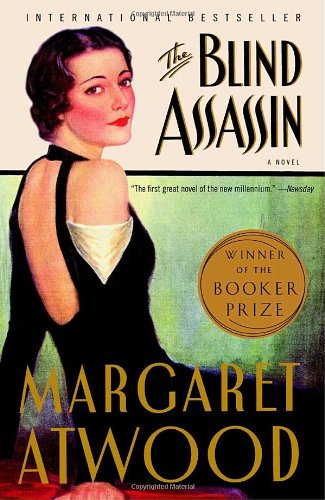
Most of us will. We'll choose knowledge no matter what, we'll maim ourselves in the process, we'll stick our hands into the flames for it if necessary. Curiosity is not our only motive: love or grief or despair or hatred is what drives us on. We'll spy relentlessly on the dead: we'll open their letters, we'll read their journals, we'll go through their trash, hoping for a hint, a final word, an explanation, from those who have deserted us -- who've left us holding the bag, which if often a good deal emptier than we'd supposed.
The Blind Assassin has at least five distinct threads: (1) The present-tense, first-person narrative of Iris Chase Griffen, a widow near the end of her life, (2) Iris' past-tense recollections of her early life as the daughter of a wealthy Canadian industrialist, and later as the reluctant wife of Richard Griffen, who temporarily saves her family's button business in exchange for the marriage, (3) a series of dialogues between two unnamed lovers, meeting in secret, (4) a science fiction story called "The Blind Assassin," being composed extemporaneously by the male lover, and (5) a series of newspaper clippings, most of which deal with Iris' sister's Laura's suicide, and the success of her posthumously published novel--The Blind Assassin.
Iris' story is that of a woman caught up in the machinations of cruel and powerful men, isolated by the resentment of her sister and the demands of her husband. At times, Richard and his malicious sinister Winifred are cartoonishly evil, going so far as to institutionalize Laura and, later, separate Iris from her daughter and granddaughter. But the greater moral ambiguity is Iris', reflecting at the end of her life on the fine line between helplessness and complicity:
I thought I could cope with Richard, with Winifred. I could live like a mouse in the castle of the tigers, by creeping around out of sight inside the walls; by staying quiet, by keeping my head down. No: I give myself too much credit. I didn't see the danger. I didn't even know they were tigers. Worse: I didn't know I might become a tiger myself. I didn't know Laura might become one, given the proper circumstances. Anyone might, for that matter.
Atwood controls the narrative with a hand just subtle enough to keep the reader in doubt as to which of the two sisters, Iris or Laura, is the unnamed lover who is the audience for, and sometimes participant in, "The Blind Assassin." Either way, the story is devised mostly by the male, Alex, and the novel attributed to Laura after her suicide is a kind of monument to a love that could never be public or permanent. In it, the titular assassin falls in love with a girl marked for sacrifice, and whose vocal cords have been cut. Of course, these characters are stand-ins for the lovers, themselves maimed, voiceless, and uncertain.
I found myself wanting more of this "novel within a novel," and less of the primary narrative, which struck me as overlong and over-detailed. Atwood invests a lot in her fictional town, Port Ticonderoga*, but the insistent realism she wants it to have was, for me, far less compelling than the fantasy world, Sakiel-Norn. I've only read a handful of Atwood's books, but they seem best when she really allows her imagination to run freely. The narrative of the assassin's escape with the voiceless girl is never really resolved, and though I know that we're meant to understand that either Iris or Laura completes it--the act of writing, as always, is a marker of agency--it left me dissatisfied. Though I enjoyed it, a lot of the novel's energy and attention seemed to me to be misplaced.
*Am I the only one that found the similarity to "Fort Ticonderoga" really distracting?
Friday, January 2, 2015
Brittany's Top Books of 2014
Compared to last year (when I was blogging by my lonesome at My Year In Books), I read....1 more book! However, the books I read this year were much less serious due to the fact that I'm done with grad school and not teaching any new classes that require me to brush up on my reading. 2014 was a binge on the candy cornucopia of Young Adult Lit.
By The Numbers
37 complete books read (12 young adult, 7 non-fiction, 5 "classics," 3 plays [in one book], 2 graphic novels, 1 classic poem, 1 choreopoem)
30 authors (repeats included: Veronica Roth, Marissa Meyer, Ransom Riggs, Gillian Flynn)
11 female authors, 19 male authors
26 living authors, 4 dead authors
7 nationalities (American, French, Canadian, Egyptian, British, Nigerian, Russian)
1 book was read because I had a super major crush on a man and he said he loved it (just like last year)
My Top Books
1. Americanah by Chimamanda Ngozi Adichie: If a person is looking to read a book about race, right now this is my number one recommendation. The perspective of African immigrants in America and Britain is one that is incredibly interesting. When people say things that make it obvious they don't understand race and racism, I find myself using examples from this book to try to make the world make sense to them. (Like when a family member mentioned how people would be so offended if there were a White magazine, but Jet magazine is okay - I pulled an anecdote from the novel of this EXACT argument between a black woman and her white boyfriend. The woman takes her boyfriend to a grocery store and shows him how none of the magazines have black women on the cover [fun fact: British Vogue is doing a solo black cover model for the first time in 12 years], very few black women as models, and how the hair, makeup, and fashion tips are completely irrelevant for many black women (this web magazine article about how 'nude' heels will make legs appear longer features 4 white women and 16 pairs of shoes that would only match the skin tone of white women - I have seen this fashion tip in various magazines and they never feature shoes for non-beige women to match their skin tone to).
2. Suite Francaise by Irene Nemirovsky: The writing of this book is so beautiful and the scope of the novel is so ambitious. It was an absolute pleasure read, but one that was deeply satisfying the way that 'great' novels satisfy. For anyone interesting in France, World War II, or romance, this novel is lovely. The only reason to not read this text is because of the unfinished nature of it.
3. The Storyteller by Jodi Picoult: Absolute pleasure read. I have no idea who I would recommend this book to - it's a mystery, history, romance, fantasy novel that covers generations of stories interwoven. I vividly remember reading the last chapter by headlamp while camping. I finished and tears were streaming down my face. (My top 3 are all these long ambitious interconnected stories. I wish that were its own section in the bookstore as I would immediately go there every time).
4. The Martian by Andy Weir: I know I'm a little late to this game, but this was the most satisfying sci-fi book I have read in years. I didn't have a chance to review this, but if you are at all into sci-fi you must read this book. The novel opens with a man who was thought-to-be-dead and left behind on America's third manned mission to Mars. The first couple of chapters are his typed logs as he tries to survive alone on Mars. It then switches to the perspective of the people on Earth who think they have just lost one of the men on the mission. By the end of the book I was incredibly taken with the main character and regularly laughing out loud.
He is ridiculous when his life is in danger: “The screen went black before I was out of the airlock. Turns out the “L” in “LCD” stands for “Liquid.” I guess it either froze or boiled off. Maybe I’ll post a consumer review. “Brought product to surface of Mars. It stopped working. 0/10.”
He also puts science jargon into words anyone can understand: "Problem is (follow me closely here, the science is pretty complicated), if I cut a hole in the Hab, the air won't stay inside anymore.”
5. Dark Places by Gillian Flynn: Flynn is the only author to appear on both last year's list and this year's list. Her more well-known novel is Gone Girl, but I actually liked this book better. Her choices in using point of view and time are really interesting and effective. I love how Flynn builds suspense and creates characters who are absolutely unlikeable and yet...I still care what happens to them. The shifting perspectives of Libby Day in the present trying to find the truth while the audience is also in the past getting closer to finding the truth was really really compelling. I can't wait to see what Flynn does next.
6. Into Thin Air by Jon Krakauer: My climbing partner is incredibly into Mt. Everest, so this book has been on my radar for a long time. This book details the events of the 1997 Everest disaster where 8 people died which was - I believe - the most deadly day on Everest until the 2014 avalanche that killed 16 sherpa guides. Although I'm not an Everest fiend, I am a climber, so my interest is definitely due to the fact that I have wondered if I would ever get into ice climbing (answer: no. I was recently out in 40* weather and my Las-Vegas-born body refused to function well enough to climb). My hands were sweating and my heart was pounding through almost the entire book - but I don't know that I would recommend it for anyone who isn't into climbing. I am definitely not going to climb Mt. Everest (not because the accidents in the book scared me, but because altitude sickness just sounds terrible. Also, the cold).
7. Handmaid's Tale by Margaret Atwood: Everyone who is interested in women's issues should read this novel at some point in their reading life. I put this on my list of Outside Reading options for my English 101 class because my students are very interested in feminism, sex work, and sex education, and every student who picked it flew through it and enjoyed it. (Fun fact: sex ed is now the second topic that is banned from my class. This has been a hot topic in my district this year, and out of 30 students, I had 3 who were focused on sex ed for the whole first semester over multiple assignments (synthesis paper, research paper, argument paper, and speech), so it is now banned. The Handmaid's Tale was a perfect present for them before I banned the topic.)
8. Three Plays by Rajiv Joseph: I still love Rajiv Joseph and am very happy that he's still writing (The North Pool, The Monster at the Door, The Lake Effect all came after his first three plays. In 2015 he's debuting two new plays, Mr. Wolf and Guards at the Taj.) I will read and see everything he does.
Honorable Mention: Divergent series and Cinder series: 7 of the 12 young adult novels I read this year were from these two series, and especially in comparison to the other YA, these were stand out awesomes. Both have female protagonists in interesting situations, and both are a sharp turn away from what has been the trend in romantically focused plots in YA. I don't feel like they can quite get onto my top list because they're candy books, but I do want to put them out into the universe as solid reads.
By The Numbers
37 complete books read (12 young adult, 7 non-fiction, 5 "classics," 3 plays [in one book], 2 graphic novels, 1 classic poem, 1 choreopoem)
30 authors (repeats included: Veronica Roth, Marissa Meyer, Ransom Riggs, Gillian Flynn)
11 female authors, 19 male authors
26 living authors, 4 dead authors
7 nationalities (American, French, Canadian, Egyptian, British, Nigerian, Russian)
1 book was read because I had a super major crush on a man and he said he loved it (just like last year)
My Top Books
1. Americanah by Chimamanda Ngozi Adichie: If a person is looking to read a book about race, right now this is my number one recommendation. The perspective of African immigrants in America and Britain is one that is incredibly interesting. When people say things that make it obvious they don't understand race and racism, I find myself using examples from this book to try to make the world make sense to them. (Like when a family member mentioned how people would be so offended if there were a White magazine, but Jet magazine is okay - I pulled an anecdote from the novel of this EXACT argument between a black woman and her white boyfriend. The woman takes her boyfriend to a grocery store and shows him how none of the magazines have black women on the cover [fun fact: British Vogue is doing a solo black cover model for the first time in 12 years], very few black women as models, and how the hair, makeup, and fashion tips are completely irrelevant for many black women (this web magazine article about how 'nude' heels will make legs appear longer features 4 white women and 16 pairs of shoes that would only match the skin tone of white women - I have seen this fashion tip in various magazines and they never feature shoes for non-beige women to match their skin tone to).
2. Suite Francaise by Irene Nemirovsky: The writing of this book is so beautiful and the scope of the novel is so ambitious. It was an absolute pleasure read, but one that was deeply satisfying the way that 'great' novels satisfy. For anyone interesting in France, World War II, or romance, this novel is lovely. The only reason to not read this text is because of the unfinished nature of it.
3. The Storyteller by Jodi Picoult: Absolute pleasure read. I have no idea who I would recommend this book to - it's a mystery, history, romance, fantasy novel that covers generations of stories interwoven. I vividly remember reading the last chapter by headlamp while camping. I finished and tears were streaming down my face. (My top 3 are all these long ambitious interconnected stories. I wish that were its own section in the bookstore as I would immediately go there every time).
4. The Martian by Andy Weir: I know I'm a little late to this game, but this was the most satisfying sci-fi book I have read in years. I didn't have a chance to review this, but if you are at all into sci-fi you must read this book. The novel opens with a man who was thought-to-be-dead and left behind on America's third manned mission to Mars. The first couple of chapters are his typed logs as he tries to survive alone on Mars. It then switches to the perspective of the people on Earth who think they have just lost one of the men on the mission. By the end of the book I was incredibly taken with the main character and regularly laughing out loud.
He is ridiculous when his life is in danger: “The screen went black before I was out of the airlock. Turns out the “L” in “LCD” stands for “Liquid.” I guess it either froze or boiled off. Maybe I’ll post a consumer review. “Brought product to surface of Mars. It stopped working. 0/10.”
He also puts science jargon into words anyone can understand: "Problem is (follow me closely here, the science is pretty complicated), if I cut a hole in the Hab, the air won't stay inside anymore.”
5. Dark Places by Gillian Flynn: Flynn is the only author to appear on both last year's list and this year's list. Her more well-known novel is Gone Girl, but I actually liked this book better. Her choices in using point of view and time are really interesting and effective. I love how Flynn builds suspense and creates characters who are absolutely unlikeable and yet...I still care what happens to them. The shifting perspectives of Libby Day in the present trying to find the truth while the audience is also in the past getting closer to finding the truth was really really compelling. I can't wait to see what Flynn does next.
6. Into Thin Air by Jon Krakauer: My climbing partner is incredibly into Mt. Everest, so this book has been on my radar for a long time. This book details the events of the 1997 Everest disaster where 8 people died which was - I believe - the most deadly day on Everest until the 2014 avalanche that killed 16 sherpa guides. Although I'm not an Everest fiend, I am a climber, so my interest is definitely due to the fact that I have wondered if I would ever get into ice climbing (answer: no. I was recently out in 40* weather and my Las-Vegas-born body refused to function well enough to climb). My hands were sweating and my heart was pounding through almost the entire book - but I don't know that I would recommend it for anyone who isn't into climbing. I am definitely not going to climb Mt. Everest (not because the accidents in the book scared me, but because altitude sickness just sounds terrible. Also, the cold).
7. Handmaid's Tale by Margaret Atwood: Everyone who is interested in women's issues should read this novel at some point in their reading life. I put this on my list of Outside Reading options for my English 101 class because my students are very interested in feminism, sex work, and sex education, and every student who picked it flew through it and enjoyed it. (Fun fact: sex ed is now the second topic that is banned from my class. This has been a hot topic in my district this year, and out of 30 students, I had 3 who were focused on sex ed for the whole first semester over multiple assignments (synthesis paper, research paper, argument paper, and speech), so it is now banned. The Handmaid's Tale was a perfect present for them before I banned the topic.)
8. Three Plays by Rajiv Joseph: I still love Rajiv Joseph and am very happy that he's still writing (The North Pool, The Monster at the Door, The Lake Effect all came after his first three plays. In 2015 he's debuting two new plays, Mr. Wolf and Guards at the Taj.) I will read and see everything he does.
Honorable Mention: Divergent series and Cinder series: 7 of the 12 young adult novels I read this year were from these two series, and especially in comparison to the other YA, these were stand out awesomes. Both have female protagonists in interesting situations, and both are a sharp turn away from what has been the trend in romantically focused plots in YA. I don't feel like they can quite get onto my top list because they're candy books, but I do want to put them out into the universe as solid reads.
The Reef by Edith Wharton

The Reef is, apparently, Edith Wharton's attempt at writing a novel in the style of Henry James. I love Wharton, but I find James to be very frustrating, so it's no surprise that The Reef is one of my least favorite of all the Wharton novels I've read. In the Jamesian way, the plot is barely a plot at all, little more than a barebones structure on which to hang an investigation into the complexities of human thought and experience. Most of the events in the novel involve one person ushering another person into a different room than the one they're standing in so that they can have a heart-to-heart conversation. Those conversations never quite reach a satisfactory conclusion--that's why they keep having to do it over and over again.
But Wharton is a canny observer, and her clear prose makes The Reef a more enjoyable experience than wading through something like The Ambassadors. The story follows George Darrow, an older man who is disappointed by the reticence of the woman he's loved for many years, Anna Leath. His dissatisfaction compels him to drift into a brief affair with a young and impecunious woman named Sophy Viner. This affair lasts for only a few days, and it drifts out of Darrow's mind, but later, when he and Anna are about to be reconciled, he visits her estate in the south of France to realize that her new governess is none other than--you guessed it--Sophy Viner. And what's more, Sophy is engaged to Anna's stepson, Owen.
Sophy's low status gives Darrow the excuse he needs to mildly oppose the marriage, contrary to Anna's wishes, but this position threatens to divide the two older lovers as much as the revelation of Darrow's affair would. The Reef is one of those strange reading experiences that remind us what a foreign world was the past of even a hundred years ago; it's impossible to imagine Darrow having the kind of anxiety he exhibits here in 2015. His affair with Sophy would be unfortunate, and a bizarre coincidence, but it wouldn't drive him to the desperation to interfere with her marriage to Owen that he exhibits here. Part of appreciating The Reef is accepting that Darrow's actions force him into a real moral dilemma, and that the choice he has to make between his own marital happiness and Sophy's is a reasonable one. What is at risk for Darrow is the wholeness of a past, present, and future in Anna's love:
And so she seemed now to be walking to him down the years, the light and shade of old memories and new hopes playing variously on her, and each step giving him the vision of a different grace She did not waver or turn aside; he knew she would come straight to where he stood; but something in her eyes said "Wait," and again he obeyed and waited.
Darrow's affair comes out of course; Anna is too observant and has been too intimate with Darrow than to be held in the dark. Much of the psychological richness of the novel comes from the way that the characters "read" each other, always incompletely and inconsistently, but also with surprising perceptiveness. Eventually--spoiler alert--the two of them come to a place of reconciliation, but Wharton refuses to offer a cheap solution to the question of which of the two, Darrow and Sophy, will get their marriage and their happiness. Sophy drifts off in the end, away from the Leaths and back into poverty and uncertainty, toward the chaotic East represented by India. The way in which the novel gives her up--in which she gives herself up for Darrow and Anna--is a bitter price that mutes the happiness we are meant to feel for Darrow and Anna. It's hard not to feel that Sophy, always inherently honest and, if I can say so, a thousand times more interesting than the mild widow Anna, doesn't deserve what happens to her. But then again, neither do Archer Newland and Countess Olenska, nor does Lily Bart. (Ethan Frome probably deserves it, though.)
Thursday, January 1, 2015
Maud Martha by Gwendolyn Brooks

This summer I asked for suggestions for a book to add to our ninth grade curriculum. It's a great set of books, but lacking in women and persons of color, as both characters and authors. The book which had been chosen to fill some of those gaps, Kindred, just isn't good enough as a book to really fit the criterion. But finding a replacement turned out to be surprisingly hard, often because the best choices, like Their Eyes Were Watching God, were already taken by the other grades. I got a lot of great suggestions, though, many of which I've never heard of, and which forced me to admit that I could do a better job of seeking these kind of books out.
Maud Martha was by far my favorite of those suggestions I read, and very nearly made my end-of-year list. The only novel of poet Gwendolyn Brooks, it tells the story of the titular protagonist from childhood to marriage and motherhood. The early chapters, when Maud Martha is young, have a kind of dreamy quality that captures being a child very well, and reveals the poetic quality of Brooks' prose:
To be cherished was the dearest wish of the heart of Maud Martha Brown, and sometimes when she was not looking at dandelions (for one would not be looking at them all the time, often there were chairs and tables to dust or tomatoes to slice or beds to make or grocery stores to be gone to, and in the colder months there were no dandelions at all), it was hard to believe that a thing of only ordinary allurements--if the allurements of any flower could be said to be ordinary--was as easy to love as a thing of heart-catching beauty.
What I like most about Maud Martha is that very little happens. The most intense conflict comes from the petty drama of married life, like her husband Paul's desire to become a well-respected member of the Foxy Cats club in Harlem, or Maud Martha's dissatisfaction with the smallness and meanness of her apartment. Mostly, Maud Martha is a celebration of domestic life, and Brooks' poetic eye dwells on the small and significant stuff of ordinary lives. Other suggestions, like I Know Why the Caged Bird Sings and The Bluest Eye are far more interested in exposing the terrible consequences of black estrangement in America, and though they do that important task well, they would be bleak additions to an already admittedly bleak curriculum. But Maud Martha's insistence that domestic life, and black domestic life at that, can be a source of poetic interest strikes me as being as important, and even more radical. Racial conflict is persistent here, but muted, as in Paul and Maud Martha's realization that they are the only black people in a crowded theater and the vague shame it inspires. Few books do such a good job of observing how issues of race affect the ordinary and the quotidian.
Anyway, we're not teaching it, not yet. I would really like to, but it didn't help that I lost my copy and couldn't loan it anyone--that's why this review is so late (it seems amusingly appropriate that I only found it today, the first day of the new year). I wonder how students would deal with what seems to me to be an aggressive plotlessness, and the unprosiness of its prose. I found it very affecting, and I think they would, too.
Wednesday, December 31, 2014
Wolf in White Van by John Darnielle

John Darnielle's song "The Best Ever Death Metal Band in Denton," from The Mountain Goats' 2002 album All Hail West Texas, is about a pair of high school students whose friendship is destroyed by well-meaning parents who react with paranoid fear to the music of their band. Cyrus and Jeff's parents are worried that their sons have become victims of a pernicious cultural force, but can't bring themselves to think about what Cyrus and Jeff need from metal, and what results is a deeply seeded resentment: "When you punish someone for dreaming their dream," Darnielle writes, "don't expect them to than or forgive you."
Darnielle's new novel Wolf in White Van illustrates just how easy it is to go from being perceived as the victim of pernicious culture to its perpetrator. The narrator, Sean Phillips, is disfigured from a suicide he attempted when he was a teenager. As an adult, he makes a living by operating a series of role playing games like mail, including his most popular, the Trace Italian, in which players travel through a post-nuclear United States in search of the titular citadel, the last remaining outpost of civilization and of safety. The narrative vacillates between the present day and Sean's memories of the period just after his disfigurement. His own parents' persistent need to blame his actions on some exterior force--the music he listens to, the girl he's been dating--becomes tragically reflected in the present, when Sean is sued by the parents of two teenagers who died from exposure while trying to enact the plot of the Trace Italian.
Sean seems monstrous, of course, from a certain perspective. But his own experiences amplify the sympathy he feels for the parents of the deceased--and for the kids, with whom he had a peculiar but very real relationship, through the correspondence of the game. To what extent is he responsible for their death? Is Sean the "wolf in white van" that a Christian television show says can be heard when a certain radio is played backwards?
And I thought, maybe he's real, this wolf, and he's really out there in a white van somewhere, riding around. Maybe he's in the far back, pacing back and forth, circling, the pads of his huge paws raw and cracking, his thick, sharp claws dully clicking against the raised rusty steel track ridges on the floor. Maybe he's sound asleep, or maybe he's just pretending. And then the van stops somewhere, maybe, and somebody gets out and walks around to the side to the back and grabs hold of the handle and flings the doors open wide. Maybe whoever's kept him wears a mechanic's jumpsuit and some sunglasses, and he hasn't fed the great wolf for weeks, cruising the streets of the city at night, and the wolf's crazy with hunger now; he can't even think. Maybe he's not locked up in the back at all: he could be riding in the passenger seat, like a dog, just sitting and staring out the open window, looking around, checking everybody out. Maybe he's over in the other seat behind the steering wheel. Maybe he's driving.
But there is no wolf--no evil force that tragedy can be safely assigned to. The Trace Italian games, for Sean, are a way of managing the forces of chance and uncertainty that are associated with such tragedy. No one has ever reached the Trace, but there is a comfort in knowing that the scenarios have been written and lie in a drawer: the whole plot, constructed and whole, known only to Sean. The death of the teenage players threatens to disrupt the certainty and structure that Sean has needed since his disfiguration.
As a debut novel, Wolf in White Van is very assured. But like with Cyrus and Jeff, Darnielle has been thinking about these themes for years, and they're no doubt influenced by his own infamously turbulent childhood. And while the Satanic paranoia of "The Best Ever Death Metal Band in Denton" seems very much a relic of a couple of decades ago, Wolf in White Van shows how the need to identify and root out what we call "evil" remains prevalent and powerful.
Tuesday, December 30, 2014
Billy's Top Five
This year was one of my lower book totals, but I was pleased to at least get halfway there. I also, like Chris, had a tough time reviewing books this year (sorry everyone!). I don't know if it was because I didn't have as much time, or because I ran into some tough books this year (my Kindle is scattered with the corpses of several books that I just didn't like enough to finish, plus there's on one my nightstand that is fascinating, but for some reason is taking me forever to get through).
All that being said, I read some pretty good books this year. Here are the ones I found particularly noteworthy:
5. A Man in Full by Tom Wolfe: I probably enjoyed this funky book more than most because it was set in Atlanta and I read it right after reading #4 on my list. I got a kick out of reading about characters driving past 10th and Piedmont (an intersection I cross every day) and dealing with Freaknik, a city wide spring break extravaganza for HBCs in the 90s (that has since been discontinued). But I also thought the characters were compelling and well drawn, even if the story itself was a little bananas by the end. It definitely didn't turn out how I expected it would.
4. Atlanta Rising by Frederick Allen: Since moving into Atlanta proper, I have become increasingly interested in Atlanta history. Much of it is fascinating and it is fun to get a new perspective on my city. This book (along with Where Peachtree Meets Sweet Auburn, another Atlanta history book that I love, but haven't been able to finish yet) do a good job of charting the civil rights movement in Atlanta and how it differed from the debacles in other southern cities, like Little Rock and Birmingham. In short, Atlanta had a much more peaceful and progressive integration because Atlanta's white business leaders, like Coke President Robert Woodruff (incidentally, an alum of my high school), and politicians, like Bill Hartsfield and Ivan Allen, Jr., realized that racial strife was bad for business (this balance was made possible in no small part by black voting activists like John Wesley Dobbs, who fought for the electoral power and rights for black Atlantans that made the election of men like Hartsfield and Allen achievable).
3. Speaker for the Dead by Orson Scott Card: Much has been said about the irony of Card's works. This installment in his famous series is another exhortation for empathy above judgment. It was a good read, and I appreciate his message (even if the author doesn't do so himself).
2. Bad Feminist by Roxane Gay: Gay's collection of essays is fantastic, each one bringing something different to the table. From hilarious stories about competitive Scrabble tournaments and biting and amusing reviews of pop culture to poignant stories about what it is like to be a black woman in academia and America, Bad Feminist has stories that will make you think and make you laugh.
1. Men We Reaped by Jesmyn Ward: This is one of the two I actually reviewed, so I'll direct you to that summary, but this is still one of the most affecting books I have read in quite some time. Since I read/reviewed it (after the death of Mike Brown, but before the grand jury announcement in his and Eric Garner's cases, etc.), its lessons have become even more important to me. It is so hard but so important for white people (like me) to really listen to and learn about POC's lived experiences in this country, because it is becoming more and more clear that we have no idea what their lives are like, and that ignorance can be deadly. As was suggested in a comment on my original post, it is very sad, but I still recommend it.
Sunday, December 28, 2014
Cloud Atlas by David Mitchell
- Exposition: the workings of the actual past + the virtual past may be illustrated by an event well-known to collective history, such as the sinking of the Titanic. The disaster as it actually occurred descends into obscurity as its eyewitnesses die off, documents perish + the wreck of the ship dissolves in its Atlantic grave. Yet a virtual sinking of the Titanic, created from reworked memories, papers, hearsay, fiction--in short, belief--grows ever "truer." The actual past is brittle, ever dimming + ever more problematic to access + reconstruct: in contrast, the virtual past is malleable, ever-brightening + ever more difficult to circumvent/expose as fraudulent.
- The present presses the virtual past into its own service, to lend credence to its mythologies + legitimacy to the imposition of will. Power seeks + is the right to "landscape" the virtual past. (He who pays the historian calls the tune.)
- Symmetry demands an actual + virtual future, too. We imagine how next week, next year, or 2225 will shape up--a virtual future, constructed by wishes, prophecies + daydreams. This virtual future will eclipse our virtual one as surely as tomorrow eclipses today. Like Utopia, the actual future + the actual past exist only in the hazy distance, where they are no good to anyone.
- Q: Is there a meaningful distinction between one simulacrum of smoke, mirrors + shadows--the actual past--from another such simulacrum--the actual future?

In Cloud Atlas, David Mitchell has the audacity to attempt to write about Justice and Humanity in a universal way. He realizes this ambition, and presents to the reader a puzzle-box of a novel--six short stories, five split in the middle. Thus, the first story ends halfway and the second story starts. It, in turn, ends halfway and the third story starts. And so on until the sixth story, which runs all the way through. Then we return to the fifth story, which ends, to the fourth story, etc. etc. etc.
Such stylistic flourish is necessary because Mitchell is telling one story, with six different iterations. The different iterations show the universality of this one story, which repeats over and over, through time, like an endless cycle that is the story of humanity. Thus, our first story is in the 1800s, and the last story is in some post-apocalyptic future.
What is the one story? It is a story of two dueling narratives about humanity. This passage encompasses both:
What precipitates outcomes? Vicious acts & virtuous acts.
What precipitates acts? Belief.
Belief is both prize & battlefield, within the mind & in the mind's mirror, the world. If we believe humanity is a ladder of tribes, a colosseum of confrontation, exploitation & bestiality, such a humanity is surely brought into being . . . . You & I, the moneyed, the privileged, the fortunate, shall not fare so badly in this world, provided our luck holds. What if it consciences itch? Why undermine the dominance of our race, our gunships, our heritage & our legacy? Why fight the "natural" (oh, weaselly word!) order of things?
Why? Because of this:--one fine day, a purely predatory world shall consume itself. Yes, the Devil shall take the hindmost until the foremost is the hindmost. In an individual selfishness uglifies the soul; for the human species, selfishness is extinction.So, insofar as Cloud Atlas is a theory of humanity, the theory is a dichotomy: altruism v. self-interest. If we, as a species, choose self-interest, humanity is doomed to failure. If we, as a species, choose altruism, humanity will flourish. One might call Cloud Atlas the anti-Rand.
The altruism/self-interest debate is age-old, of course. What makes Cloud Atlas special, though, is its genuine interest in approaching this topic from the perspective of humanity, rather than from an individual point of view. Of course, Mitchell tells this story through individuals, but the individuals are presented as mere examples of a universal phenomenon.
This was a second reading for me. Like Winter's Tale, I re-read this novel because I recommended it to someone and he did not like it as much as I thought he would. (Evidently, I'm 0-2 on recommendations this year.) Like Winter's Tale, this book re-read even better than my original reading. Interestingly, both books were recommended to me by one person around the same time in my life (around when law school ended). And both books have a thematic similarity: an attempt to present Justice from a literary perspective. I can't help wondering if timing had something to do with my interest in both novels.
With all that said, I loved this book. My friend faulted it because it lacked the "greatness" I've discussed in reviews earlier this year. I'm not sure I agree. Specifically, my friend felt that the writing is not beautiful in the way the Great Writers write beautifully. I would agree on this point. I remember reading somewhere that Nabokov never trusted any writer with an ulterior motive in his writing--Cloud Atlas certainly reads as though it has an ulterior motive. Namely, spelling out a theory of humanity. The writing itself may not be as great as Nabokov's, but the novel has much to offer. I'm going to let it sit in the back of my mind a couple more years before deciding what I think about it.
With all that said, if nothing else, it is a really good novel. Thus, I recommend it to anyone.
But for the love of God, do not go see the movie (only the movie adaptation of Winter's Tale was worse).
Friday, December 26, 2014
Christopher's Top Ten 2014
10.) Riders in the Chariot by Patrick White -- White's story of four outsiders in suburban Australia who share a vision of the divine helped cement my opinion that he's one of the most underrated and under-recognized English-language writers in the 20th century, unless you're in Australia. White's fulsome, kitchen-sink prose illuminates the way that the divine lives just beyond the edge of what c an be expressed in words.
9.) A Far Cry from Kensington by Muriel Spark -- Slots nine through seven are all books I read late in the year and haven't gotten around to reviewing. A Far Cry from Kensington was the best of the three Muriel Spark books I read this year because it has a warmth and depth of character that many of her books lack. That's partly because it, like The Mandelbaum Gate, is partially autobiographical: the heroine, like Spark, writes about her experiences in the absurd world of post-war publishing. Like Memento Mori, the plot is driven by a series of threatening phone calls, this time to a fragile Polish seamstress living in the protagonist's boarding house. But even when she repeats herself, Spark is always original, and this is one of her very best.
8.) To the Lighthouse by Virginia Woolf -- I love lighthouses. But this book really isn't about lighthouses, unless by "about lighthouses," you mean "about the deep and inexpressible needs of human expression." It takes place over two of the Ramsay family's holidays in the Hebrides, years apart, and the only real plot point--Mrs. Ramsay's death--happens "off screen," between the two sections. Instead, what Woolf provides is the most detailed and layered expression of what goes on in the brains of people that I've ever read.
7.) The Ponder Heart by Eudora Welty -- Last year I was surprised by the emotional depth and complexity of Welty's The Optimist's Daughter. The Ponder Heart amplifies the comedic elements that happen at the fringes of that novel and reconfigures them into something that is both hilarious and humane. The story revolves around Daniel Ponder, a generous and perhaps half-witted man who is put on trial for killing his younger second wife. It lacks some of the gravitas of The Optimist's Daughter, but its humor captures the essence of the small-town South more successfully, for me.
6.) At Freddie's by Penelope Fitzgerald -- I've been trying to get Brent to read Penelope Fitzgerald for a while now, and apparently all I needed to do was to mail a book to his house. I think At Freddie's, which depicts the lives of the students and teachers at a child's acting school in London, is my second favorite of her novels after The Blue Flower. It didn't hurt that it reminded me of a lot of my own students.
5.) Kleinzeit by Russell Hoban -- Randy says this novel isn't "great." I don't know that that concerns me. I value its idiosyncrasy, and its sheer weirdness. Hoban's choice to anthropomorphize everything in Kleinzeit's universe, like the hospital that thinks of Kleinzeit as a tasty meal, is a bizarre choice perfectly executed. It isn't until late in the book that you realize that it's not merely a stylistic choice, but a thematic one; Kleinzeit is about the relationship between human beings and the forces in the world that seem cruel and impersonal. Randy: Now you have to read Hoban's best book, Riddley Walker.
4.) Possession by A. S. Byatt -- I don't know if the prose of Possession can match anything that's on this list, but I guess it's the poetry that matters: Byatt's pitch-perfect, thoughtful imitations of Robert Browning and Christina Rossetti (as poets Randolph Henry Ash and Christabel LaMotte) are the foundation of a moving meditation on what it means to write, and write about, literature.
3.) Paradise Lost by John Milton -- I didn't really know where to put this. Is it too low? Too high? I'm not sure that I can gauge the extent to which I enjoyed Paradise Lost--in fact, I think Milton would agree that enjoying it is beside the point. Milton wanted his epic of the fall of Adam and Eve to inspire people to be more obedient to God. I tried to read it in that spirit, and though I wasn't always--or often--successful, recognizing the great intellectual achievement that creates that effect is extremely rewarding.
2.) The Remains of the Day by Kazuo Ishiguro -- I'm a sucker for unreliable narrators: Nick Carraway, John Dowell, etc. Ishiguro's butler Stevens is one of the absolute best, and the least reliable. He's so wrapped up in his idea of a butler's devotion to dignity, that he cannot recognize that his employer, Lord Darlington, is a Nazi sympathizer, nor that his father is dying, nor that the maid Miss Kenton is in love with him--not even that he is in love with her! The Remains of the Day is a deeply sad story of self-denial and self-defeat, even as it leaves a space open for redemption and new life.
1.) Invisible Man by Ralph Ellison -- Man, what a book. Race relations in the United States have always been a mix of the terrifying and the absurd, and it takes a terrifying and absurd book to really depict them. Ellison's unnamed narrator moves from the South to New York City, a first hand witness to the weird and sad experience of being black in America. Ellison wrote only one other book, and from what I've heard, it never reaches the same heights as Invisible Man, as if after writing that one (nearly) perfect novel, Ellison didn't have anything left. I get to teach this book this year, and I'm pretty excited about it.
Happy new year! If you'd like to join us at the Fifty Books Project, you can email me at misterchilton-at-gmail-dot-com. We'd love to have you!
Subscribe to:
Posts (Atom)