Wednesday, February 1, 2017

Book 8: The Axe and the Oath by Robert Fossier

Dubbed as a history of ordinary life in the Middle Ages, the Axe and the Oath is easily one of the most confounding history texts I've read in a long, long time. Fossier, a professor emeritus at the Sorbonne, seeks to cover daily life of the non-nobility over a stretch of 1000 years, working thematically instead of chronologically. This task is massive, and, judging from this book, impossible.

Fossier's book is translated from its original French, and I found myself contemplating the writing on a meta-level almost as much as I found myself paying attention to the information in the book. I have to imagine the book makes more sense in French - or, at the very least, Fossier's constant declarations, "I could say more..." come off with a different meaning in French than they do in English. As just an example from the last 100 pages, after I had the brilliant idea to start taking notes on these things:

  • On law: "As is my wont, I will no venture into a technical area that is among the most encumbered..."
  • On peace and honor: "...war (about which I shall have more to say) and the periodic effrois, or terrors (about which I will not)..."
  • On weights and measures: "I shall not pursue the question of the calculation errors that abound in medieval accounting..."
  • On universities: "So much ink and saliva [ew] has already been spent on this majestic medieval 'heritage' that I shall add only a few minor notes..."
  • On literature: "The best I can do is sweep out a corner or two."
  • On monuments: "I am not about to draw up interminable lists of monuments, or painted and sculpted works."
  • On art: "I have no intention of studying the evolution of all these works."
  • On human knowledge: "During the course of my narration, few surveys have left me as unsatisfied as this one."
  • On the Church: "I am supposing that my reader is not hoping here for a history of the Church."
Fossier ends with a three-page epilogue that he mentions is there only because epilogues are expected in an academic work. In this epilogue, he writes, "In truth, I am not quite sure whom I am addressing." It shows.

Moving away from the book, I've actually been looking forward to this book for a few years now. Back in October of 2013, my wife and I took her visiting mother up to the Cloisters. Despite living in the city since 2000, it was my first (and so far only) trip to the museum. For those of you who aren't from New York City, the Cloisters is a branch of the Metropolitan Museum that focuses on medieval art, and mimics in part a medieval castle. I saw the Axe and the Oath in the bookshop and marked it down for future reading.

On that trip to the Cloisters, the 40-part Motet was on display. I had seen it once before at MoMA, but at the Cloisters, it took on an entirely different meaning. The Motet is an installation piece, with 40 speakers set up in a circle; each speaker is an individual voice of the Salisbury Cathedral Choir singing a sixteenth-century chant/hymn. In the antiseptic environment of the MoMA, it is breathtaking. There is nothing else to consider except the human voices coming together in concert to create such a moving, beautiful piece.

In the Langon Chapel at the Cloisters, built in 12th-century style, it is transcendent. Better than anything I can imagine, it captured the feeling of living in the Middle Ages and the role of the Church in such a world. Outside, it was a dark, violent world. The woods were dark and mysterious. Nature was unexplained. Death could come at any moment. Inside, in the confines of a chapel, there was beauty. There was the harmony of God. Better than anything else, it explains the role that a Church (however exploitative it may have even been realized to be at the time) played in the lives of the people. 

Tuesday, January 31, 2017

Book 7: How Soccer Explains the World, by Franklin Foer

I swear I'm not limiting my reading to the books in the Read Harder categories, but this is the sports book requirement from said challenge.

My dad loved Soccer Made in Germany on PBS in the early 80s. I had nothing to do in 1994 when the World Cup was on TV, since I only had a learner's permit until right after the Final, so that was my first taste of actual soccer (who could remember how Colombian gangsters killed that one guy who scored an own-goal, allowing the US to advance to the second round?!?!). As recently as 2007, I freely mocked my coworkers who followed the Premier League with their instance of saying "darby" when the word is clearly derby. Then I started playing in a few rec leagues with some friends and my cable carrier picked up NBC Sports so I could bother my poor wife by adopting another sports league. So I guess this is a long way of saying I've only really cared about soccer as a sport to watch more frequently than the world cup for about five years now.

Being interested in the results of the game for only a limited time, I have long been fascinated by the larger soccer culture and how it affects culture in general. The best book about sports fandom I've ever read remains Fever Pitch (when I read it in 2001, I told my friend Sweaty that it was the best book about being a Red Sox fan that could possibly ever be written - unfortunately, I must have said this within earshot of a Hollywood exec, because three years later there were Jimmy Fallon and Drew Barrymore on the field after Foulke flipped the final out to Miniwinivich)(not his name, I don't care). Bill Buford's Among the Thugs scared the holy hell out of me. The rivalries that competitions like the World Cup and the Euro Cup put on the field against each other resemble WWI or imperialistic struggles. Soccer truly can be used to explain the world, it seems.

Which Foer proves in a very entertaining read. He uses various clubs and national teams from around Europe and South America to explore most of the modern world, such as new oligarchs, American culture wars, antisemitism, and globalization. Each chapter makes its point in a compelling fashion, while touching on some of the most famous pieces of soccer history that even a casual fan of the beautiful game could connect to. (Like, Pele. I'm betting just about everyone knows who Pele is.)

While every chapter is interesting and worth reading, I think the first, on How Soccer Explains the Gangster's Paradise, is probably the most compelling to people unfamiliar with soccer, as it focuses on horrific violence. (Maybe I'm revealing a lot about myself? Meh.) As much as I loved Among the Thugs, it's from a time before I started paying attention to soccer, and a time that certainly seems like it's in the rear view now. Hooliganism has been priced and policed out of the British Premier League. I have no doubt that there are still fascist firms stirring shit up, but they no longer terrorize vast swaths of the population as they did in the 1980s. The hooligans that Foer tracks down (and this information, too, could be a bit dated, as this book was published in 2004 - recently to be sure, but before a vast infusion of Russian and Middle Eastern oil money that has greatly transformed a lot of the big leagues around Europe) are Serbian nationalists who partook in ethnic cleansing. In 2012, I took a group of students to the Hague and the International Court of Justice, where some Eastern European warlord was on trial for the murder of 40,000 civilians (obviously I did a great job tracking the details). Seeing this man, stone-faced, answering and deflecting questions about ordering his snipers to open fire on women trying to cross a river, was stomach-churning, and he was behind bulletproof glass and completely unaware of my existence. The characters that Foer encountered in shady bars and firm clubhouses... I can't even imagine.

Also amazing, because of his similarities with our own Dear Leader, was the chapter on Silvio Berlusconi and his teams at AC Milan. If only Trump had gotten permission to buy the Buffalo Bills... But it wasn't enough for Berlusconi, and it probably wouldn't've been enough for His Orangeness, either. Oh well.

Basically, this was great beach reading if you like either soccer or... the world.


Sorry. I couldn't resist.

Sunday, January 29, 2017

The Familiar, Volume 3: Honeysuckle & Pain

Do we miss not only the past but every future the lost past describes? Is that just the nature of missing? All the lost might-have-beens? The certainty that those uncertain futures are gone?

If we can't embrace uncertainty do we miss the point of love?

I waited, not intentionally, almost a year before picking up Volume 3. My reading suffered for it. Now, I could have looked up online summaries; I could have re-read Volumes 1 and 2 before picking up Volume 3.

I did not do this. I felt that I should read these as I'd read any other novel to see how Danielewski's literary experiment is working on me. In a sense, I wanted to know how this series would work for the type of fiction-reader I am: literary tastes, but not literary levels of attention to detail. A heavy reader, but not necessarily a heavy fiction reader. And also someone with other commitments and interests.

I'm also worried about looking at things on the internet because I'm worried that reading fan-theories about what is going on will ruin it for me. Give me ideas about the novel that I'm not ready for; plant thoughts I don't want because they haven't occurred to me, and I want the pleasure of coming to them myself.

But this approach was costly. Other than the general contours of what happened in Volume 1 and 2, my memory was pretty blank. I was reliant on cues within Volume 3 to remind me who characters were and what happened in the prior novels. Fortunately, in many cases Danielewski provides cues (not on par with, say, Rowling in the Harry Potter books, but still a helpful lifeline here and there).

My lack of memory was mostly okay for the main plotline: the family who adopts this cat and the strange events that start occurring around the daughter most invested in the cat. More strangeness surrounding the daughter; more day-to-day of the family. Danielewski's writing is the strongest here, as he shows a (relatively) normal family, with their (relatively) normal family concerns, and the gradual unnerving effect of the cat and the strange occurrences. We also saw another major plot line, involving hackers, develop in an interesting way and also intersect with the family plot line. This was entertaining and, alone, made Vol. 3 worth reading (and also maintains my interest in continuing to read the series).

My lack of memory, though, was a problem for basically every other plot line. There were often reminders, but most of the time, I was relying on hazy (at best) recollections. There was a strong correlation between how much a story line was written in dialect and how much I didn't remember.

I don't expect anyone to get
this reference except for me.
I think one of the difficulties of Danielewski's project is that he was inspired by television and the long-form narratives that audiences are interested in, exemplified by Breaking Bad and The Wire, to take two examples. However, one extremely fundamental difference between the two forms is that human beings are wired to take in information visually: we intuitively recognizes faces and register information from scenes. I think this information is ingrained into our minds without much conscious effort. With the written word, however, we see only what we ourselves envision, and our memories do not intuitively register information. Thus, recognizing characters is a very different experience in television as compared to novels.

All that aside, I remain steadfastly committed to continuing on with Mr. Danielewski's experiment. Vol. 4 comes out in just a couple of weeks (though I'm probably going to give it a second--I have other novels on my queue). Even with my memory issues, the main plot lines are good enough to subsist me.

And, hell, I'm 2,400 pages in. I can't stop now.

Saturday, January 28, 2017

The Dud Avocado by Elaine Dundy

I remember all this part so very clearly. And I remember a little later wondering why things always turn out to be diametrically opposed to what you expect them to be. It's no good even trying to predict what the opposite will be because it always fools you and turns out to be the opposite of that, if you see what I mean. If you think this is geometrically impossible all I can say is that you don't know my life. 
On the surface, Sally Jay Gorce sounds terrible: she roams around Paris on her uncle's dime, she has no real job, and she's on a quest to "find herself." My least favorite collection of things. But, somehow, she is sharp, funny, and one of the more endearing narrators I've found in a long time. In his review, Christopher likened her to Holden Caufield; I would add in Holly Golightly to explain the flighty behavior and Eloise for being queen of her castle and a propensity for being nosy.

Sally Jay's nicknames for the characters who populate her world are one of my favorite (and most Holden-esque) aspects of her prose. There's a "lazy, devastatingly handsome Princeton boy who owned a Glider and said mostly nothing but 'Zop, zop'" who is known exclusively as Zop Zop from that point forward, two men with beards known as Beard Boring and Beard Bubbly, and a bullfighter she dubs "El Wheero" His naming made me giggle: "Manuel Sanchez, 'El Wheero' (that may not be spelled right; it's the first time I've tried)." She's funny and sarcastic and honest and vulnerable all at once.

Paris is beautifully described, and Dundy pairs the longing way that expats, on the cusp of being insiders, look at Paris with Sally Jay's casual wit to great effect:
The interior of the café, a room of goodish size, was designed to satisfy every possible café desire. The counter, with its long brass foot-rail for bar-drinkers, was always propped up, even at this time of evening, by an exceedingly pickled Englishman in the company of his exceedingly sober dog. Along the walls ran a banquette upholstered in very old plush, ideal for  eavesdropping, or reading the evening papers, while the tables, generally occupied by rowdy groups such as the Hard Core, were placed in the center of the room, thus allowing breathing space for the other customers. At one point the room took a sudden L turn, and the six or seven booths built into this partition isolated the serious lovers and chess players from the rest of us. A beautiful, twilight neon tubing shed its mellow glow on the dim, dirty mosaic-tiled floor and flickered over the rainbow-hued coiffures of the women, as many-colored as the coats they sat in, which were made of the skins of some raffish, exotic creatures, totally unknown outside the city limits. On the banquettes a lot of American spinsters sat together, talking clearly and precisely of their travels, or else read and smoked alone while having to steel pots of un-American tea. It always made me sad to see that there were so many unmarried women in the world--sadder still to realize that they were largely unseen because there were so few public places they dared brave without a sense of strain.
I started typing that paragraph, fully intending to stop after the dog sentence, and had to keep going because each sentence seemed more worth including that the last. And the end! This turn from dry humor to serious introspection happens over and over in The Dud Avocado, and it's what makes Sally Jay so appealing.

Later in the novel, Dundy switches over to journal entries, giving us a more internal, more telegraphic version of Sally Jay that is even funnier and more endearing (and occasionally came off sounding like Trump tweets). A couple of my favorites:
"Have been watching our house chat for some days now, a real phony if I ever saw one."
"Hate birds. Hate cats too. Wish every bird would meet every cat and then every cat meet every dog. Don't like dogs much, either."
The book takes a satisfyingly dark turn at the end, saving it from being a rich girls travel log, and the last page is delightfully weird. Overall, I loved it. Great recommendation, Chris!

Wednesday, January 25, 2017

Alice's Adventures in Wonderland

"Dear, dear! How queer everything is to-day! And yesterday things went on just as usual. I wonder if I've been changed in the night? Let me think: was I the same when I got up this morning? I almost think I can remember feeling a little different. But if I'm not the same, the next question is 'Who in the world am I? Ah, that's the great puzzle!"
Our ninth graders are reading Alice's Adventures in Wonderland, and I've been spending time in one of the ninth grade classrooms, so I wanted to be able to keep up. I expected it to be weird, and my expectations were met and then some. If you've seen the movie or existed in the world, you know the vague outline: Alice follows a rabbit down a rabbit hole and finds herself in Wonderland. Bizarre adventures ensue.

The book (as is almost aways the case) is way darker and creepier than the movie. The inhabitants of Wonderland are all either vicious or so fully self-absorbed that they have no time to help Alice who spends the book lost and constantly changing sizes. Alice handles all this like a champ, only occasionally losing her cool. She deals gamely with endless nonsensical riddles and jibber jabber:
"I quite agree with you," said the Duchess; "and the moral of that is--'Be what you would seem to be'--or, if you'd like it put more simply--'Never imagine yourself not to be otherwise than what it might appear to others that what you were or might have been was not otherwise than what you had been would have appeared to be to them to be otherwise.'"
"I think I should understand that better," Alice said very politely, "if I had it written down: but I ca'n't quote follow it as you say it."
She even handles her constant and dramatic changes in size gamely: "Curiouser and curiouser" seems to be the most extreme emotion she feels (in situations where I would be caught in a cycle of panic attacks).

In another time and place, I would have read this as a metaphor for that in between spot between childhood and young adulthood--where everything is always changing and the world is a puzzling landscape filled with seemingly unfriendly people. But I read this the weekend before Trump's inauguration, and it became instead a metaphor for a country I no longer recognize as my own filled with people I have trouble fitting into my schema of how Americans behave. Trump is the Queen of Hearts, shouting "Off with their heads!" at every perceived slight, and women like Alice no longer can control their bodies. Alice is the lucky one here; she gets to wake up and go home.

Runaway by Alice Munro

Even the man in charge of learning in that place did not believe that learning had to do with life. He thought that what she had done was crazy, as everyone else did.

Except Mrs. Travers, who had been sent to business college, instead of a real college, in order to make herself useful, and who now wished like anything, she said, that she had crammed her mind first with what was useless.


Last year, I read my first Munro, Dear Life, and I liked it. It even made a good showing in my top 10 last year. But, as much as I liked some of the stories in it, I was left, a little, wondering what the big deal was. But Runaway, this was something else. I sort of wish I’d read it first, but...

All of the stories here involve women who, in various ways, are running from something. While that might seem a little on the nose, given the title of the collection, one thing that came to mind while thinking about what I’d write here was the great variety of things that exist, from which to run: plans that are not your own, lovers you no longer love, a life that is not what you expected, a rampaging sheep. Lots of things.

And while I wouldn’t exactly say that Munro varies her actual writing style a great deal throughout this collection, the voices of her characters, especially her protagonists are very distinct. There’s a cycle of stories in here, covering a girl, Juliet, as she moves from twenty-something Classics major to lonely widow which, to be honest, made me feel a little like I was entering an existential crisis. The title story, on the other hand, is much more optimistic and ambiguous, with small-riding-school-owning Carla doing the classic “what I wanted was right here all along”, but not in the classic way.

In fact, I want to talk for a moment about how brilliantly Munro constructs her stories. On paper, they sound like typical MFA fare--people finding themselves, having internal crises, etc--but in actuality, Munro starts with simple, almost cliche setups and then lets her dogged devotion to character--it is very hard to find anything out of character in these stories--take over and lead the whatever ending makes sense. In Runaway, for example, there are feints toward a divorce story, a lesbian affair, a country-girl-in-the-city narrative, a blackmail potboiler, and then Munro pulls back and draws those threads into something more special and unpredictable.

The final story in the collection, Powers, even dabbles in a little bit of the supernatural before turning a story about little white lies into a decade spanning epic (of sorts--it is only 50 pages long). It’s a masterful piece that encapsulates everything Munro does in this collection. There’s not a dud in the bunch.

Tuesday, January 24, 2017

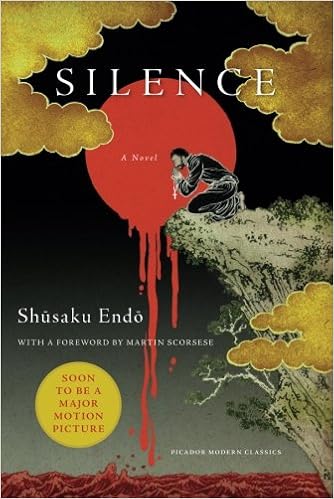
Book 4: Silence, by Shūsaku Endō

Having already read several reviews of Silence, including one on this site, I'm hesitant to launch into my own. This counts as my book set more than 5000 miles away from where I live for ye olde Reade Harder. Taking place during the early isolationist period of Japan's history, Silence follows a Portuguese priest, Sebastian Rodrigues, trying to track down a supposed apostate countryman as he tends to the faithful in Japan. Things go quickly awry thanks to a pathetic Judas figure, Kichijiro, who tries time and again to redeem himself, to no meaningful avail in Rodrigues' situation. Throughout his ordeals, Rodrigues is faced with the ineffable silence of God, despite his faith and his trials.

For many, the silence of God is basically equal to the problem of God. It's been quite a while - if ever - since people have been happy with the explanation given in Job, and Endo does a tremendous job of tracking someone's fall from total adherence to realizing, creepingly at first and with a torrent of doubt finally, that there may be a damned good reason for this silence. As many have, I found a good deal of my own struggles with God mirrored in Silence. Full disclosure, I attend Mass pretty much every week, and take my three and a half year old son along with me. Still, I find myself bristling during the homily many weeks, as the most recent manifestation of God's silence was, for me, heard on Election Day. It was probably the closest I've ever come to flat-out giving up on the faith, and yet I still found myself in the pews that Sunday. Is it because, like Rodrigues, I've been raised with the face of Christ my entire life? Because I can't deal with accepting the silence? Because I can almost hear something behind the silence? I don't know for sure, a frustrating but true answer. When I was 14, Marvel put out their Infinity War comics, a grand superhero battle with the trappings of philosophy and theology kind of slapped over top of them. Each issue of musclebound nonsense (boy, rereading comics from the early 90s is not an exercise for the faint of heart) opened with a quote that had no business being in such lunacy, and one that has always stuck with me is Tennyson's "There lives more faith in honest doubt, believe me, than in half the creeds." (I probably should've started this review with the information that I learned Tennyson and religious credos from comic books, and saved you all the time it took to read this.)

And, just because it didn't fit with the religion part of my rumination but it feels like a very vital part of this novel, I just wanted to say: Man, I don't think I've ever been presented with a view of Japan that is so ugly. When I think of the countryside of Japan, I think of Kurosawa films, woodprints, and the Maple Treeway from Mario Kart. Endo's rural Japan is mud, rain, and mudswamp. Obviously the mudswamp of Japan is one of the central themes of the book, but it was a major challenge to my preconceived notions (similar, I suppose, to the challenge of a 1950s consumer America that welcomed me in Lolita).

Book 6: We Should All Be Feminists, Chimamanda Ngozi Adichie

As I've mentioned, I teach AP Language and Composition at the high school I work at. For those unfamiliar, AP Lang is an all nonfiction, rhetoric-based class, as opposed to AP Literature, which is for the fancy readin' and theory learnin' to raise future English majors. I took Lit in high school because my very small rural middle-of-nowhere school didn't offer anything else, but I have a feeling Lang is the more useful of the classes (says the modest AP Lang teacher). Anyway, I focus on issues of social justice in my attempt to turn all of my students into screaming leftists, and for the most part I've been very happy with the results.

I've got race and class covered, but I've had a very hard time finding what I felt to be an accessible, intro-level text on feminism or gender rights in general. I've made a concentrated effort to address this in my reading the past year, but have run into several dead-ends. I think, however, Adichie's (very) slim volume is going to help me finally fill out this part of my curriculum. Adapted from a TED Talk that it's likely you've heard, We Should All Be Feminists is conversational, engaging, covers a wide variety of issues, and puts out a call that all can understand and take steps to answer. Adichie humorously traces her "labeling" of her feminism early on, going from a Happy Feminist to a Happy African Feminist to, eventually, a Happy African Feminist Who Does Not Hate Men And Who Likes to Wear Lip Gloss And High Heels For Herself And Not For Men. That paragraph alone opens avenues for all sorts of conversations about the perception of feminism in our culture. (I read this for the specific purpose of bringing it to a high school classroom, so much of my review will be written with that in mind.) While the African bit of the equation gives the feminist-resistant in the audience an easy out ("we're not Africa - we're a much more equal society!"), I feel like the Women's March this past weekend provides enough of a window into the mindset of America outside of the Brooklyn bubble. (To wit, Slate had the reaction of some Trump supporters who witnessed the March, and said things like, “I just don’t understand why they are marching. I don’t know what rights they are losing or what’s being threatened... The only thing I can see that might be threatened is abortion rights, a little bit. Most of this is not necessary at all.”)

Adichie ends with, "All of us, women and men, must do better." Since so much of, um, the conversation right now focuses on getting the conversation started, I feel like that is appropriate, useful, and, most importantly for my purposes, actionable. A lot of my kids realize that feminism is good, because they believe in equality, but they just don't know all the things that go into feminism. As one of the speakers at the March this weekend said, criminal justice is a woman's issue. Income inequality is a woman's issue. Healthcare is a woman's issue. Looking at society through that lens, I hope, will be an easy and useful leap for my kids (says the white, heterosexual, cisgender male who will be teaching his students about feminism). 

Book 5: Lolita, by Vladmir Nabokov

This is my "reread" for the Read Harder challenge. I originally read Lolita back my senior year of college, for my Cold War Fictions seminar, and while I remember liking it, I definitely don't remember it hitting me like the work of genius that it very clearly is. Probably this is because I had to burn through it to read another book for another class (but it could just also be stunning immaturity).

Lolita is famous enough that I don't really need to get into specifics, which is nice, as it will make for a quicker review. The stuff that Lolita is famous for, however - the relationship between Humbert Humbert and his underage stepdaughter - is really a small part of the novel. Lolita is really just a dizzying exercise in genre, I think - romance to travelogue to almost a noir fever dream in the final third. Throughout, the repellent wit of Nabokov's narrator and the scathing indictment of America's (at the time nascent) consumer culture are the glue that hold the entire thing together.

I couldn't help but think about the impact this book mu
st have had in 1955. A grown man opening lusting after and then dry humping a preteen girl? Constant droll David Sedaris-level sarcasm? Describing the great American highways as nothing more than connecting bumpkin-filled dots on an endlessly repetitive map? None of this fits the narrative I have of 1955 America, even peeling away the rose-colored tint that infects even some of the revisionist histories of the time. And when you consider this criticism comes from an immigrant who had left Soviet Russian and Europe as it was plunging into WWII, it is especially poignant.

(This said, the final third of the novel felt a bit much for me. Judging from a few conversations I've had with others, this isn't a unique opinion. My wife had read the book twice, and for the life of her, couldn't remember who it was that Humbert Humbert killed at the end. I couldn't, either. Honestly, after 200 pages in H.H.'s mind, I was ready to move on. But that's no doubt part of what Nabokov was doing - the charm of this sociopath inevitably has to wear off.)

As a final note, I made the active choice to be reading this book while my AP Language and Composition students were writing an essay in class on Friday - as Donald Trump was taking the oath of office. I found it very fitting to be reading the narrative of a narcissistic, truth-bending sexual predator, as Lolita provides more than a little warning about what could easily become (and what has become) Trump's America, 60 years before it happened. Time and time again, Humbert Humbert fools people who should know better, and even the people who suspect things wind up totally unable or unwilling to stop him. He provides just enough surface-level charm and convincingness to skate by, until finally he doesn't, and the consequences are disastrous for everyone involved. Oh, boy! America!

Sunday, January 22, 2017

The Brothers Vonnegut by Ginger Strand

Kurt had not realized that there were different kinds of ice crystals. Of course, Bernie was happy to explain. He told Kurt to imagine cannonballs stacked on a courthouse lawn. Just as the balls could be piled up into different shapes, ice crystals could stack up in different configurations. In fact, Bridgman had described a whole series of ice phase variants, ice-1 through ice-6. And who knew--there might be more to come. 

Kurt Vonnegut got his first full-time writing job writing copy for General Electric's PR department at a time where GE was revolutionizing everything from lightbulbs to fighter jets. His older brother, the much more successful Bernie, was a scientist at GE's Research Lab. As Kurt wrote robotic copy, Bernie was encouraged to chase down his dreams and find something "fun" to research. Strand's book follows the brothers' intertwined careers as well as the rise and fall of "The House of Magic," scientists' loving nickname for the Research Lab.

A cloud-seeding demonstration.
Bernie Vonnegut at center
Kurt is clearly the underdog here--his work is mindless, and he has to devote his nights and weekends to the fiction that sustains him. He is constantly striving for a nebulous, intellectual existence where his fiction writing supports him, his wife Jane, and their future family of seven children, and his work at GE does not fit into that vision. Bernie, on paper the more successful of the two, has struggles of his own. He is working on Project Cirrus, a Herculean attempt to control weather through cloud seeding--the process of impregnating clouds with various substances to prompt precipitation. He and his team are in it for pure scientific curiosity, and the joy they take from their early work is palpable in Strand's prose (as well the photographs included throughout, including the one to the right). But, as they become more successful, the project takes on political significance and Bernie struggles with the meaning and implications of their success.

By far my favorite aspect of this book were the parallels between the work being done at GE (by Bernie and by the other scientists the Vonneguts worked with) and Kurt's fiction. I haven't read all of Vonnegut's writing, but the ties to Cats Cradle (ice-9!), Slaughterhosue Five, and Sirens of Titan were especially clear. By layering Bernie's story on top of Kurt's, we get the excitement and potential of science along with the tinge of skepticism needed, but also a clear road map to Kurt's later work. Bernie haunts his pages just as much as his experience in the war. The debate over the atomic bomb and the ethical responsibilities of scientists runs throughout Strand's book as clearly as it does through Vonnegut's fiction, and the two brother's perspectives inform and enrich each other as their lives progress. 

Even without the context of Vonnegut's novels, this is a great read. The work being done at GE in the 40s and 50s is fascinating--almost bordering on science fiction all on its own--and Strand's writing draws you into the world the brothers inhabited.