Monday, May 31, 2010

Travels with My Aunt by Graham Greene

“Do you know what you’ll think about when you can’t get to sleep in your double bed? Not of women… You will think of how every day, you are getting a little closer to death. It will stand there as close as the bedroom wall. And you’ll become more and more afraid of the wall because nothing can prevent you from coming closer and closer to it every night while you try to sleep.”

Travels with My Aunt
could have been renamed Graham Greene’s Carpe Diem without doing injury to its themes and ideas. It opens at a funeral, where Henry Puller meets his long lost Aunt Augusta. Her first words to him are, “I was once present at a premature cremation.” After the funeral, they get together for a cup of tea and she convinces him to travel with her. The rest of the novel is concerned with their movement from one place to the other, as Henry tries to figure out exactly what kind of man he is.

Aside from a fairly obvious twist near the end, Travels with My Aunt isn’t terribly concerned with plot. It is, however, populated with some of Greene’s most memorable characters: the irascible Aunt Augusta, seventy-five and not ready to slow down yet; Visconti, the Italian lover who sounds like Al Pacino but looks like Danny DeVito; Wordsworth, Augusta’s black lover; the two Tooleys, father and daughter; and dozens more, some appearing in the main narrative, some existing only in the stories told to Henry by his aunt.

The real emphasis of the novel is the inner life of the protagonist, Henry. When the novel opens, Henry is a recently retired banker whose only hobby is raising Dahlias and whose only romantic interest is a somewhat dull, matronly woman named Ms. Keene. During his time with his aunt, Henry’s attitude turns from disbelief and disdain of his aunt’s dissolute and somewhat illegal lifestyle to admiration and, finally, embracing it. As he says near the end, “I have been happy, but I have been bored for so long.”

It’s interesting, then, to look at Travels with My Aunt in comparison with Greene’s other novels. In his most famous works, the Catholic books, his protagonists are driven by something higher than themselves. Whether they believe in God or not, their lives revolve around the bigger questions in life. In Travels, God hardly makes an appearance—though Aunt Augusta claims to be a Roman Catholic, she says, “I just don’t believe the things they believe”—and big picture issues are hardly considered at all. On the one hand, Travels is clearly a comic novel, and such themes might not work in context; on the other, Aunt Augusta and Henry are well-developed characters and share poignant moments. It seems somewhat disappointing then that the ultimate theme of the book seems to be the ephemeral “live for the moment”, when the themes of Greene’s best works could be characterized as “live for the world to come.” However, it’s these contradictions that make Greene such a fascinating man and author, and I’d recommend Travels with My Aunt to anyone wanting a lighter-hearted visit to Greeneland.

Sunday, May 30, 2010

The Weight of Glory by C. S. Lewis

The difference between this situation [forgiving your fellow man] and the one in which you are asking for God’s forgiveness is this. In our own case we accept excuses too easily; in others, we do not accept them easily enough. As regards my own sins it is a safe bet that the excuses are not really so good as I think; as regards other men’s sins against me it is a safe bet that the excuses are better than I think.

C. S. Lewis is my favorite writer. Like John Updike according to the blurb on the back of my copy of The Weight of Glory, “I read Lewis for comfort and pleasure many years ago, and a glance into the books revives my old admiration.” Everything I desire in non-fiction is present in Lewis’s essays: a consistent but not overbearing authorial voice, a dry sense of humor, and the thoughts of a mind sharp enough to generate thought whether you agree with them or not.

The Weight of Glory is a collection of essays, some of which are adapted from radio addresses Lewis delivered throughout his life. They touch on some the subjects you might expect from Lewis: theology, mythology, Christianity, and some you may not, such as cliques and war. Although it’s true that all these essays end up tying into bigger theological concerns, the smoothness and logic with which Lewis lays out his arguments ought to be an inspiration for Kierkegaards everywhere.

The titular essay concerns itself with the afterlife and the Christian’s response to it. It’s quite powerful and moving, one of the best he ever wrote, and yet the shortest essay in the book, one titled “Forgiveness” was the most impactful on me, saying more in a scant 5 pages than many authors can say in an entire book. The excerpt that opens this review comes from it, and seems to me to be wonderful advice to keep in mind whether you’re a Christian or not.

The Martian Chronicles by Ray Bradbury

"I've always to see a Martian," said Michael. "Where are they, Dad? You promised."

"There they are," said Dad, and he shifted Michael on his shoulder and pointed straight down.

The Martians were there. Timothy began to shiver.

The Martians were there--in the canal--reflected in the water. Timothy and Michael and Robert and Mom and Dad.

The Martians stared up at them for a long, long silent time from the rippling water...

The oldest stories in Ray Bradbury's Martian Chronicles were not meant to be part of a comprehensive mythology, and some of the seams show: The brown-skinned, golden-eyed Martians of "Ylla" and "The Summer Night" are conspicuously unlike the glittering jade mantis of "The Night Meeting," but Bradbury doesn't seem to find it necessary to detail why there are two sentient species on Mars, or how they interacted with one another. But for the most part, all the stories here seem to fit together into a larger whole, if not in testament to Bradbury's ability to go back and fill in the gaps, then definitely to the consistency of the themes that dominate his work: the passage of time on scales large and small, the vitality of small-town life, the hope for social progress that only science fiction can truly reflect. Bradbury imposes a larger arc on the stories he had already written in which, in roughly a thirty year span, man first reaches Mars, colonizes it (accidentally killing off the local population), and returns back to try to save an Earth dying from world war.

"The Night Meeting" is my favorite of these. In it, a man named Tomas Gomez encounters a Martian while traveling through a dead Martian town. Both are shocked at and fascinated by the others' presence, but when they try to shake hands, they pass right through each other. Eventually, Gomez and the Martian determine that they exist on different planes of time. When Gomez points out that his time-dimension must be the later one--he can see the ruins of the same great city that the Martian is from--the Martian dismisses the significance of this:

"Who wants to see the Future, who ever does? A man can face the Past, but to think--the pillars crumbled, you say? And the sea empty, and the canals dry, and the maidens dead, and the flowers withered?" The Martian was silent, but then he looked on ahead. "But there they are. I see them. Isn't that enough for me? They wait for me now, no matter what you say."


I love this for two reasons. First, it wonderfully expresses a theme to which Bradbury frequently returns, usually with less subtlety: the primacy of the moment, living and cherishing the here and now. Secondly, it affirms that Bradbury's chosen task, writing about the Future, ironically does the exact opposite. Here Bradbury uses the Future to tell us, as the Gospel says, "do not worry about tomorrow, for tomorrow will worry about itself."

But the episodic nature of The Martian Chronicles makes it uneven. Consider "The Third Expedition," in which an explorer comes to Mars only to land in what seems to be his hometown of Green Bluff, Illinois in the day of his childhood. The line between Green Bluff and the Green Town that provides the setting for Dandelion Wine and Something Wicked This Way Comes (mine, Brent) is nearly nonexistent. As such, the explorer's experience mirrors Bradbury's modus operandi. The explorer travels to Mars, only to find he is back in Green Bluff. For all his ingenuity, Bradbury seems incapable of truly imagining a world in which the small Illinois town he was born in is not the fulcrum of the universe.

This idiosyncrasy of Bradbury's turns The Martian Chronicles into something of a paradox. His investigation of Martian society can be strikingly creative:

Mr. and Mrs. K had lived by the dead sea for twenty years, and their ancestors had lived in the same hourse, which turned and followed the sun, flower-like, for ten centuries... Once they had liked painting pictures with chemical fire, swimming in the canals in the seasons when the wine trees filled them with green liquors, and talking into the dawn together by the blue phosphorous portraits in the speaking room.


I especially like the idea that the Martians are telepathic. This is how Gomez can communicate with the Martian, and in an earlier story an expedition crew is locked in a Martian asylum because the natives they meet assume their strange appearance and story are the mental projections of mental insanity.

But elsewhere, Bradbury seems trapped by his own perceptions. The worst offender here is "Way in the Middle of the Air," a story about how all the blacks in the United States decide to move to Mars to escape social oppression. A bitter racist named Samuel Teece is outraged that he is losing his hired help:

"I suppose you got names for your rockets?"

They looked at their one clock on the dashboard of the car.

"Yes, sir."

"Like Elijah and the Chariot, The Big Wheel and The Little Wheel, Faith, Hope, and Charity, eh?"

"We got names for the ships, Mr. Teece."

"God the Son and the Holy Ghost, I wouldn't wonder? Say, boy, you got one named the First Baptist Church?"

"We got to leave now, Mr. Teece."

Teece laughed. "You got one named Swing Low, and another named Sweet Chariot?"

The car started up. "Good-by, Mr. Teece."

"You got one named Roll Dem Bones?"

"Good-by, mister!"

"And another one called Over Jordan! Ha! Well, tote that rocket, boy, lift that rocket, go on, get blown up, see if I care!"


This story is set in 2003, but its depiction of race relations is culled straight from the year The Martian Chronicles was written, 1946. How is it that Bradbury is able to imagine a Martian society so unlike ours, but can't conceive how human society might have changed in almost sixty years? This story leaves a bad taste, and underlines an undercurrent of pessimism that sets The Martian Chronicles apart from most of Bradbury's other works.

Still, the stories that succeed outweigh and outshine those that don't. Strangely, Bradbury kills off the Martians early on (from chicken pox, sort of like The War of the Worlds), but it seems necessary to get them out of the way. At its heart, The Martian Chronicles is about human ambition and discovery, the possibilities afforded by a new frontier. For Bradbury, space travel seems to represent a fundamental challenge to the compassion and wisdom of the human race. His characters, sadly, don't respond to this challenge very well, but the last image of the book--a human family seeing their reflection in the rivers of Mars, knowing they are looking at true Martians--suggests a hope that Bradbury will be proven wrong.

Saturday, May 29, 2010

Point Omega by Don DeLillo

We drove in silence behind a motorboat being towed by a black pickup. I thought of his remarks about matter and being, those long nights on the deck, half smashed, he and I, transcendence, paroxysm, the end of human consciousness. It seemed so much dead echo now. Point omega. A million years away. The omega point has narrowed, here and now, to the point of a knife as it enters a body. All the man’s grand themes funneled down the local grief, one body, out there somewhere, or not.

Spoilers.

I realized while thinking about this review that I’ve read more DeLillo books than any other author since the Fifty Books Project started. It seems strange now that I disliked DeLillo’s abstracted, distant prose and stylized dialog, but there it is. Now, I consider him one of my favorite authors even though I’ve disliked about as many of his books as I’ve liked. DeLillo, at the best of times, is only marginally interested in plot. Libra is the only book of his I’ve read that’s even slightly plot-driven, and even his characters, as enigmatic and interesting as they can be, generally aren’t the driving force in his books. Instead, it seems to me, liking or disliking DeLillo as an author comes down to appreciating his primary themes—the disconnection of the modern man and the difficulty or impossibility of reconnecting, the absurdity of everyday life, the vapidity of consumerism, etc—and his prose. DeLillo is, hands down, one the best stylists I’ve ever read and it’s that quality that makes even his mediocre novels, like The Body Artist, interesting to me.

Point Omega
, his most recent book, certainly falls closer to The Body Artist than Libra. It reads almost like two novellas, one nested inside the other, with no clear connection between the two. In the first, titled Anonymity, an unidentified man stands in the Museum of Modern Art in New York, and watches a display called 24 Hour Psycho. This exhibit, which actually exists in real life, consists of a projection screen, viewable from both sides, playing Alfred Hitchcock’s Psycho, slowed down so it plays through once every 24 hours. The man visits the exhibit every day and marvels at how changing the presentation changes the entire feel of the film, making each moment as banal as the last. In the second, postmodern documentarian Jim Finley travels to the middle of the California desert to film ex-Iraq War consultant Richard Elster. Things are uneventful until Elster’s daughter Jessica shows up, sent by her mother in an attempt to end her relationship with the mysterious Dennis. Circumstances change, however, when Jessica disappears, leaving behind all her possessions and sapping both Jim’s will to make the film and Elster’s will to live. The books ends by completing the story in the first section, such as it is: the unnamed man meets a mysterious woman, they discuss the film, and then leave. The only connection between the two stories is the exhibit itself—while trying to convince him to participate in his film, Jim takes Elster to see 24 Hour Psycho.

Man, this book was abstract. Jessica’s disappearance is the closest thing to a plot development in the entire novel, and even it occurs only during the last 20 pages of the second section and is barely explained at all. We (and Jim and Elster) never discover what happened. Possibilities are thrown out—lost in the woods, suicide, elopement with Dennis—but no evidence is given to weight one over the other. Much like The Body Artist, virtually all conclusions that can be drawn are equally valid, not that DeLillo had ever been particularly didactic. The themes are right there in the title and the excerpt above: the omega point is a term that describes the maximum level of complexity toward wich the universe seems to be evolving, but DeLillo seems to say that focusing on the advancement toward complexity isn’t as significant as the little moments—hence the fascination with Psycho when it’s broken down into its simplest bits, and the de-emphasis on creating the documentary once Jessica disappears. These ideas are hardly seamless, but on the whole, it makes sense to me. At a little over 100 pages, Point Omega is never particularly dull, thanks to DeLillo’s language, but it’s as stripped down as DeLillo gets, and sometimes feels a little unnecessary. At his best, DeLillo revels in complexity. I'd like to see him heading back in that direction.

Thursday, May 27, 2010

Fear and Trembling by Soren Kierkegaard

“Much is said in our age about irony and humor, especially by those who have never been capable of engaging in the practice of these arts, but who nevertheless know how to explain everything.”

I think it’s safe to say that I was not prepared for this book. I was drawn in by the premise—Kierkegaard, one of the fathers of existentialism, writing a treatise on faith, using the story of Abraham being asked to sacrifice his son Isaac as his basis—and its length, a scant 95 pages. It sounded right up my alley, but I hadn’t counted on Kierkegaard’s writing style, which is intentionally dense and off-putting to discourage the casual reader (me). So it turns out that this little pamphlet actually took longer to read than the 400 page Robin Hood.

But anyway, on to the content of the book. As mentioned above, Fear and Trembling is a meditation on the story of Abraham’s sacrifice of Isaac as recounted in Genesis 22. I say Abraham’s sacrifice because, although God actually provided a ram to replace Isaac, Kierkegaard argues that, in the most meaningful sense, Abraham did sacrifice Isaac since he remained willing up until the final moment, when the ram appeared.

This is one of the most difficult stories in the entire Bible, and Kierkegaard doesn’t shy away from the difficult questions it raises. Interestingly, however, he doesn’t focus on why God would ask Abraham to commit the act, as many theologians do. He rather focuses on Abraham and what his reaction to the request reveals about him and, in the bigger picture, faith itself.

As the conclusions Kierkegaard reaches, I’ll share what I understand of them here, in greatly condensed form. Kierkegaard says that Abraham is the only example of true faith he knows of, and he defines faith in a very complex way which I’m going to try to communicate in a few points:

a) Faith requires a basic belief in the object of the faith. b) Faith requires complete resignation of the finite world into the hands of God, followed by c) a resignation of infinite matters as well, so that d) finite matters can again be appreciated. Further, Kierkegaard argues that true faith requires more than hope, since hope requires a belief that the event believed in will actually happen. Abraham’s faith was true, he says, because Abraham believed that God would restore Isaac to him even though he also believed it was impossible that Isaac should be restored. Kierkegaard points to faith as an example of the absurd: believing that things that will not happen are going to happen is the paradox of faith.

There’s a lot more in this book (the information I described is mostly in the middle third), including some interesting questions about whether or not ethics can be superseded by a divine command and whether or not it is possible to act both within the boundaries of true faith and ethics at the same time (Kierkegaard argues that for Abraham, the ethical choice—that of not sacrificing his son—was actually a temptation away from the absolute best choice of following God’s command), but to be honest, these sections were both interesting and opaque to me.

I don’t really know how to end this review. I wouldn’t want anyone to think that I’ve exhausted or even fairly explained Kierkegaard’s views in this short post. There’s a lot here, and I may return to it in the future.

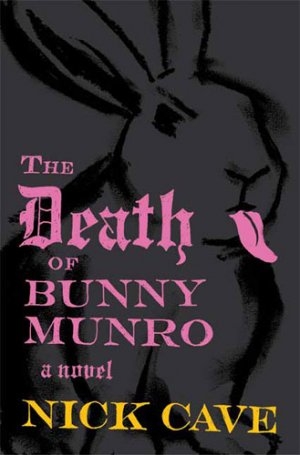
The Death of Bunny Munro by Nick Cave

Bunny gropes around on the bed until he finds the remote and, with a crack of static, the TV implodes into nothingness and he closes his eyes. A great wall of darkness moves toward him. He can see it coming, vast and imperious. It is unconsciousness and it is sleep. It moves like a great tidal wave but before it breaks over him and he is away, before he renders himself completely to that oblivious sleep, he thinks, with a sudden, terrible, bottomless dread, of Avril Lavigne's vagina.

Nick Cave has two personae. The one I was first familiar with was the brooding, Gothic piano player of As I Sat Sadly By Her Side, but that was a later invention. The original Cave was the frontman for an Australian band called The Birthday Party, and that Cave is loud, brash, and quite filthy. It's that persona that Cave would return to for his Grinderman side project, who recorded this:


The Death of Bunny Munro was written by this Cave. It is a junkyard clattering of death and sex, as bitter as it is squalid. The titular character is a middle-aged traveling salesman with a sex addiction that has irretrievably alienated him from his wife, and when she commits suicide he takes their son, Bunny Junior, and drags him on a whirlwind tour of the south of England as he tries to hawk his wares and chase poon at the same time.

Bunny is a horrendous man. His need for constant sexual fulfillment puts him through mental and physical hardship and distracts him from his son, a prepubescent egghead who absorbs himself in his comprehensive (but somehow, single-volume) encyclopedia. Bunny Junior idolizes his father, but doesn't truly understand him:

His mother bought the encyclopaedia for him, just because she loved him to bits, the boy likes to remember. Bunny Junior thinks it is an elegant-looking book with a jacket the exact colour of one of those citronella-impregnated mosquito candles. Merlin was the son of an incubus and a mortal woman, and the boy looks up 'incubus' and finds that an incubus is a malevolent spirit who has intercourse with women in their sleep, then he looks up 'intercourse' and thinks, Wow, imagine that, as he gradually intuits the presence of his father standing in the doorway.


Bunny, of course, is defined solely by "intercourse." In turn, Bunny doesn't care to even try to know his son, and instead spends most of his spare time thinking on Avril Lavigne's vagina. This is a frequent conceit, and Cave even apologizes to Avril at the end of the book, but the pointed realness of it reminds me of similar complaints I had about J. G. Ballard's sexualization of Elizabeth Taylor.

Cave dangles a couple more limbs from his Frankenstein's monster: First, there is the Horned Killer, a serial murderer in a red cape and horns making his way south through England while flaunting the media. The Horned Killer is a metaphor for the promised death of the title (which, you will notice, may refer to either Bunny or his son), winding its fated path to Brighton. Second, the ghost of Bunny's wife insists on haunting both Bunny and his son.

Add this to the noisy, ostentatious prose--you can almost see Cave sweating from the effort--and it's all too much. Beneath the clutter, The Death of Bunny Munro is a simple tale about a man, too sad to be vile, whose subservience to his addictions destroys his relationships. Despite his attempts at misdirection, Bunny ends up exactly where you expect. It isn't necessary for Bunny to be redeemed, but there is little enjoyment in watching a distasteful man fail distastefully.

Aristotle tells us that a tragic hero must be neither wholly good nor bad, so that we may see ourselves in him and feel both pity and fear, but when Bunny walks into a client's home and rapes a near-comatose girl because she looks like Avril Lavigne (seriously), following him to the end becomes a bitter chore.

This is Cave's second book, after The Ass Saw the Angel, separated by a twenty-year gap. Clearly, his schedule in the last twenty years has been fairly full (besides his solo work and Grinderman he has scored several movies), but with that kind of time, you would hope Cave's creative impulse would have produced something so sordidly mean.

Tuesday, May 25, 2010

Something Wicked This Way Comes by Ray Bradbury

“Beware the autumn people...For some, autumn comes early, stays late, through life, where October follows September and November touches October and then instead of December and Christ’s birth there is no Bethlehem Star, no rejoicing, but September comes again and old October and so on down the years, with no winter, spring or revivifying summer. For these beings, fall is the only normal season, the only weather, there be no choice beyond.”

Somehow, I missed Something Wicked This Way Comes while I was scouring the children’s section of the library, and it’s probably a good thing. It’s hard to imagine how an avid Goosebumps reader would have dealt with a scary book that’s actually scary and substantial, not just for the grotesque images or the shocking twists, but for the themes it carries. There are spoilers in this review, mostly from the first third of the book.

The book opens on its dual protagonists, Jim Nightshade and Will Holloway. Both thirteen years old, they are inseparable sides of the same coin. Jim is rash and impetuous, always on the lookout for a thrill or an adventure; Will is more careful, although, as he says in the book, is often dragged into adventure by Jim whether he wants to be or not. The books opens in Autumn with the arrival of a mysterious carnival, populated by a diverse array of freaks and run by the Illustrated Man, Mr. Dark, a mysterious entity who exercises control over his freaks with his vast array of tattoos. The centerpiece of the carnival is broken down Carousel that nevertheless comes alive at night. It can spin either way, making its riders either older or younger. Soon after the carnival opens, Jim and Will see the carousel in action and make an enemy of Mr. Dark who, of course, spends the rest of the book trying to turn them into a couple of his freaks.

In addition to the boys, there’s a third, equally important character: Charles Holloway, Will’s 54 year old father. Married to a beautiful woman 20 years his junior, he struggles with feeling too old for her and too old to properly relate to his son.

Something Wicked
is surprisingly dense, and there are a lot of things I could talk about, but I’d like to focus on what seemed like the overriding themes: the elders’ fear of aging and death and the youth’s desire to speed the process along. The Carousel stands at the center of the novel, towering over even Mr. Dark in its sway over the protagonists. So let’s start with a laundry list: Will fears that, with time, he and Jim will grow apart. Jim fears that he will never grow up at all, and Charles fears that he’s already too old to relate to the people he cares most about. The thing is aging or de-aging on the carousel is no good. It rushes things, so young men end up with old men’s minds and old men are still children inside. It is the ultimate relationship breaker, because it makes relation with other people of your own age impossible—who wants to hang out with the 30 year old who still wants to play marbles, or the 16 year old who has all the worries in the world?

I don’t want to talk much more about the plot, but I will say that there are some very disturbing images, not so much because they’re graphic, but because being turned into a wax dummy is kind of terrifying. Anyway, this review is all over the place, but if you missed this as a child, it’s well worth reading. And I hear the film is pretty scary.

Sunday, May 23, 2010

The Merry Adventures of Robin Hood by Howard Pyle

In merry England, in the time of old, when good King Henry the Second ruled the land, there lived within the green glades of Sherwood Forest, near Nottingham Town, a famous outlaw whose name was Robin Hood. No archer ever lived that could speed a gray goose shaft with such skill and cunning as his, nor were there ever such yeomen as the sevenscore merry men that roamed with him through the greenwood shades.

We all know the story of Robin Hood, the sober, humorless soldier, hardened by his battles during the Crusades, rounds up a band of sober, humorless men to fight beside him and, in a psychic flash, discovers the Magna Carta and brings Democracy to Medieval England after fighting an epic battle against the French. And now that we’ve covered the 2010 movie, whose authors apparently didn’t realize that there’s already a fictional character named Robin Hood, let’s talk about this book.

I admit it: although I’ve read Robin Hood before, I was inspired to read it again after seeing the essentially unrelated and joyless film. I knew the basic outline and I knew the source material was much lighter and more humorous, but I had forgotten how much. The Merry Adventures of Robin Hood is really a comic novel, written as a series of inter-related vignettes, which collects various folk tales of Robin Hood and put them into a coherent framework, codifying Robin and his Merry Men into something like an Anglo-Saxon mythology—but this misses the point. Robin Hood isn’t a dull academic exercise, and it doesn’t read, aside from the poetic King’s English, like it was written over a century ago. It moves quickly—I read the entire 350pp book in a little over a day—and rarely missteps.

What was surprising to me is how much of my idea of Robin Hood was missing from the book. Maid Marian warrants exactly two mentions, both times as passing thoughts in Robin’s head. Prince John, immortalized as a lion cub in Disney’s retelling, appears only at the tail end. And what’s included is sometimes surprising as well. Close to a quarter of the book recounts adventures in which Robin himself doesn’t appear at all, focusing on the Merry Men and, in one case, a knight given assistance by Robin’s band.

But, onto the stories themselves. They largely follow the same structure—Robin and his men get bored, hatch an elaborate prank, execute it, and improvise. This leads to Robin’s merry band getting their butts kicked a lot, and it’s this element of “Will it work or not?” that gives the book most of its narrative thrust. However, just when the repetition threatens to grow stale, Pyle switches formats, focusing on a side character or a more involved adventure, such as the elaborate plot to help newfound Merry Man Alan a Dale reclaim his love at her wedding ceremony. The final third of the book, however, abandons the format almost entirely and takes some surprisingly dark and affecting turns.

Ultimately though, Robin isn’t a gloomy slog. It’s joyous and raucous and funny, and the characters, thinly sketched as they sometimes are, are really likable. Like Sherlock Holmes (which also got a terrible movie adaptation recently), Robin Hood is well worth revisiting.

Some Legal History for the Lawyer Folk

To Keep and Bear Arms: The Origins of an Anglo-American Right by Joyce Lee Malcolm

In this book Joyce Malcolm analyzes the British history of the right to bear arms. She focuses on the transformation in England from a duty to bear arms into a right to bear arms. Specifically, historically men in England were expected to possess a firearm so that they may join roving militias. If, for instance, a crime was committed, there was not really a person or organization in place to seek out and arrest the criminal. In such a situation the men were called forth and expected to serve their communities by helping to find the criminal, if necessary, by force. However, gradually expectations changed as parliament struggled against the monarchy to consolidate its own authority. As parliament and monarchs bumped heads against each other, the perception that the other had control of weapons was seen as a threat and two things happened. One was an extreme skepticism towards the efficacy of a standing army. The second was the development of a right to bear arms; this second development was seen as a way of curbing the threat of a standing army (it was thought that an armed populace could stand against an evil standing army).


Malcolm makes a convincing case for how the right to bear arms was understood during the framing era, and as such I have become convinced that Scalia's opinion in Heller more accurately reflects the historical understanding of the right (that is: there is an individual right to bear arms). Nonetheless, we might question the appropriateness of appealing to the history, given that the right to bear arms was primarily understood as a right to bear arms against a tyrannical government. Given the extreme (and just) condemnation of armed attacks against the government, I'm not sure that the historical basis for the right to bear arms is exactly what people want when they claim their entitlement.

Be warned, this was a terrifically boring read. Of all the books reviewed here, this is the one most meant for an academic audience (and thus least approachable for someone with a general interest in legal history). For all that, it's also the book which most changed my perspective. Before reading this book, I agreed more with Stevens' dissent in Heller, but now I'm more in line with Scalia's view.

(Pictured: A right bear arm, indicated by the arrow; not to be confused with the right to bear arms.)

Brown v. Board of Education: Caste, Culture, and the Constitution by Robert Cottrol (my history professor), Raymond T. Diamond, and Leland B. Ware

Here, the authors placed the social/political/legal history of Brown within a context of caste. That is, they understand black history and the equal protection clause to be a protracted debate about whether the United States is or should be a caste system. Thus, slavery is understood to be the epitome of the American caste system, and on the other side of the spectrum, Brown is understood to be the rejection of the caste system. The starting and ending points, however, are the least interesting points of this book's analysis (the parallels between slavery and caste are somewhat obvious). What is most interesting about this book is the understanding of caste which the authors use to explain Southern antagonism to Reconstruction, and the broader understanding of the Reconstruction Amendments which Brown represents.

(Pictured: Barack Obama as a child (left), in a desegregated postage stamp.)

The Death Penalty: An American History by Stuart Banner

I have the least to say about this book. Like Brown (the book, not the case), this book gives the reader a social/political/legal history, focusing on (yes, you guessed it), the death penalty. Banner's history is devoid of any ethical or moral lessons about the death penalty, his intent is merely to lay out the cultural role of the death penalty in the U.S. Of interest is the changing nature of that role. In the 19th century, executions served as a kind of community entertainment and parable. Members across the socio-economic spectrum would attend an execution which came to be a spiritual ritual. Audience members would be made aware of the crime, often written versions of the crime would be sold at the execution. The accused would be given an opportunity to speak; in an ideal execution he would explain the errors of his ways and pray for the Lord's forgiveness. In this way the community would have an opportunity to show an example of improper conduct and its inevitable result.

As time passed however, it became vogue to feel repulsion at what was soon viewed as a mob's pleasure. Executions, an imprecise science, came under attack for their ineffectiveness (stories of failed hangings became more and more prevalent; apparently there are few things worse than watching a person suffocate to death while hanging). A science of executions developed (this is how we got such marvels as the electric chair, the gas chamber, and lethal injection), which was not necessarily more precise. Thus executions went behind closed doors and only certain political elites could gain access to them.

Interesting thing: Apparently the age-old debate about executions is literally age old; it hasn't changed in the 200 years of this country: deterrence and retribution have been the talking points the entire time. Yeah, bit of an interesting thing.

(Pictured: Another victim of hanging, condemned for inadequate spelling skills)

Lochner v. New York: Economic Regulation on Trial by Paul Kens

All law students who take Constitutional Law II read Lochner v. New York which is universally reviled as the worst Supreme Court decision, ever. (Yes, even worse than Dred Scott, which legally speaking isn't as absurd as high school history teachers make it out to be). It's considered the apex of judicial over-reaching, legislation from the bench. How dare the Supreme Court have the audacity to question a legislative judgment?!

This book focuses only a little on the legal history of the case and focuses much more on the political aspect, looking at New York politics and how the law regulating bakers' hours came to be passed. What's interesting about this book is that it doesn't focus on Lochner (the case) as a case of judicial over-stepping, instead it treats the case as a case about bakers and politics. A fun read for the story behind the story of Lochner.

(Pictured: A baker, or a victim of laissez-faire capitalism?)

Reconstructing the Fourth Amendment: A History of Search and Seizure, 1789-1868 by Andrew E. Taslitz

I hated this book. As such it is highly ironic that I spent the most time with it relative to these other legal histories (I wrote a paper on this one). The book purports to be a history of the Fourth Amendment (my favorite Amendment to read about) starting with the Founding Fathers and going through Reconstruction. Histories of the Fourth Amendment during the founding era are not remarkable (relative to other Amendments, the Fourth's history is well documented), but an ante-bellum history is hard to come by. After reading the book, I became convinced that such a history is hard to come by because the Fourth Amendment didn't really mean anything until the advent of the exclusionary rule (the rule by which illegally obtained evidence is inadmissible in court). Unfortunately, Taslitz focuses on all the different ways that slaves did not have privacy, freedom of movement, or property. The problem with his focus is that the Fourth Amendment did not really protect these things per se until the criminal procedure revolution of the Warren court. As such, the book ends up being a history of slaves with brief references to the Fourth Amendment. I think this is another book which takes a conventional history and tries to give it a novel treatment (in this case a racial treatment) even though the novel treatment does not give us any novel conclusions as to history. I would not recommend this book to anyone.

(Pictured: Kool-Aid Man, Oh Yeaahh!).

The Intruders: Unreasonable Searches and Seizures from King John to John Ashcroft by Samuel Dash

This is another history of the Fourth Amendment. It's one of those awkward books that just doesn't have a market. In one way it's too academic: it's too abstract for most lay people to want to read (it goes into the drafting history of the Amendment and often analyzes the nuances of Supreme Court opinions). In another way it's not academic enough: the history of the Fourth Amendment and analysis is so dumbed down that no academic could confidently cite this work as an authority.

As such, though the book isn't bad, I probably wouldn't recommend it to anyone because I don't know who I would recommend it to. The thesis of the book is that the Founding Fathers intended, in the Fourth Amendment, to give us broad protections from searches and seizures; unfortunately the evil conservative rights-hating establishment (ie republicans) have systematically narrowed and chipped away at these rights, turning the Fourth Amendment from a gallant princess-saving white knight into a whiny little bitch with an inferiority complex (I might be paraphrasing a little). Dash particularly takes issue with the treatment of terrorists and the freedoms which have been afforded the Bush administration (yes, the work is a little dated) in seeking out terrorists.

(Pictured: The only thing worse than an liberal-yuppie-terrorist-loving ACLU lawyer is a criminal defense lawyer.)

Saturday, May 22, 2010

Riddley Walker by Russell Hoban

Note: I wrote this review a month ago, and saved it so that I wouldn't spoil anything for Brent. Any similarities between our reviews means that he cribbed off of me, and not the other way around.

On my naming day when I come 12 I gone front spear and kilt a wyld boar he parbly ben the las wyld pig on the Bundel Downs any how there hadnt ben none for a long time befor him nor I aint looking to see none agen. He dint make the groun shake nor nothing like that when he come on to my spear he wernt all that big plus he lookit poorly. He done the reqwyrt he ternt and stood and clattert his teef and made his rush and there we wer then. Him on 1 end of the spear kicking his life out and me on the other end watching him dy. I said, 'Your tern now my tern later.'

Sweet baby Jesus, I love Riddley Walker. I'm not really in the habit of re-reading books, but when I saw that the AV Club was doing their monthly book club on Riddley Walker in April, I encourage Brent to read this with me.

I am happy to report that it is as awesome as I remember. Riddley Walker is set approximately 2700 years in the future, in an England having advanced roughly to the Iron Age after a nuclear war that occurred around present day. England, now called Inland, is ruled by a shadowy government called the Ram, and order is maintained by the Pry Mincer and Wes Mincer (derivatives of prime minister and westminster) who maintain a traveling puppet show that tells and re-tells the culture's central myth, the Eusa Story. The Eusa Story is cobbled together from disparate parts; while it tells a broken version of the nuclear war that ruined society, it is also mixed with the story of St. Eustace, as well as government propaganda. Like most religious texts, various versions of it are told, and it is interpreted in wildly different ways.

When his father dies in a bizarre accident, Riddley becomes his community's conexion man, responsible for interpreting everyday events as well as telling the significance of the traveling Eusa show. Shortly after his initiation into this role, Riddley is drawn into a conflict between those who wish to seek the sort of knowledge that brought civilization to ruin and those who would stop them.

I have been thinking on Riddley Walker for a few days now, and it is a difficult book to characterize simply. It seems to me that it is ultimately a story about knowledge--what it is, how it is gathered, and what it is worth. In 2700 years language would surely have evolved into something much different from English, but the strange, broken idiom that Riddley speaks is representative of the perverse, askew version of Western culture and religion in which he lives. Knowledge, like language, has not been lost, but shifted, changed, twisted. Early in the book, Riddley is told the story of "Why the Dog Wont Show its Eyes," about how man and woman received the "1st knowing":

The man and woman seen the fire shyning in the dogs eyes. The man throwit meat to the dog and the dog come into them by the fire. Brung its eyes in our of the nite and then they all lookit at the nite to gether. The man and the woman seen the nite in the dogs eyes and thats when they got the 1st knowing of it. They knowit the nite the same as the dog knowit.


There seems to be a distinction being made between the "1st knowing," a sort of primal understanding of things represented by their shapes, and more advanced forms of knowledge. To understand the shape of something is to know it instinctively, to be able to feel it in three dimensions. In the legend, the man and woman become more "clevver," gaining the sort of knowledge that is represented by numbers instead of shapes, and they lose the 1st knowing.

Hoban presents this progression of knowledge without judgment. On the one hand, it is easy to lament the way that man has lost this primal knowledge, and it is easy also to sympathize with Riddley when he encounters the remnants of twentieth-century era machinery:

How cud any 1 not want to get that shyning Power back from time to time back way back? How cud any 1 not want to be like them what had boats in the air and picters on the wind? How cud any 1 not want to see them shyning weals turning?


And indeed it seems that progress is inevitable; Riddley is unable to stop the Pry Mincer of Inland in rediscovering the secret ingredients that create gunpowder, and it is unclear as to whether or not he should. Riddley is set deep in this conflict, but he seems to be on different sides at different times, desperate to act but unsure what for or what against.

There is much that I would like to talk about but am unable to touch upon. Riddley Walker is a complex book that rewards revisiting, and I think that it would take many more times re-reading to fully understand it. Even so, I recommend it highly--this is one of my absolute favorite books.